
The Bucs are once again trailing the Panthers in the NFC South thanks to Sunday’s 23-20 loss at Carolina. They are also below .500 with just two weeks remaining in the season and cannot match or improve their record from 2024. Lots of things have gone wrong for this team in 2025. Losing a combined 65 games (and counting) from projected starters ranks right up there. Losing their best pass rusher in the second game of the season didn’t help either.
But despite all of that the Bucs were still in position to all but guarantee their fifth straight NFC South title and sixth-straight playoff appearance. With all of that on the line, the gameplan that Todd Bowles and Josh Grizzard decided on for their offense was egregious.
And certainly, deserving of replacement.
Bucs’ First Down Strategy
Look, I can get behind an “establish the run” strategy against a run defense that is 22nd in the NFL. Maybe more so than when the same defense they are facing isn’t also 26th in EPA/pass allowed. But I digress.
Yet to set a stated goal of 30 called runs is just flat-out unacceptable. The problem with that kind of strategy is that game flow on second and third down will often take run calls away altogether. Therefore, in order to achieve that volume of runs the Bucs had to almost exclusively run the ball on first down.
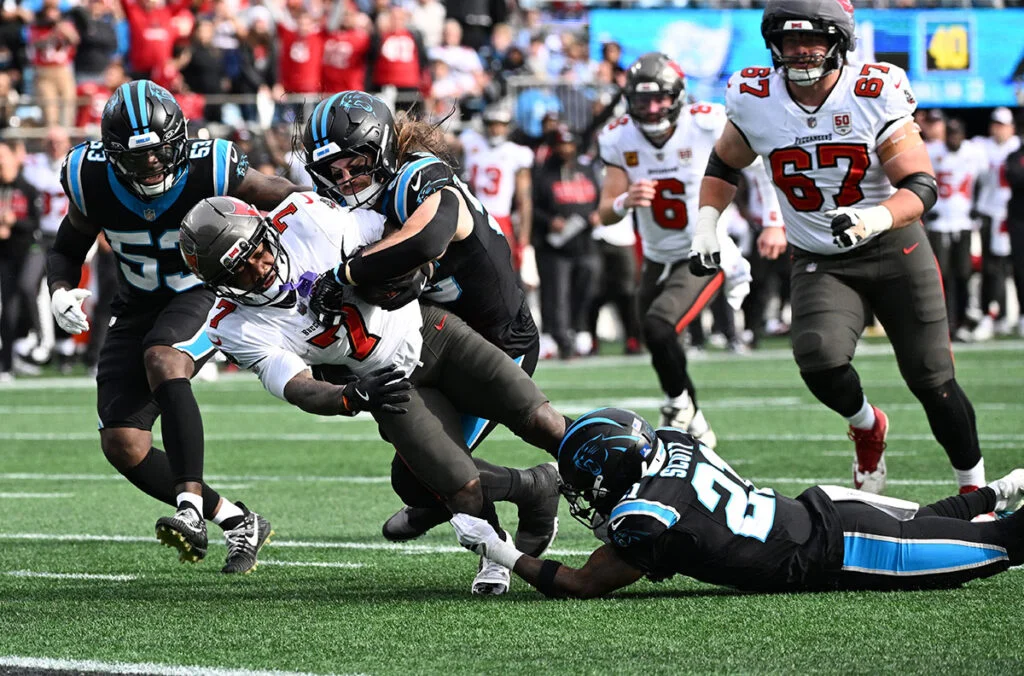
Bucs RB Bucky Irving – Photo by: IMAGN – Bob Donnan
The Bucs had a called run play on 17 of 23 first downs leading up to their final gotta-have-it drive just outside of the two-minute warning in the fourth quarter, trailing 23-20, and excluding Baker Mayfield’s kneel down to end the first half. They averaged 4.5 yards per carry on those runs. But that total is a bit of a misnomer.
It’s being elevated by a 39-yard Rachaad White run in the second quarter. Take that out and the average falls to 2.38 yards per carry. And since I am not a fan of just throwing out data all willy-nilly, success rate does a good job of keeping White’s explosive in the data set while still describing the overall futility of that terrible first down run plan. Tampa Bay was successful (gained 50% of the yards needed for a first down/touchdown) on those first down runs just 33% of the time.
The site rbsdm.com has a good visual for the difference between the success for the team regarding their pass/run split.
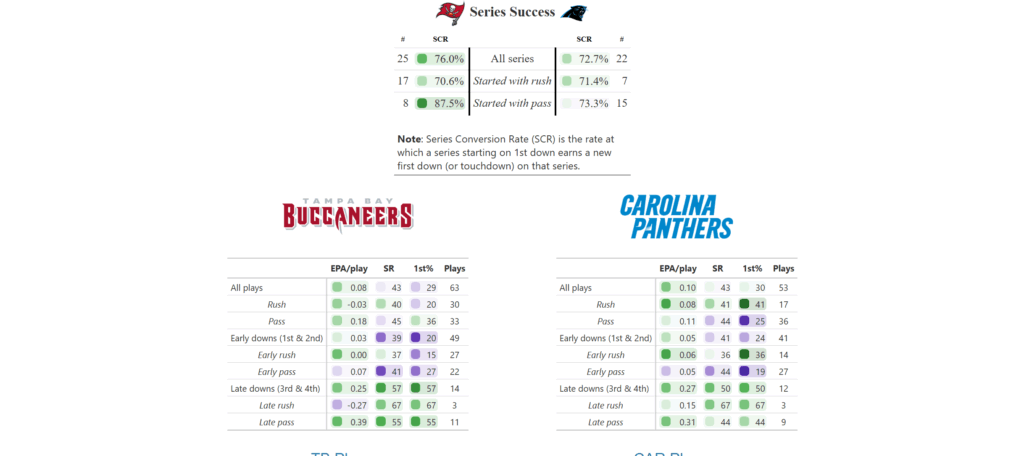
That 33% success rate was worse than their season-long average of 37.1% headed into the game. Who would have thought that leaning into something you don’t do as well would create even poorer results? If I could figure out how to put emojis into my articles, I would have the hand up guy right here.
The Bucs were able to turn just two first downs into a new set of downs on the day. That’s the definition of an inept offense. Instead, they faced second-and 4, 9, 9, 7, 7, 10, 7, 10, 9, 7, 4, 9, 9, 5 and 12. That’s an average of 7.9 yards needed with two plays to go.
It was clear that the gameplan wasn’t just to run the ball early and often. They actively wanted to take the ball out of the hands of their passing offense.
Run-Heavy Approach Reduced Bucs’ Chances To Score
The Bucs are averaging 4.2 yards per rush this year and 5.9 yards per dropback (including sacks and quarterback scrambles). When a team that isn’t elite at running the ball chooses to prioritize runs to this degree, they are actively choosing to execute long drives if their plan pays off. But with each successive play the chance of failure mounts. Yes, the Bucs had successful drives of 53, 85 and 66 yards – netting 17 points. But they also had failed drives of minus-12, minus-2, and 32 yards.
And by employing this strategy the Bucs also killed their own opportunities to score. Excluding the end of first half kneel down, Tampa Bay only had eight opportunities to score. The average number of drives an offense usually has in a game is 10-11. Imagine if the Bucs had an extra drive or two to try and win the game.
The Bucs have invested over $50 million per year in bookend tackles to protect for a $33 million per year quarterback. They have another $42.5 million per year locked into their top two wide receivers with a first- and third-round pick used on WR3 (Emeka Egbuka) and WR4 (Jalen McMillan). But the path to success according to head coach Todd Bowles was to ignore those players in favor an almost dogmatic reliance on their run game.
It’s an unforgiveable approach.
If they don’t trust the passing game – and this gameplan clearly says they don’t – then there are serious issues between talent procurement (general manager Jason Licht and the scouting department) and talent deployment (Todd Bowles’ coaching staff).
Who Is To Blame?
Offensive coordinator Josh Grizzard has been one of the run-heaviest first down playcallers in the NFL this year. But this doesn’t feel like his call. I have no inside knowledge, so I could be completely off, but this has all the hallmarks of a Todd Bowles mandate.
Perhaps Bowles yearned for the days of grind it out football. Maybe he thought third-and-manageable would make for fourth-and-short, where his newfound aggressiveness would pay off.
Bowles was asked about the run heavy approach post-game. His response included an anecdote about teams being successful against Carolina when they run 30 times or more. But that’s a fundamental cart-before-horse understanding of the game.
Teams that run 30 times or more and win consistently do so because they got out to large leads early in the game and ran late to kill the clock. The running is the building snowball at the end of the game. The approach the Bucs took was like pushing a boulder uphill while someone is on the other side pushing against you.
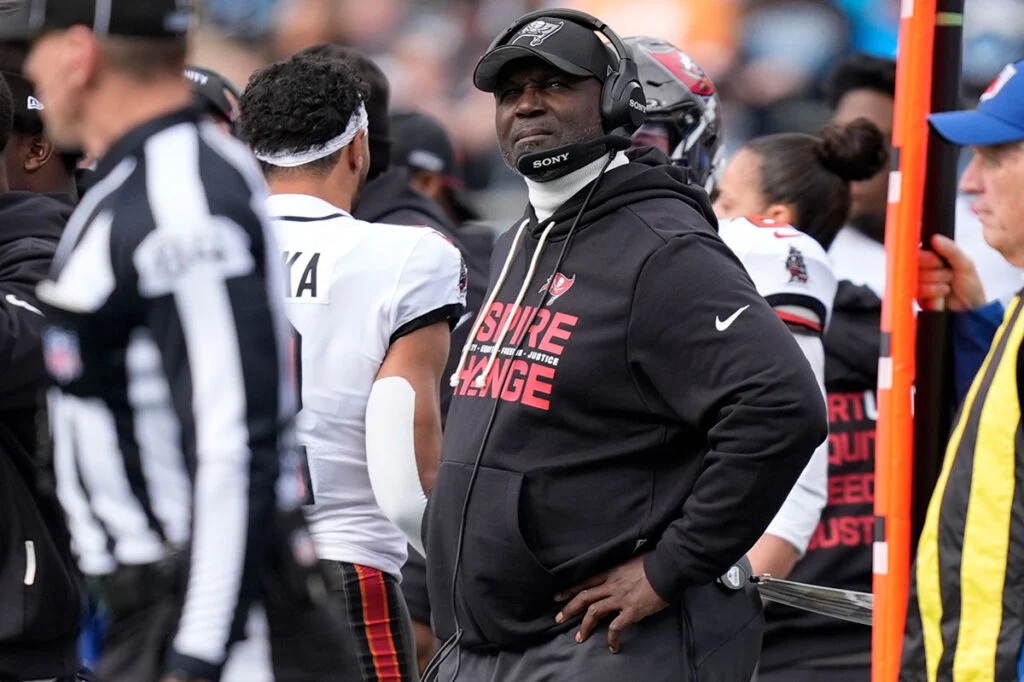
Bucs HC Todd Bowles – Photo by: IMAGN – Jim Dedmon
It was a huge miscalculation that cost the team dearly. Twenty points isn’t enough to win with in the modern NFL. And ironically, by running more on first down all they did was put a greater burden on the very passing attack they were actively trying to avoid.
Hysterically, it was the Bucs’ third down offense that bailed them out time and again. Tampa Bay converted on 8-of-14 third downs on the game, one of their best marks of the season. Quarterback Baker Mayfield was 5-of-8 for 42 yards plus a 23-yard scramble on third down. The offense converted 6-of-11 third downs when it dropped back to pass. Imagine what the Bucs could have done if they were allowed to get into more of a rhythm.
All you can do is imagine.
The Bucs may still make the playoffs. But even if they do, decision-making like this can’t continue into 2026.

Josh Queipo joined the Pewter Report team in 2022, specializing in salary cap analysis and film study. In addition to his official role with the website and podcast, he has an unofficial role as the Pewter Report team’s beaming light of positivity and jokes. A staunch proponent of the forward pass, he is a father to two amazing children and loves sushi, brisket, steak and bacon, though the order changes depending on the day. He graduated from the University of South Florida in 2008 with a degree in finance.
 Pewter Report Podcast: Bucs Lose The Lead In NFC South!
 2-Point Conversion: These Bucs Are Broken, And I'm Not Sure Todd Bowles Can Fix Them