
In the NFL, Cover 4 refers to a defensive coverage that aims to cover four deep zones on the field. Following that lead, I’m going to provide you with the same coverage of the Bucs – your favorite football team.
Each Wednesday morning I’ll cover four areas as they apply to Tampa Bay: 1. a short film breakdown, 2. a finance angle, 3. a look forward at what’s to come, and 4. a bit of fun.
Bucs Film
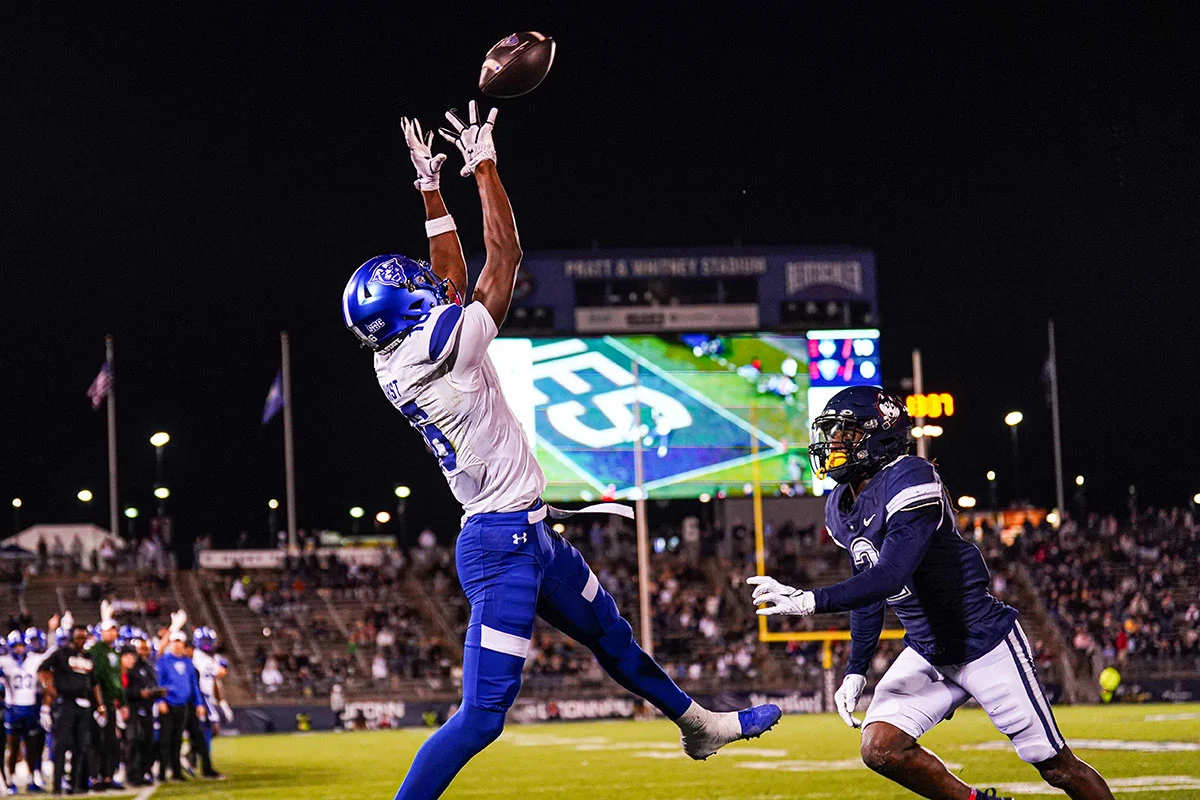
The Bucs took a size-speed specimen in wide receiver Ted Hurst from Georgia State in the third round of the 2026 NFL Draft.
Hurst’s height (6-4) and 40 time (4.42 seconds) place him in the 91st and 80th percentiles, respectively. Add in that he was a legitimate playmaker for a Georgia State program that was legitimately not good, and there’s a very interesting profile to analyze.
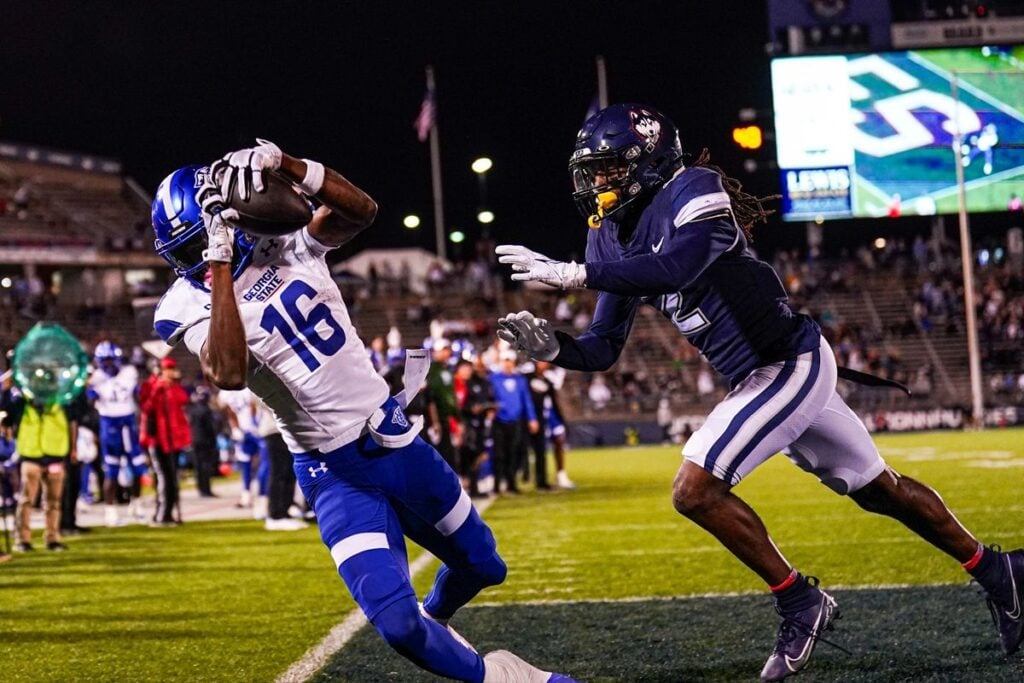
Bucs WR Ted Hurst Photo by: IMAGN Images – David Butler II
But that same physical profile has its concerns. At 206 pounds, he is lean for his height. And despite the impressive 40 time, his 10-yard split was quite average at 1.55 seconds. Add in the lower level of competition and now you see why he was available in the third round.
Watching his tape, here are my takeaways:
The real special stuff in Hurst’s game is how he wins downfield. Over the past two seasons he has caught 42% of his targets of 20+ air yards. That’s an incredibly high rate for such a low percentage type of shot.
Hurst can spring free and get behind defenses with his easy speed, and when he does have to contend with defenders who manage to keep up, his ball tracking skills and strong hands at the catchpoint win the day more often than not. That’s supported by his insane 61% contested catch rate in college per Pro Football Focus.
You have heard Ted Hurst has excellent ball tracking skills. Exhibit's A and B. The first one is bananas when you consider the way he adjusts his route and the body contortion on top of the tracking. pic.twitter.com/B7iGfmc1yz
— Josh Queipo (@JoshQueipo_NFL) April 28, 2026
What I am most excited about – and what can get Hurst on the field the fastest – isn’t the downfield highlight reel stuff. It’s the ho-hum short yardage contributions that may be a real unlock for the Bucs offense. While he has a limited route tree, one featured route he is especially adept at running is the slant. That’s good news for Baker Mayfield, especially in Zac Robinson’s scheme, which features the slant route more than Josh Grizzard did last year.
Mayfield is at his best when he can get into an early rhythm with some easy buckets. We saw that in 2024 in Liam Coen’s scheme, which is similar to what Robinson is expected to run.
Chris Godwin Jr. provides one form of easy bucket with his choice routes. Hurst can provide a secondary option with some quick slants where he uses his large frame to box out corners playing off coverage. Mayfield doesn’t have to throw a perfect ball for Hurst to haul in the pass and get an easy 6-8 yards on first down. And if the pass is perfect and the cornerback’s coverage isn’t? He can take the pass for a house call due to his impressive yards-after-catch (YAC) ability.
That’s how you gain extra snaps at the NFL level.
You know what else gets you extra snaps in the NFL? Contributing in other areas even when the ball isn’t coming your way.
Ted Hurst creating space for others as a vertical threat and then preserving the score with the downfield block. pic.twitter.com/bXdBhZOInC
— Josh Queipo (@JoshQueipo_NFL) April 27, 2026
The role Hurst should occupy is the traditional X receiver spot. That’s the boundary role Emeka Egbuka played some last year in Mike Evans’ absence and saw uneven results as a rookie. And it’s not a natural fit for Godwin or Jalen McMillan, either. Hurst has the size, speed, and vertical-stretch profile to slot in there cleanly, and in doing so, he should give the rest of the room more space to operate in the short and intermediate areas.
The fit question for Tampa Bay isn’t whether Hurst earns snaps in year one. It’s whether the offense leans into him as the boundary X immediately or eases him in while operating the offense as if it doesn’t have an X in the meantime. The tape shows he can handle the role; the question is whether it translates up in class as he played at a non-Power 4 school. Training camp will tell us whether Robinson thinks Hurst is ready to do it against the best of the best.
Bucs Finance
Now that the Bucs are past the 2026 NFL Draft, we can start to look at their cash position for 2027 and beyond. We know the Glazers like to keep cash spending tied to the league-wide salary cap. With this year’s cap landing at $301.2 million, an 8% jump in 2027 puts the working budget around $325 million.
What’s Already On The Books In 2027
After accounting for the recent draft picks and undrafted free agent signings, the Bucs should have 46 players under contract for 2027 at a price tag of around $183 million. Assuming a salary cap of $325 million, they have $142 million left in cash for free agents, draft picks, extensions, practice squad players and operating room.
I’m going to estimate draft pick compensation at $35 million, operating room at $7.5 million and practice squad compensation at $5.5 million. That leaves $94 million for contract extensions and free agents.
That may not seem like much but watch how fast it goes.
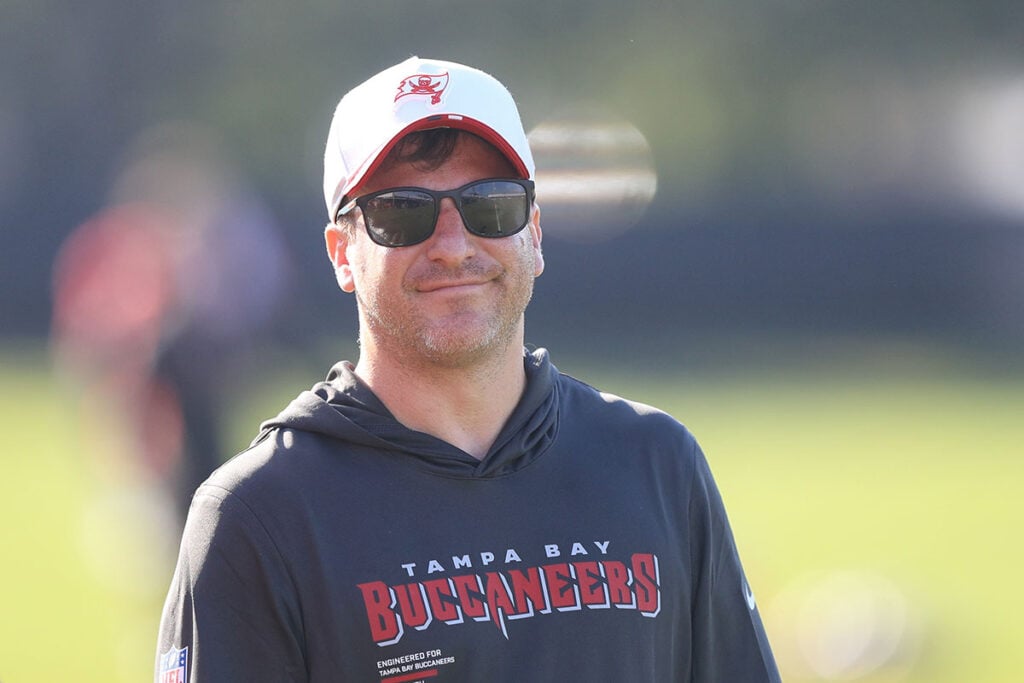
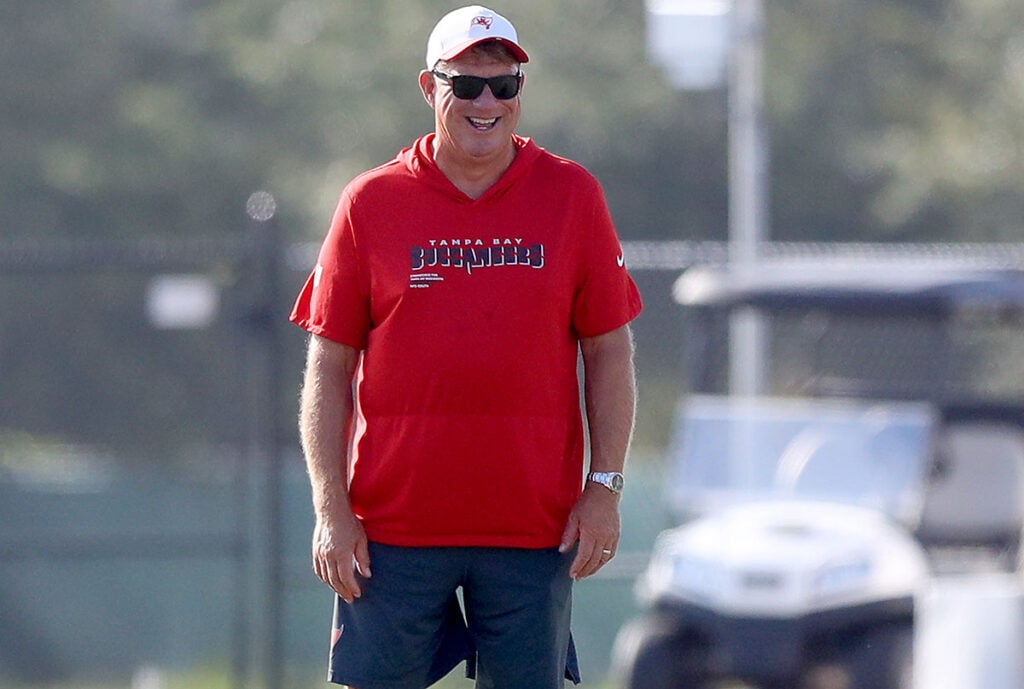
Bucs assistant GM Mike Greenberg – Photo by: Cliff Welch/PR
Who Needs a New Contract in 2027
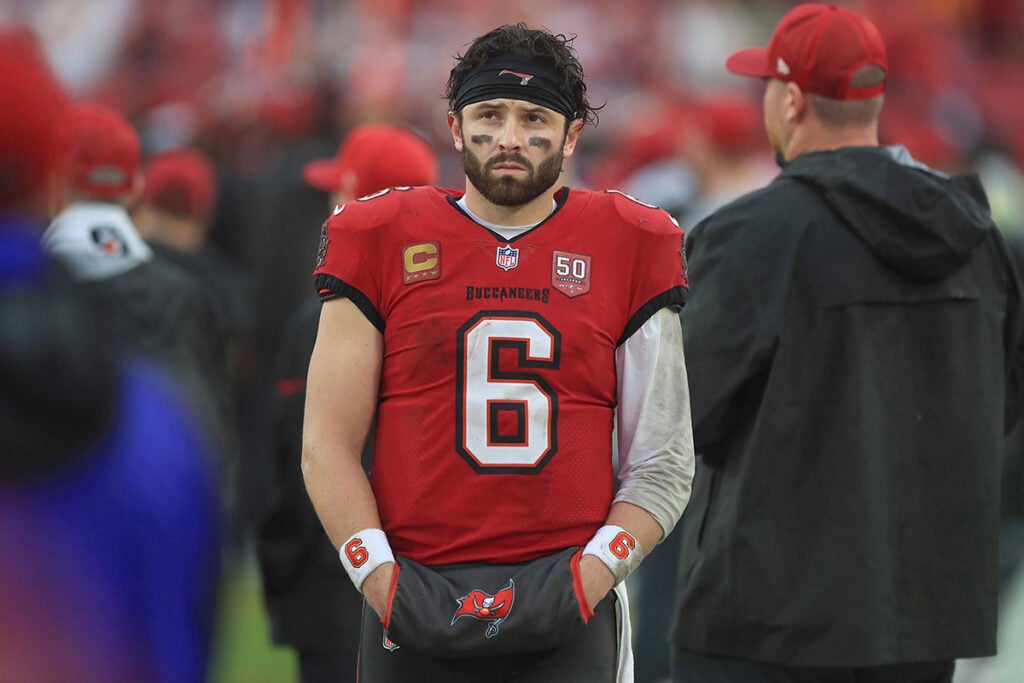
The 2023 draft class is the story here. Three of that class’s starters are entering the final year of their rookie deals in 2026, with outside linebacker Yaya Diaby, right guard Cody Mauch, and a fifth-year option of $14.475 million on Calijah Kancey all coming due. Add quarterback Baker Mayfield, defensive tackle Vita Vea, and kicker Chase McLaughlin all coming off contract years in 2026 and you have some significant paydays to balance against a budget that is now feeling tighter by the typed word. Mayfield alone is expected to fetch an extension worth at least $50 million per season.
I guess $94 million doesn’t buy what it used to, does it?
The Bucs are going to need to make some hard decisions. Next week I’ll detail potential cut candidates in 2027 to increase that $94 million in cash space.
Bucs Forecast
The Bucs’ rookie mini-camp will be held from May 8-10 this year. It’s three days of the kind of football that gets over-interpreted on social media and under-interpreted by the team, and I’m not going to pretend there’s a ton of competitive football to analyze. What I am going to be on the lookout for:
Ted Hurst’s Release Package vs. Air
No pads, no contact, but Ted Hurst’s footwork off the line and the route stems against bag drills will tell you whether the Senior Bowl tape (where he flashed against better competition) was real or a fluke. He’s a 22-year-old rookie, which means there is plenty of room for development. It’s a matter of how fast his learning curve is.
Reuben Bain Jr.’s Movement Profile In OLB Drills
First-round picks always get the most hyped coverage. What I’m actually looking for is how the coaching staff uses him: they mentioned post draft that they think Rueben Bain Jr. is versatile. Can we see that in how they are asking him to prepare? Will he stand up in the A gap? Will he drop into coverage? Will he see some time lining up over a guard as a 3-technique defensive tackle in addition to lining up on the edge as an outside linebacker?
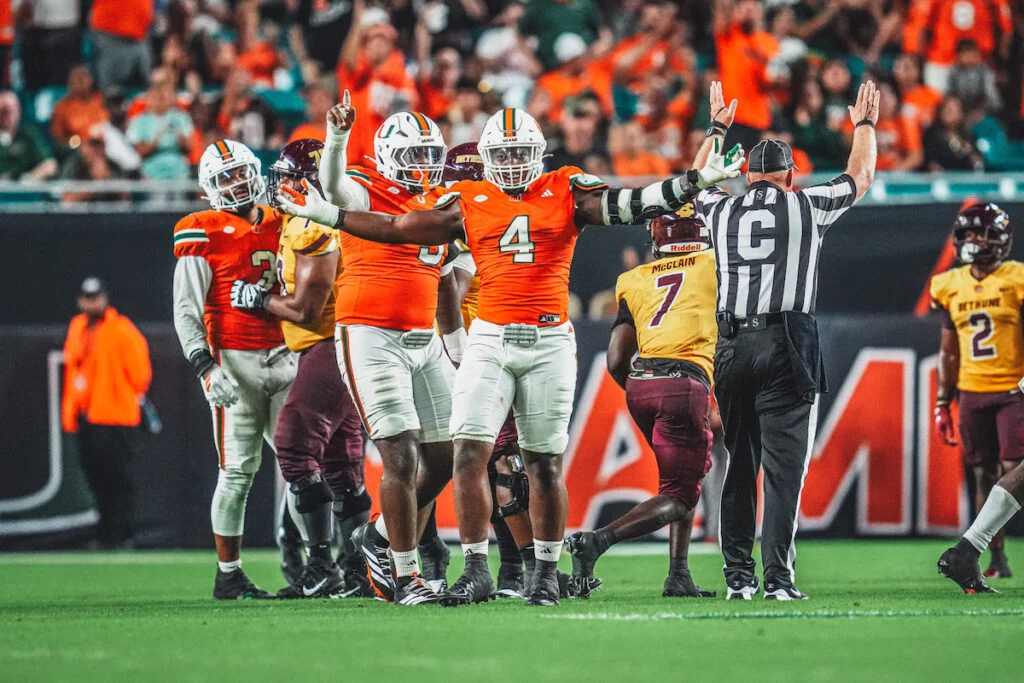
Bucs edge Rueben Bain Jr. – Photo by: Jared Lennon – The University of Miami
Josiah Trotter’s Coverage Drops
The discourse over middle linebacker Josiah Trotter’s coverage chops will fill the summer months. For now, I want to see his ability to flip his hips and cover ground in zone. Jason Licht mentioned on 95.7 WDAE on Tuesday that the Bucs’ second-round pick moves well in space. That should show even in shorts and shells.
Can he move in space against NFL players? That’s the differentiator year one for me.
Fourth Down Fun
Fourth downs used to be where drives went to die. Now, thanks to the analytics crowd that finally got coaches to stop punting from the opponent’s 38, fourth downs are where games get decided, and they’re fun again.
In that spirit, the Fourth Down Fun section of this column is where I’ll keep things lighter. Expect spicier takes, weirder predictions, and the occasional bad joke – just with a little less math and a little more fun.
This week’s topic: rookie jersey numbers.
God, I hope Ted Hurst doesn’t keep No. 16. It’s not a wide receiver number. Argue with a wall. Connor Bazelak currently has that number, so I remain hopeful. Calvin Johnson wore No. 81 for the Lions. I like it for Hurst.
Reuben Bain Jr. needs a single digit. Get out of here with double digits for an alpha edge. He wore No. 4 at Miami but Chase “Money” McLaughlin has that locked up. You don’t mess with a prolific scorer like McLaughlin. Move up a digit and give him No. 5.
Josiah Trotter has been less than lovingly called “K.J. Britt 2.0”. Naturally he needs to avoid No. 52 at all costs. Or does he? Embrace the madness, Josiah. Own that number and make it the next 50s moniker to get retired by the Bucs after a long, successful career. Lean in!
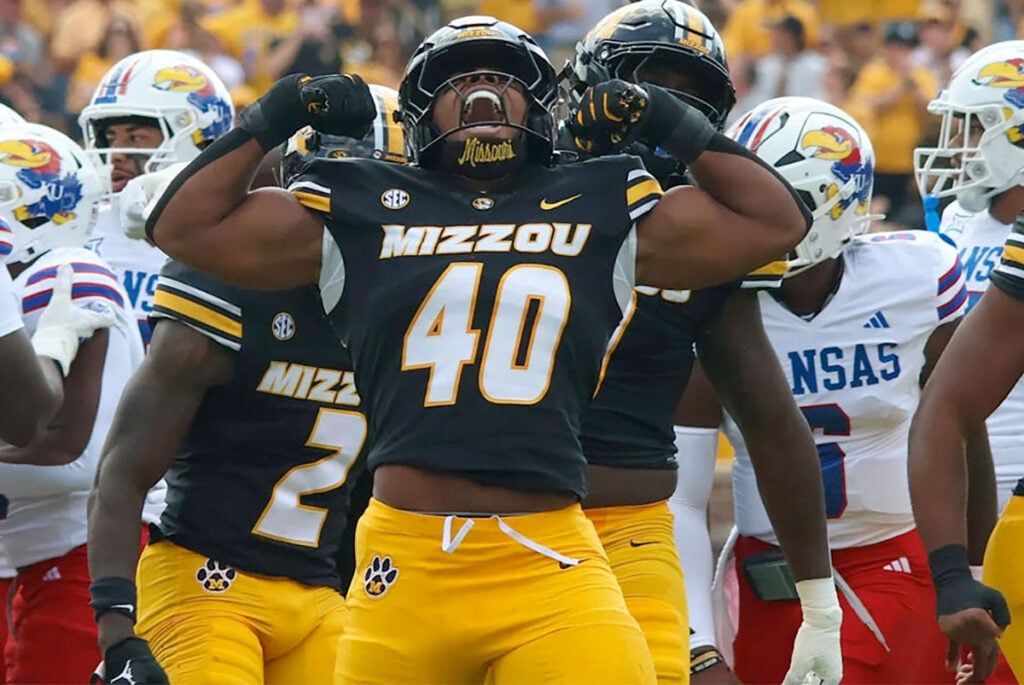
Bucs ILB Josiah Trotter – Photo courtesy of Missouri Athletics
Three calls – all are sure to be no-doubt home run predictions. Check back with me when the Bucs roster page updates and we’ll see how I did.
Refunds available in column form only.

Josh Queipo joined the Pewter Report team in 2022, specializing in salary cap analysis and film study. In addition to his official role with the website and podcast, he has an unofficial role as the Pewter Report team’s beaming light of positivity and jokes. A staunch proponent of the forward pass, he is a father to two amazing children and loves sushi, brisket, steak and bacon, though the order changes depending on the day. He graduated from the University of South Florida in 2008 with a degree in finance.
 Jason Licht Reveals Bucs' Draft Grade On Rueben Bain Jr.
 Baker Mayfield, Bucs Contract Extension Update