
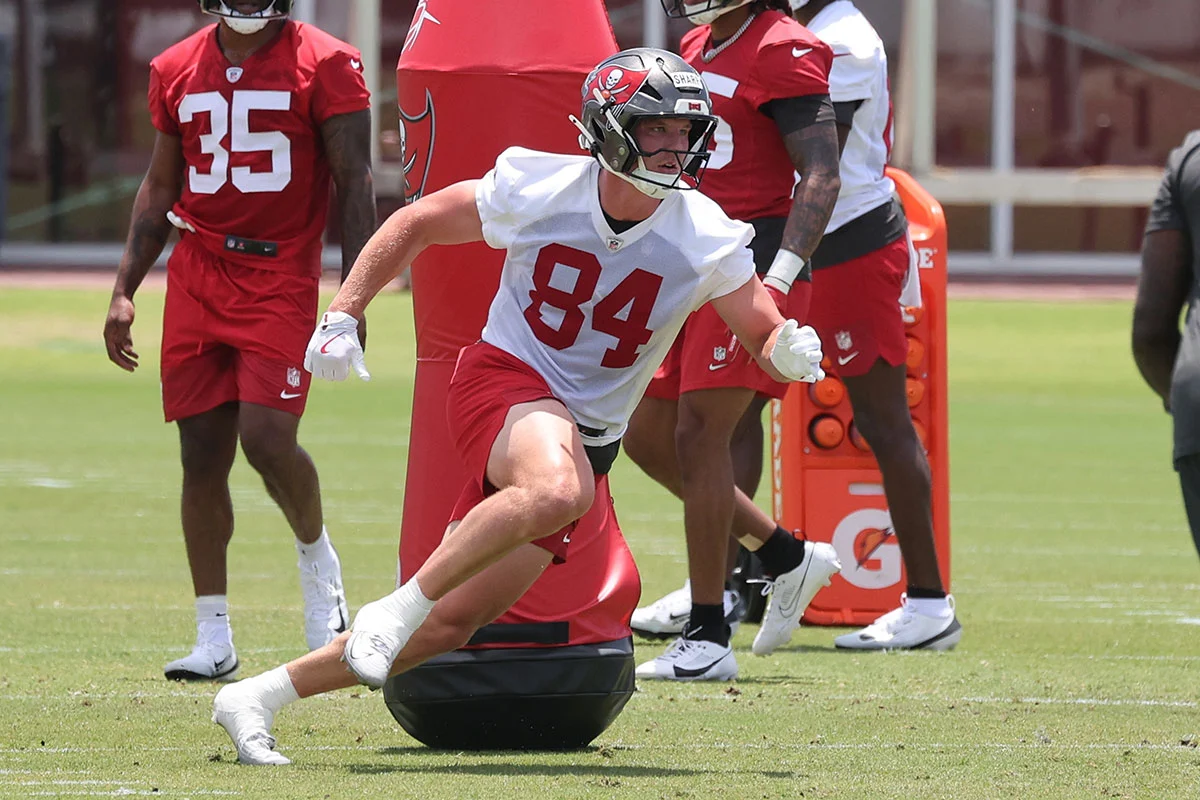
Welcome to a new series I am debuting called Saturday Scouting, where I’ll profile a player, concept, or matchup that is of interest to the Bucs. Bauer Sharp, the Buccaneers’ final draft pick of the 2026 NFL Draft, is this week’s focus for Saturday Scouting.
For three years Cade Otton has been a bit of everything for the Bucs offense. The in-line Y, the move tight end, the chain-mover, the safety valve. There was even a four-game stretch in 2024 where the passing game genuinely ran through him with Mike Evans and Chris Godwin Jr. on the sidelines with injuries. Otton’s 77 first downs from 2023 to 2025 are two fewer than Dalton Kincaid and six more than Zach Ertz. And strikingly, he has led all NFL tight ends since 2023 in snaps with 2,968.
Last year the tight end room was one of the weaker units in the NFL as far as production is concerned. As a unit they ranked 32nd in receptions (61), 32nd in receiving yards (589) and tied for 31st in touchdowns (2). With no additions to the room through free agency, the team stood to add to the room through the draft. And they took their swing in the sixth round with LSU’s Bauer Sharp.
A sixth-round pick is rarely the answer to a 32nd-ranked position group. Sharp does not need to be. The value he adds shows up first in what he unlocks for Otton.
Sharp’s positional versatility means Otton will be able to play more to his strengths and require him to be less of a catch-all player. Sharp can play the F, line up in the backfield as an H-back, motion across formations, and can split out wide as the apex of a trips bunch. He can play the Y too, but the value of putting him at the F is that it lets Otton stay at the Y where he is at his best.
Bauer Sharp’s Positional Versatility
Sharp is a natural move tight end. Line him up as the outside man on the wing just off the line of scrimmage and he presents a threat motioning from the field to boundary. He’s not explosive off the snap from a static set, but motion solves that. By the time the ball is snapped he’s already moving, and his carrying speed is real once he’s underway. Sharp ran a 4.63 in the 40-yard dash at the NFL Scouting Combine.
Split him out wide and the defense has to account for him with a defensive back. Linebackers will not be able to keep up with him in space. And the biggest defensive backs in the NFL will be mismatched against his 6-foot-5, 249-pound frame.
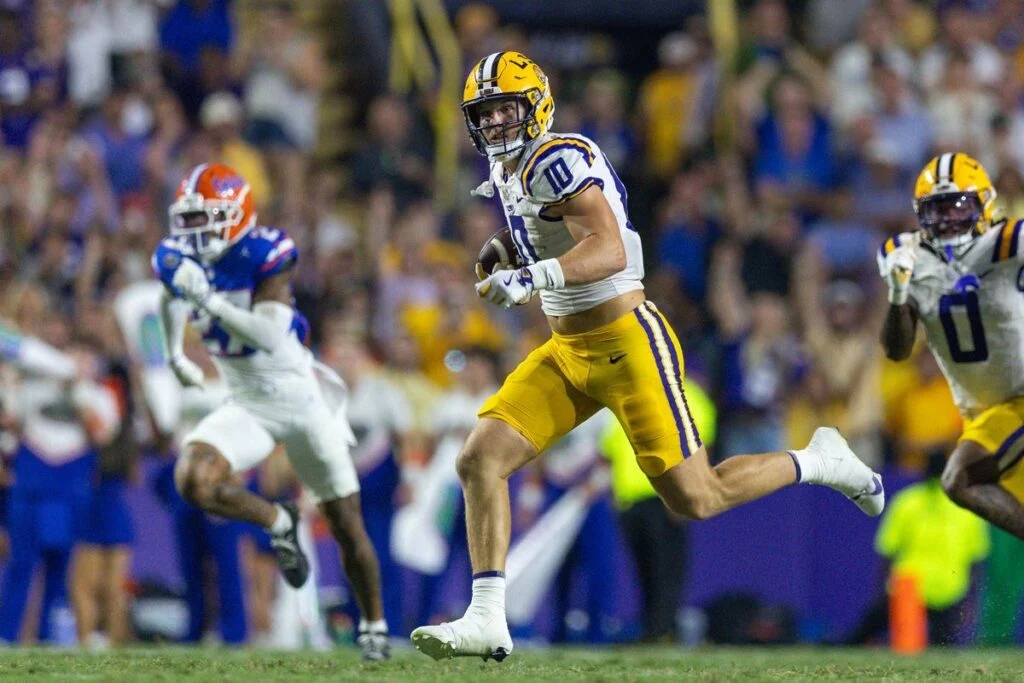
LSU TE Bauer Sharp – Photo by: IMAGN Images – Stephen Lew
Or you can line Sharp up in the backfield as an H-back, where he’s a competitive blocker in the run game and a free release into the seam in play action. That alignment is where his run-pass duality matters most, because the same pre-snap look serves both.
Bauer Sharp’s Blocking Is A Work In Progress
Now to the part that actually matters for whether he plays a real snap count as a rookie, which is the blocking. The Bucs are a play-action team with a downhill running game, and you do not get on the field at tight end in this offense if you cannot block. Devin Culp has found that out the hard way. Bauer Sharp competes his ass off and who loves to drive with his lower half to move defenders back, and his first rep against Houston in LSU’s bowl game was a textbook drive block where he moved a defender about 10 yards off the spot.
Hey #Bucs fans. Get to know new TE Bauer Sharp in one play. #10 motioning to attach to the line. pic.twitter.com/J3Ek6uC9jJ
— Josh Queipo (@JoshQueipo_NFL) April 26, 2026
Sharp works well on doubles. He is willing to dig out defensive ends. He strains on the perimeter. Sharp climbs off double-team blocks to the second level with effort and timing, which matters in a wide zone scheme where the second-level block is often the difference between a four-yard gain and a forty-yard one. And most importantly he is more than willing to put his shoulder down and commit to what the scheme requires of him.
Bauer Sharp stepping into the A gap and stoning the linebacker. pic.twitter.com/QPDIGzrk37
— Josh Queipo (@JoshQueipo_NFL) May 9, 2026
The blocking warts are real and they are both technical and physical. Sharp gets over-anxious and loses his balance at times, which leads to him getting side-stepped and losing his latch. He can lean too much into the block and whiff. Sharp’s targeting system as a split-flow blocker needs work, as he gives up too much ground when blocking laterally, and his pad level gets too high in pursuit.
None of these are dealbreakers. All of them are the kind of thing a tight ends coach fixes in a developmental player if the player is willing. And every indicator on Sharp’s tape says he is willing. His blocking improved measurably from 2024 to 2025.
The real question comes down to how well Sharp’s frame will hold up as a blocker as he ascends competition level. The Houston rep above was beautiful. It was also against a defensive back. When he tries the same thing against linebackers, the results change. The strain and enthusiasm are always there. The results vary wildly depending on the strength and frame of the opponent.
The honest assessment of Sharp as a blocker is that he is not yet a guy you trust to handle an edge defender on a base-down isolation block, and he probably never will be. That’s fine. That is what Otton, Payne Durham and/or Ko Kieft are for.
What Sharp projects as is something Otton is capable of but not excellent at, and what Durham and Kieft are completely misfits for. That is as the F in 12 personnel, to kick out a force defender on the perimeter, and climb to the Will linebacker on a wide zone, and pin a backside end on a pin-and-pull, and chip a blitzing nickel before releasing into the flat. That is not a small list. That is, in fact, most of the blocking demands the F position generates in this offense.
Bauer Sharp As A Receiver
Bauer Sharp transitions from catcher to runner smoothly, and he has the carry speed to threaten vertically on seams when a safety rotates down with a poor angle. The 65-yard catch against Florida last year is the play that gets cut into highlight reels. The more useful tape is the stuff between the highlights, where Sharp snaps off routes at the stem cleanly, climbs off of initial blocks with a real feel for timing, and turns short catches into yards because of his transition speed.
Bauer Sharp's long speed is real. He can be a threat up the seam for the #Bucs. pic.twitter.com/pZ8A2scx41
— Josh Queipo (@JoshQueipo_NFL) May 9, 2026
The hands are the receiving wart. Sharp had drops he should not have had at LSU, including a gimme catch in the end zone on a two-point conversion against Auburn in 2024 where he gave up on a late reaction throw. That is the kind of play that scares an offensive coordinator. The counterweight is that he also makes some genuinely tough grabs through contact, and his catch rate was suppressed by quarterback play that, charitably, was not optimized to give a tight end a clean target window. His career contested catch rate in college was a strong 54.5%.
The hands are inconsistent rather than bad, and inconsistent hands are coachable in a way that bad hands are not.
Sharp Has A Real Path To A Roster Spot – And Play Time
Where it adds up to a real Bucs role is in the snap distribution. Otton has been a workhorse. Without an F on the roster the past few seasons he has been required in 12 personnel and without a quality receiving threat behind him the team hasn’t felt comfortable taking him off the field in 11 personnel.
Sharp provides a skillset Kieft and Durham don’t have. And pairing him with one of those two gives natural positional slotting that can help Otton scale back his workload and keep him fresh. It also gives them an opportunity to get to 12 in different ways. Durham as the true Y, Sharp as the true F and Otton as the natural Y who can flex.
If Sharp can absorb 25% of those snaps as a credible F, you have just bought your $10-million-a-year tight end (Otton) an extra seven or eight games of fresh legs over the course of a season. That alone can be reason enough for Tampa Bay to take a sixth-round flier on a former quarterback who began his career at Southeastern Louisiana.
Sharp is not a finished product. He needs to play more physically through contact as a route runner. His ball security needs work. And he is not going to be confused with a Y-iso blocker any time soon. But the role he was drafted to play is well-defined, the room around him is built to support it, and the player he is being asked to complement just got paid to keep doing exactly what he is best at.
Cade Otton plays more Y. Bauer Sharp gives the offense a more natural F. After an early run on tight ends on day two of the 2026 NFL Draft the Bucs needed to pivot to a player who fit their roster in a specific way. And Sharp is the right piece for that puzzle.

Josh Queipo joined the Pewter Report team in 2022, specializing in salary cap analysis and film study. In addition to his official role with the website and podcast, he has an unofficial role as the Pewter Report team’s beaming light of positivity and jokes. A staunch proponent of the forward pass, he is a father to two amazing children and loves sushi, brisket, steak and bacon, though the order changes depending on the day. He graduated from the University of South Florida in 2008 with a degree in finance.
 Slivon's Slant: Inside The 2026 Bucs Quarterback Room
 What's Holding Up Bucs LB Josiah Trotter's Contract?