
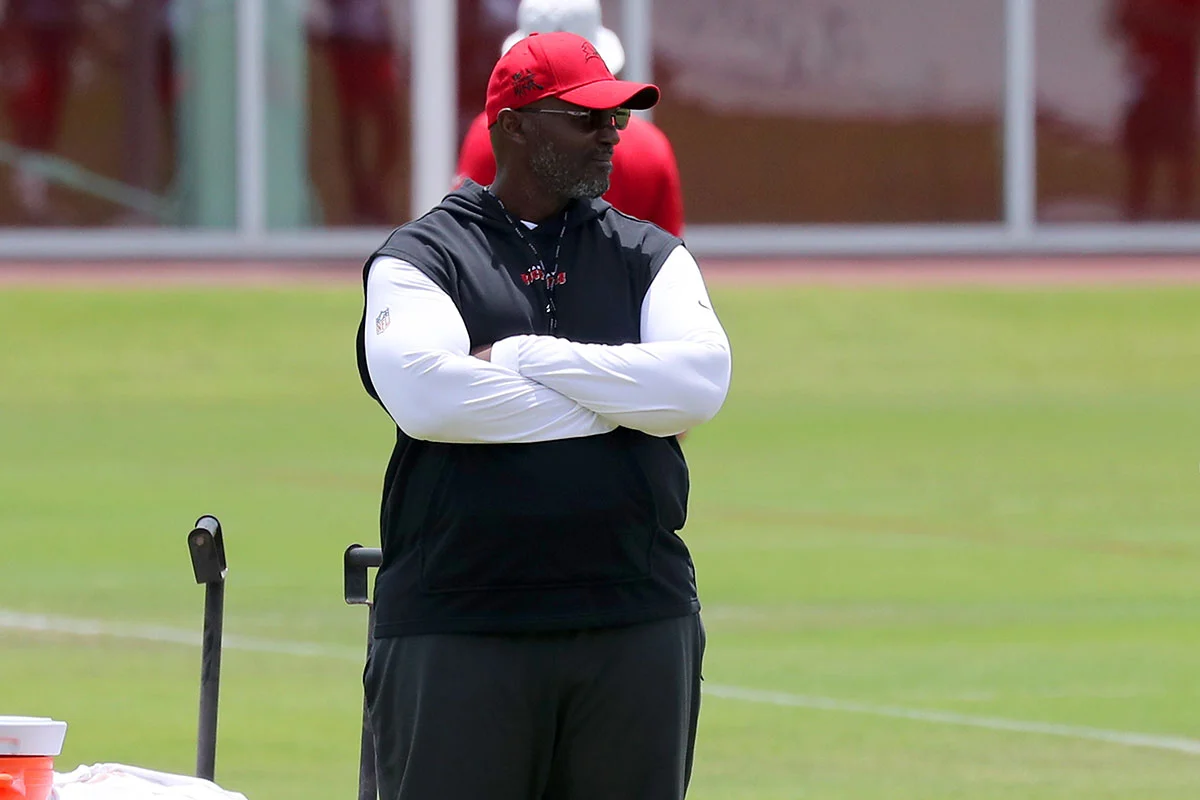
In the NFL, Cover 4 refers to a defensive coverage that aims to cover four deep zones on the field. Following that lead, I’m going to provide you with the same coverage of the Bucs – your favorite football team.
Each Wednesday morning I’ll cover four areas as they apply to Tampa Bay: 1. a short film breakdown, 2. a finance angle, 3. a look forward at what’s to come, and 4. a bit of fun.
Film – Todd Bowles Has The Pieces To Once Again Create Chaos
Todd Bowles will always be a high blitz, high pressure, high drop defensive mind. To think otherwise is foolhardy. Yes, he said during the 2025 offseason that the team needed a better four-man pass rush. And yes, the additions this offseason to the defensive line should help with that. But when the Bucs defense was at its best was 2020 and 2021.
2020
- 6th in yards/game allowed (329.1)
- 7th in EPA/play allowed (-0.08)
- 8th in points/game allowed (22.2)
2021
- 13th in yards/game allowed (331.7)
- 3rd in EPA/game allowed (-0.12)
- 5th in points/game allowed (20.8)
And here’s the kicker. With a better pass rushing unit in those seasons, the Bucs blitzed more not less. Here is Tampa Bay’s blitz rate by season dating back to their Super Bowl run:
2020 – 41.1%
2021 – 39.1%
2022 – 31.4%
2023 – 40.3%
2024 – 36.5%
2025 – 33.0%
For those wondering about 2023, the team ranked 23rd in yards per game allowed (344.6) and 17th in EPA/play allowed (-0.08) but finished 7th in scoring defense (19.1 ppg allowed).
The 2025 blitz rate of 33.0% is the lowest of the post-Super Bowl era. That isn’t an accident. That’s Bowles hedging.
Look at the 2025 defensive front and you can see why. Calijah Kancey missed time, which meant fewer one-on-ones for the rest of the front. Haason Reddick never panned out opposite Yaya Diaby. Vita Vea played a career-high in snaps because there was nobody behind him to spell. Every time Bowles wanted to send five or six, he had to ask himself whether the four left in coverage could hold up long enough, and whether the four rushing would actually get home. The answer often pushed him toward a more conservative call.
Bucs trying to trust a four-man pass rush that was always a tick to late last year. pic.twitter.com/QkBYPXDhZN
— Josh Queipo (@JoshQueipo_NFL) May 13, 2026
This was a third-and-14. The Bucs rush just four and the left side of the defense can’t make any hay from the pressure. Diaby is a tick behind the throw, and even with the conservative call the coverage can’t prevent the deep completion. Technically this is a pressure in the books. But it’s a low quality pressure in that it came very late. Patriots QB Drake Maye got to a second hitch and had plenty of time to survey the field.
Now look at the same situation when Bowles trusted the front:
Early in 2025 Todd Bowles showed more trust in his defense. It enabled him to run exotic games like this one. #Bucs pic.twitter.com/cheHXPBHDT
— Josh Queipo (@JoshQueipo_NFL) May 13, 2026
This is Bowles at his best. Bring everyone to the line of scrimmage and make the offense commit to their best guess at where pressure will actually come from – then change that picture. Manufactured confusion before contact, free runner created by scheme, quarterback forced to decide faster than he wants to.
The 2025 Bucs ran these calls. They just couldn’t run them often enough, because the personnel couldn’t carry the scheme.
Kancey’s season-long absence paired with Reddick’s own missed time and diminished play left the front at a less-than-necessary level of play. The back end faltered down the stretch due to poor linebacker play and mental lapses from cornerbacks Zyon McCollum and Benjamin Morrison.
The early season promise of the defense in 2025 was special. The end of season reality was anything but.
Yet hope springs eternal in 2026.
The Bucs have added legitimate juice to their pass rush at not just one or two, but three levels. Kancey and outside linebacker David Walker are back from injury. Veteran outside linebacker Al-Quadin Muhammad is a sneaky two-deep addition. Rueben Bain Jr. should start opposite Diaby. They all help the pass rush on the front. But middle linebacker Josiah Trotter and nickelback Keionte Scott give Bowles more threats from a plethora of angles.
With Alex Anzalone and Scott giving the team better back-end coverage options through added depth and multiplicity, Bowles should trust the coverage more this year. He even spoke about using dime coverage more often in 2026.
Double Mug pressure package. pic.twitter.com/PJwtoXdqTx
— Josh Queipo (@JoshQueipo_NFL) May 13, 2026
This is Bowles at his best. If the pass rush has chaos agents working to a common goal, they get home faster. When that happens the coverage can take more risks with less downside. Bowles can lean into his best concepts rather than shy away from them. Last year, this happened occasionally. With Bain creating chaos opposite Diaby, Kancey healthy inside, and a secondary that can play tighter because the rush is closing faster, this becomes the default.
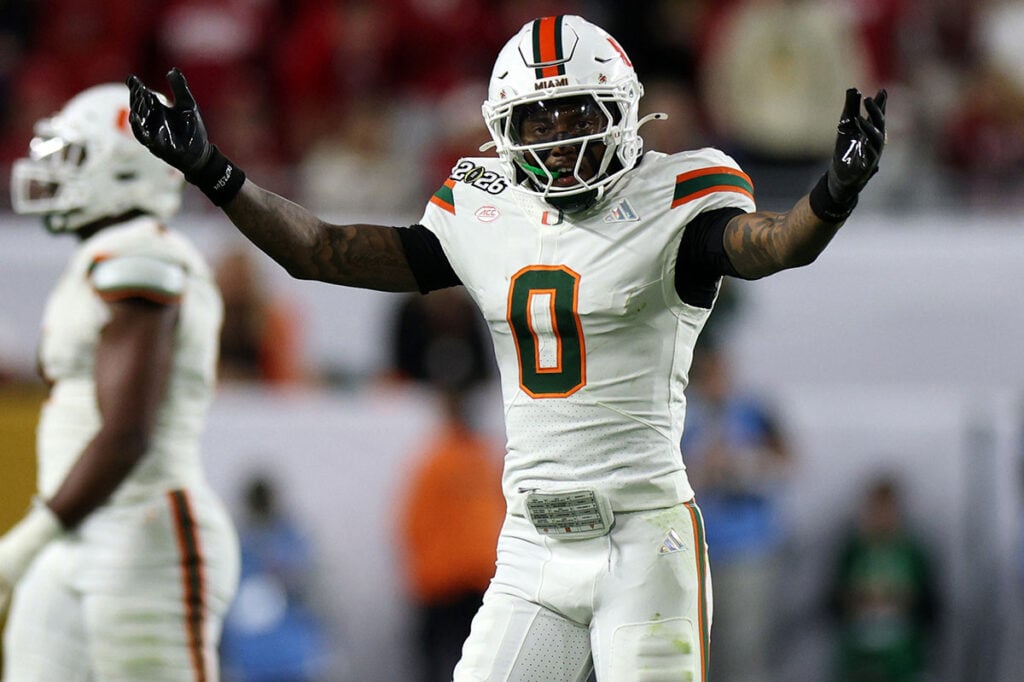
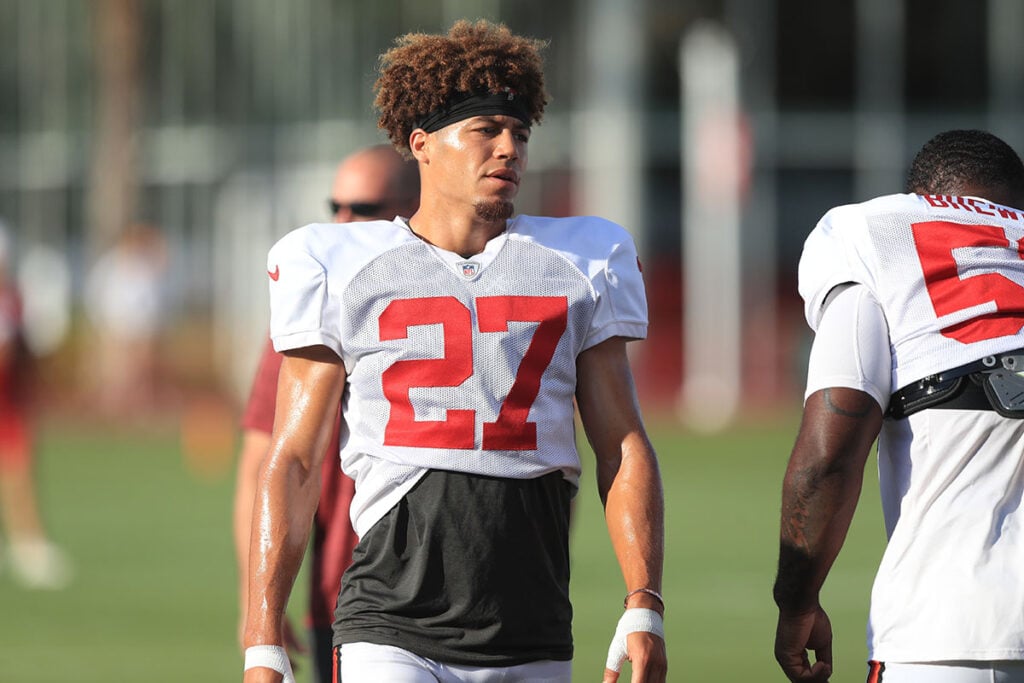
Bucs DB Keionte Scott – Photo by IMAGN Images – Jerome Miron
The blitz rate goes back up. Not all the way to 2020’s 41%, but comfortably north of last year’s 33%. The pressure rate climbs from 39.1% to 40%-plus. And the pressure gets home more often creating negative plays that end drives and force turnovers.
Bowles doesn’t need a new playbook. He needs the players to run the one he already has.
Finance – Bucs’ Hard Decisions Ahead In 2027
Over the past two weeks I’ve laid out the 2027 salary cap foundation and the salary cap cuts that get the Bucs to flexibility. This is the harder question: who actually gets extended? The Bucs have several prominent players set to hit free agency in 2027. Quarterback Baker Mayfield is the headliner. But outside linebacker Yaya Diaby and right guard Cody Mauch are also key young players that are entering contract years in their prime. Nose tackle Vita Vea and kicker Chase McLaughlin are also on the list, and we’ll find out this year if Vea is still in his prime at age 31 or starting to slip past it.
Here are some rough estimates for how much each player will likely command per year on a new deal.
Baker Mayfield: $50-52 million per year
Yaya Diaby: $23-25 million per year
Cody Mauch: $14-17 million per year
Vita Vea: $15-18 million per year
Chase McLaughlin: $5.5-7 million per year
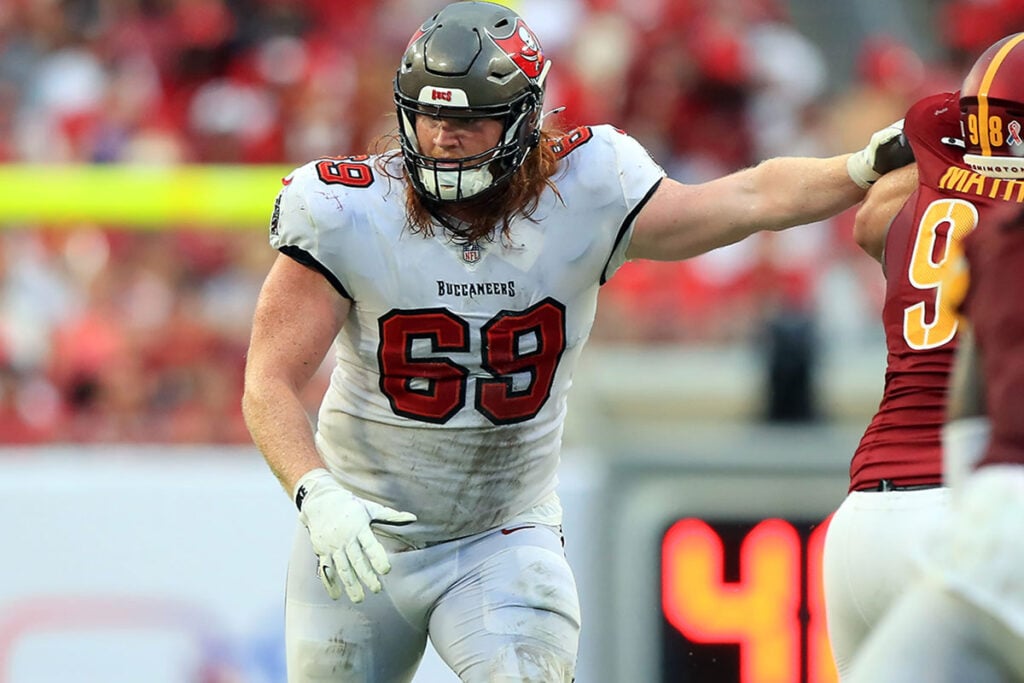
Bucs RG Cody Mauch – Photo by: Cliff Welch/PR
If the Bucs want to keep all five of those players, they will need to dish out $107.5 million on the low end. Unless the Glazers make a significant change in their cash spending habits, they won’t be able to keep all five. Here’s how I’d handle each, in the order I’d address them.
1. Diaby is an ascending pass rusher. Each season he has improved his technique and impact. If he levels up one more time he could clear $30 million APY next year. Tampa Bay can lock him up with an extension this offseason. The way they structure their extensions for players coming off rookie deals would only cost them about $3 million in extra cash this year, which they can afford. It’s the right deal for their 2026 cash position.
2. McLaughlin has quietly turned into one of the best kickers in football. Brandon Aubrey just reset the kicker market at $7 million per year. “Money” McLaughin’s market is now pretty well defined. A three-year, $18 million extension would only cost the Bucs an extra $1.5 million in cash this year, take one thing off their plate next year, and lock in one of their most consistent pieces for the foreseeable future. This should be done this offseason.
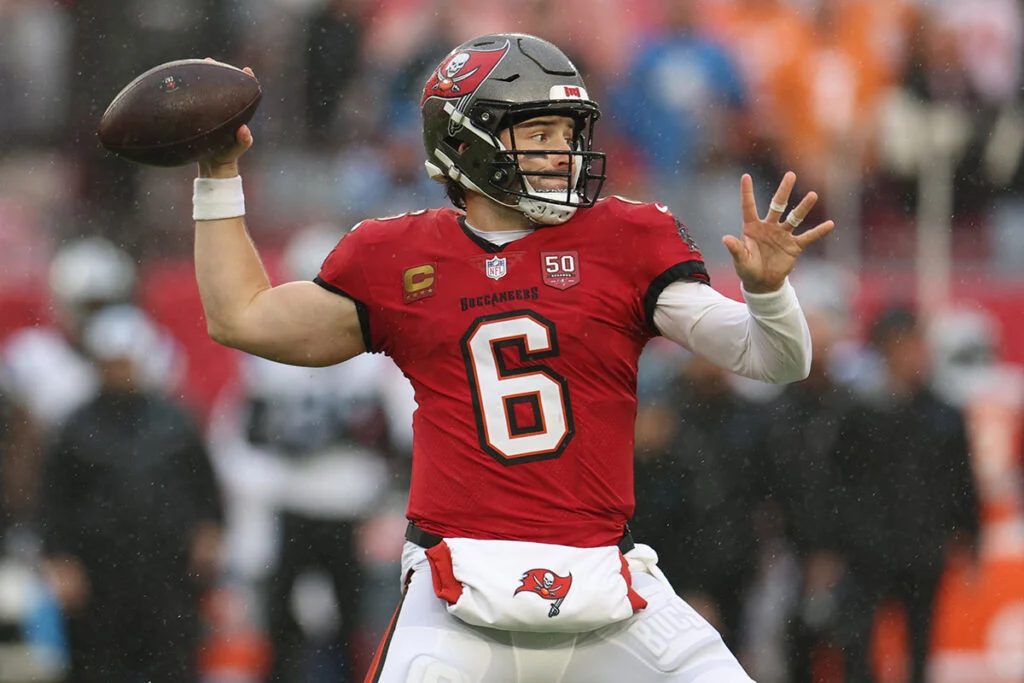
Bucs QB Baker Mayfield – Photo by: IMAGN Images – Nathan Ray Seebeck
3. Mayfield is the most important to the team. But a market-value extension would require an extra $10 million in cash. That would break the Glazers’ spending habits. I’m not saying they won’t do it this offseason. Just that I see it as more likely to be priority No. 1 for the 2027 offseason.
And the Bucs have the franchise tag in their back pockets. This year’s tag was less than $44 million, and the quarterback market has stalled over the last 24 months. Tampa Bay has legitimate control over Mayfield past this year as a security blanket that gives them ample time to get a deal done. The realistic path is to let 2026 play out and use the franchise tag as a safety net to get the long-term extension in place before he plays a single snap in 2027.
4. This is where it gets tricky. Few people are higher on Cody Mauch than I am. Keep in mind I was making the case for him as a Pro Bowler in 2024. There are three reasons I see him as the odd man out: needs at other positions, his 2025 season-ending knee injury, and Jason Licht’s penchant for finding quality offensive linemen on Day 2 of the draft. Other teams are going to see his value and be willing to pay top dollar for him if he rebounds with a very good 2026 campaign. And with all of their other priorities, I struggle to see the path where they re-sign/extend him.
5. Vea will be 32 in 2027. The aging curve for big nose tackles is not a forgiving one. And he is coming off of back-to-back seasons of setting new career highs in snaps played. With over-30 defensive tackles finding two- and three-year deals on the open market, and the Bucs preferring to go year-to-year with their over-30 players, the two sides may be misaligned on what a future for Vea in Tampa Bay looks like.
And that’s before you consider the team would be paying for his decline whereas the four above him would be entering or maintaining their primes. It all adds up to a tough sell for the big man to remain with the team past 2026.
The math points to two extensions this offseason, one more next year, and two goodbyes. That’s the most logical path forward.
Forecast – Rueben Bain Jr.’s Rookie Contributions
Tampa Bay drafted Rueben Bain Jr. with the 15th overall pick to give the entire defense a lift. I think they got exactly that, just not in the way most people expect.
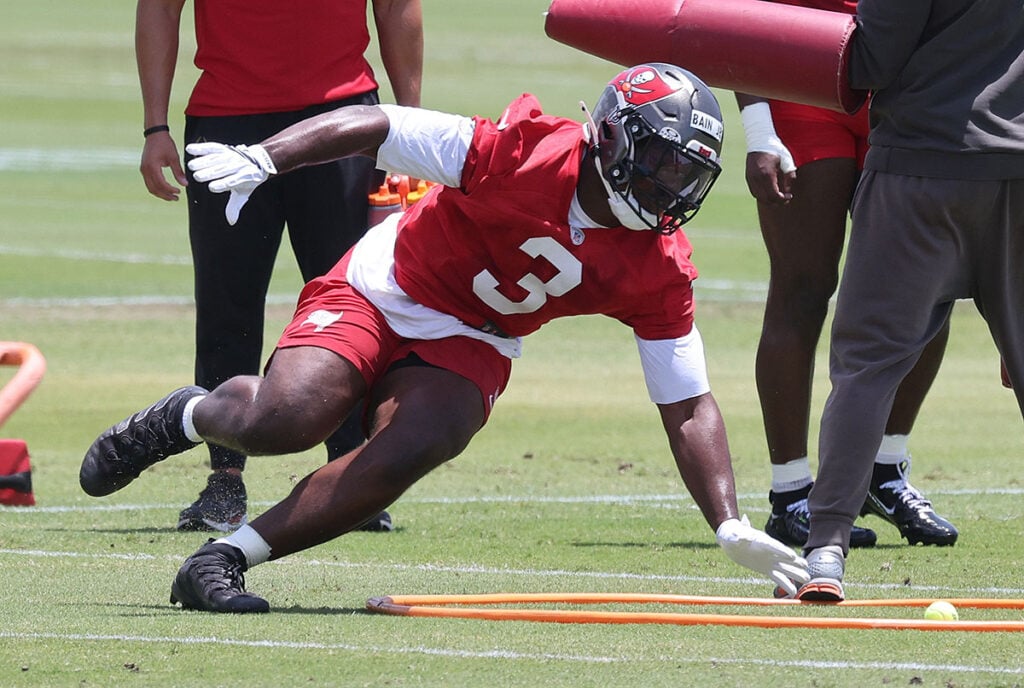
Bucs OLB Rueben Bain Jr. – Photo by: Cliff Welch/PR
Before I give you my prediction for his rookie stats, let’s set the baseline. I pulled every first-round edge rusher drafted from 2021 to 2025 who played at least 12 games as a rookie. That’s 24 players. The typical healthy rookie first-round edge rusher produced 32 tackles, five tackles for loss, four sacks, 38 pressures, and a 9.7% pressure rate. That’s the bar to clear.
The Individual Forecast: 32 Tackles, 7 TFLs, 5 Sacks, 42 Pressures, 11% Pressure Rate
My projection has Bain above the median in four of five categories, with sacks the one that lags slightly. That’s intentional.
Bain’s arm length is going to hold his sack total down. The same physical trait that helps him stay tight to blockers and win leverage battles also limits his ability to fully extend and close on the quarterback once he’s in the pocket. He’ll pressure more often than most rookies. He’ll convert those pressures into sacks at a slightly lower rate. That isn’t a knock on Bain. It’s a feature of his game that makes him more valuable than his sack total will suggest.
A few reasons I’m comfortable being above the median on pressures:
• He’s slotted as a Week 1 starter opposite Yaya Diaby. Most first-round edges rotate in. Bain gets snaps from the jump.
• Todd Bowles’ scheme manufactures pressure with disguised looks and timing. That helps a rookie who doesn’t have to win every rep one-on-one on talent alone.
• The coaching praise out of rookie minicamp was unusually strong. Bowles called him “midseason form” after Day 1. Bowles typically throws some caution when praising players, often starting his replies with “I wouldn’t necessarily say…” This is uncommon praise about Bain from the Bucs head coach.
• If Calijah Kancey is healthy for the whole year, defenses will choose to double him, Vita Vea, and even Diaby at times. That gives Bain favorable matchups other rookie edge rushers haven’t always had.
The Bigger Story: Bain Elevates The Entire Bucs Pass Rush
The 2025 Bucs led the NFL in passing touchdowns allowed and finished third in pressure rate at 39.1% per Next Gen Stats.
Read that sentence again.
They pressured the quarterback better than 29 other teams. They just couldn’t finish.
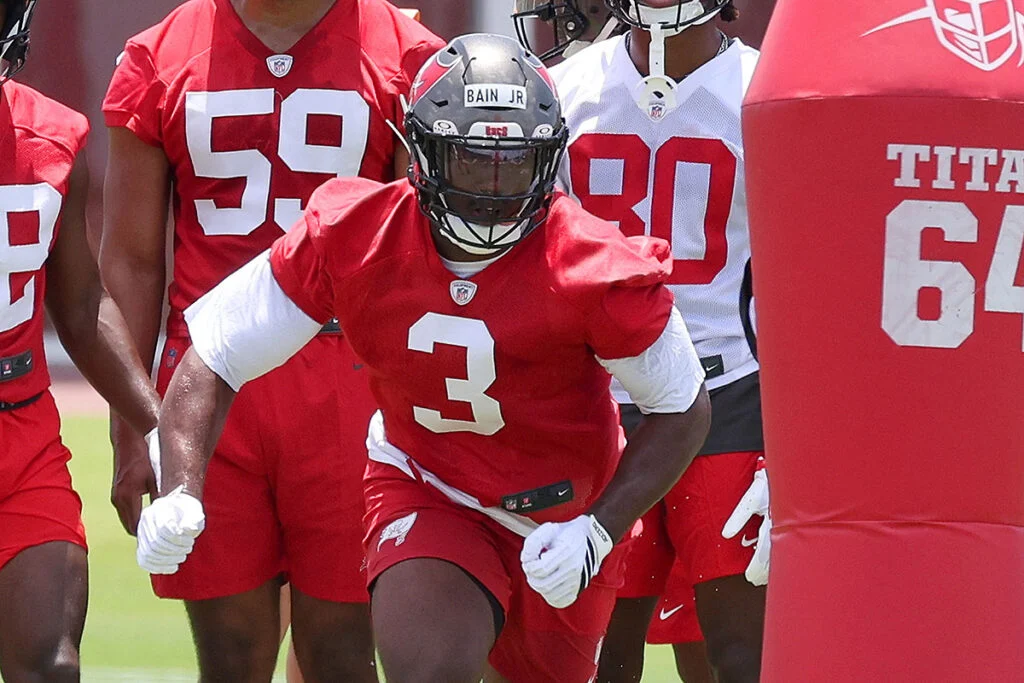
Bucs OLB Rueben Bain Jr. – Photo by: Cliff Welch/PR
Tampa Bay generated 251 quarterback pressures in 2025, the third-highest total in the league. They turned those pressures into 37 sacks, a 5.8% sack rate that ranked among the worst in the league for any team with a top 10 pressure profile. Minnesota and Denver also cleared 39% pressure rate, and they had 49 and 68 sacks, respectively. Elite pressure volume, bottom-tier conversion.
This is where Bain’s value goes beyond the box score. He’s not arriving in Tampa Bay to be the guy who necessarily finishes the play – although he can. He’s arriving to make it possible for someone else to finish it. With every snap Bain wins his rep and forces the quarterback off his spot is a snap where Diaby has a cleaner edge to bend, Vea has a one-on-one with a guard, or Kancey doesn’t get help. The pressure he creates doesn’t have to show up on his own stat line to show up on the team’s.
The Bucs Forecast: 40% Pressure Rate And 50 Sacks
A 40% team pressure rate would put the Bucs in the top two in the league. Only Minnesota and Denver got there in 2025. Tampa Bay was a hair under at 39.1%. Replace the snaps from the second edge spot opposite Diaby with Bain operating at an 11% individual pressure rate, and the math gets you over 40% naturally.
The sack number is the bigger jump. Going from 37 to 50 is a +13 leap, the kind of year-over-year improvement only a handful of teams produce. But it doesn’t require Bain to drive the increase. It requires the rest of the defense to start converting pressure into sacks at the rates comparable units managed.
Minnesota’s 49 sacks came on a 41.4% pressure rate. Apply that same 9.3% conversion to a Bucs team with 250-plus pressures, and you get to 50 sacks naturally. The sacks I’m projecting for Bain himself only account for 10% of that total. The other 90% comes from a defense that finally gets to play downhill because Bain is creating chaos on the back side.
A rookie whose own production lands above the median but whose real impact shows up in the totals around him. A defense that converts elite pressure into a top-five sack total. A unit that finally finishes the plays it was already starting. That’s what changes the math on the entire 2026 defense.
Fourth Down Fun – My Favorite Obscure Bucs
We all have them. Our favorite players of all time who when you bring them up to a casual fan they respond with “Who?”
The one-hit wonder, whose single-season contributions gave you hope for the future, only for them to recede into anonymity. The guy who stayed on the roster for seven years as a core special teamer. The trivia answer who helped you win free drinks at the local watering hole.
With the recent release of the Netflix Roast of Kevin Hart, it gave me the idea to present my top-four “obscure” Bucs roast-style, because we only roast the ones we love.
S Dashon Goldson – Dashon Goldson was fined so many times that when he signed his five-year, $41 million contract with the Bucs in 2013 he told the team to make his game checks out to “The NFL.”
LB Jeff Gooch – Gooch spent seven years in Tampa Bay mostly as a core special teamer. If ever there was a Jeff Ross of the Bucs it is Jeff Gooch. Each year the rest of the team would go home in the offseason only to return for training camp to go, “Oh, Jeff…you’re still here?”
QB Josh Johnson – Josh Johnson has had a long and illustrious career. Well…he’s had a long career. A fun fact you may not know. Josh Johnson was drafted by the Bucs in 2008. Airbnb was founded in 2008. Yes, Airbnb was created specifically to ensure that Johnson always has a roof over his head among his many NFL stops.
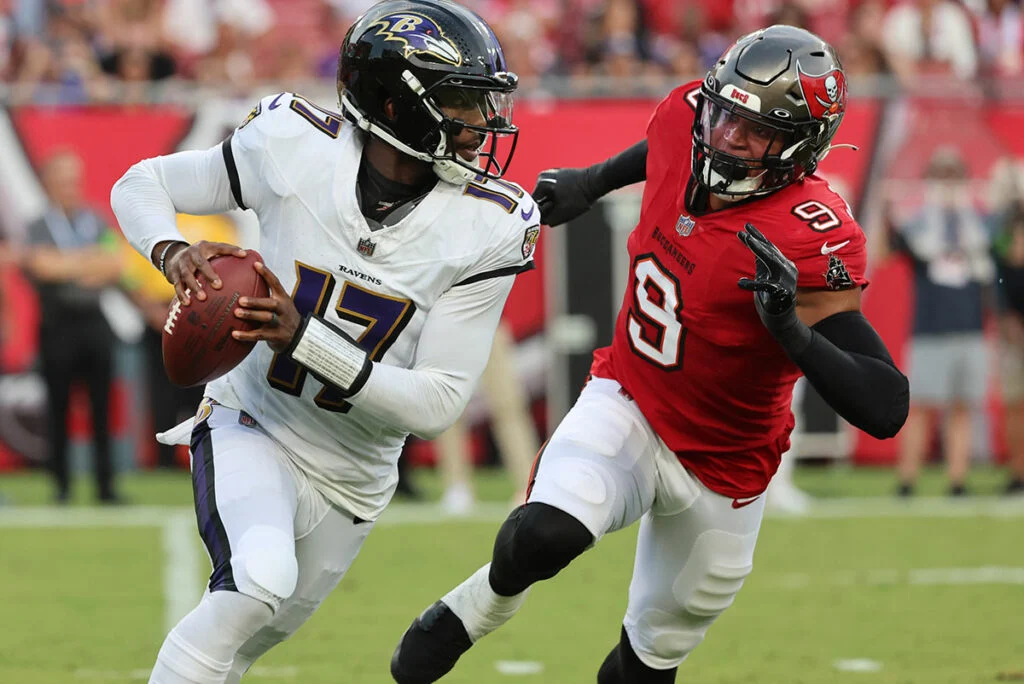
Ravens QB Josh Johnson and Bucs OLB Joe Tryon-Shoyinka – Photo by: USA Today
WR Sammie Stroughter – As a rookie, Stroughter might have been the brightest spot on the 2009 Bucs. They went 3-13. Which tells you everything you need to know about both Stroughter – and the 2009 Bucs.

Josh Queipo joined the Pewter Report team in 2022, specializing in salary cap analysis and film study. In addition to his official role with the website and podcast, he has an unofficial role as the Pewter Report team’s beaming light of positivity and jokes. A staunch proponent of the forward pass, he is a father to two amazing children and loves sushi, brisket, steak and bacon, though the order changes depending on the day. He graduated from the University of South Florida in 2008 with a degree in finance.
 Bucs GM Jason Licht Joins Pewter Report Podcast TODAY 4 PM ET
 Zyon McCollum Says Bucs’ Offseason Program Has Reached “A New Level”