
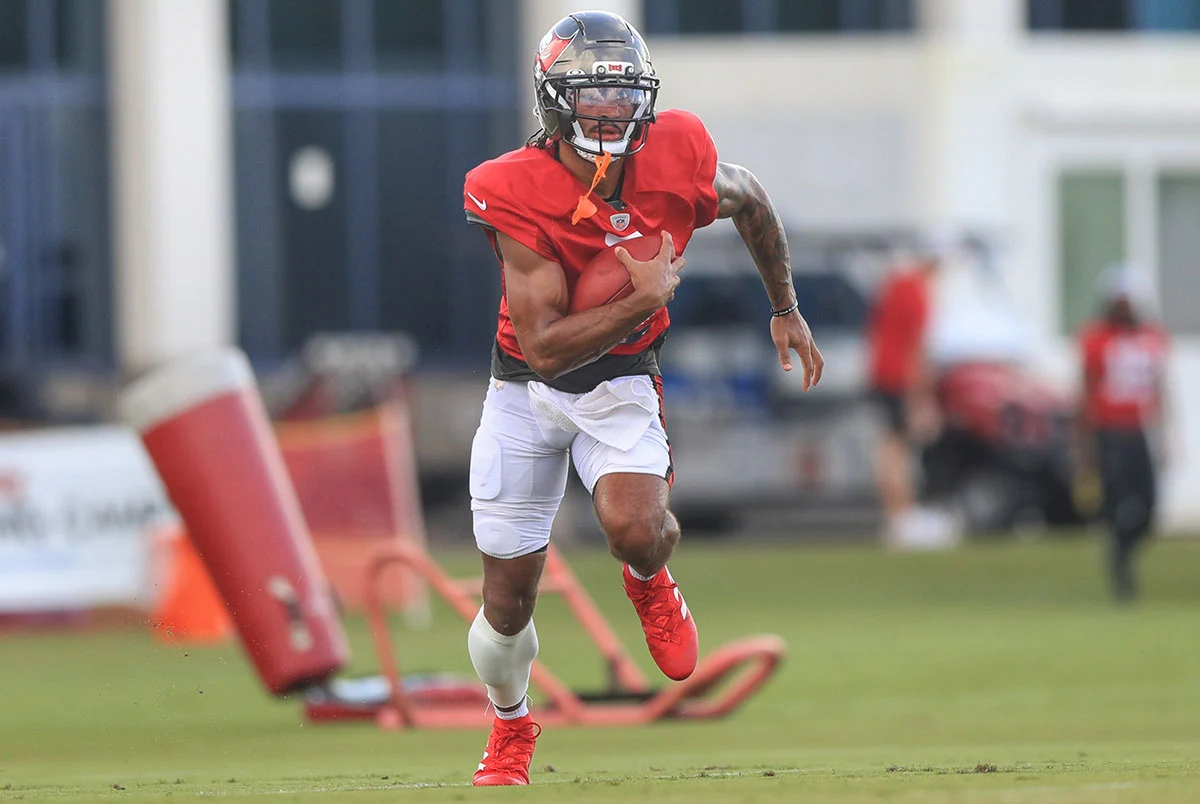
Bucs WR Emeka Egbuka – Photo by: Cliff Welch/PR

SR’s FAB 5 column on the Bucs is presented by Gameday Men’s Health
Men – do you feel tired? Are you gaining weight despite working out… struggling with sleep, focus, or sexual performance? Did you know that 1 in 4 men over the age of 30 have low testosterone? And many men don’t even realize it – and I didn’t either, which is why I am on testosterone replacement therapy at age 54 and feel like I’m 10 years younger.
At Gameday Men’s Health, low testosterone is quickly diagnosed and treated. Gameday offers a FREE testosterone test and consultation – with results in minutes. Gameday specializes in testosterone replacement therapy, along with weight loss, ED treatments, and peptides — all designed to help optimize your health and performance.
With 6 Tampa Bay area locations in Westshore, South Tampa (the clinic I go to), Brandon, Palm Harbor, Largo, and Sarasota … getting started is EASY. Visit GamedayMensHealth.com today to schedule your FREE consultation. Feel better and get back in the game with Gameday Men’s Health!
INTRO: With the start of training camp just three weeks away, let’s take a look at where each Bucs starter and key reserve need to improve the most when the pads come on. This week’s SR’s FAB 5 focuses on the offense and special teams, and next Friday’s column will focus on defense. Enjoy!
FAB 1. Where The Bucs Must Improve In Camp: Backfield
Let’s kick off this SR’s FAB 5 by analyzing where Baker Mayfield, Bucky Irving and Co. need to improve the most in training camp prior to the start of Tampa Bay’s 2026 season.
QB Baker Mayfield: Completion percentage
A year after former offensive play-caller Liam Coen helped Mayfield achieve a career-best and franchise-record 71.4% completion percentage based around completing short passes quickly and in rhythm, new offensive coordinator Josh Grizzard wanted Mayfield to push the ball downfield more with the hope of creating more explosive plays in the passing game. That approach backfired.
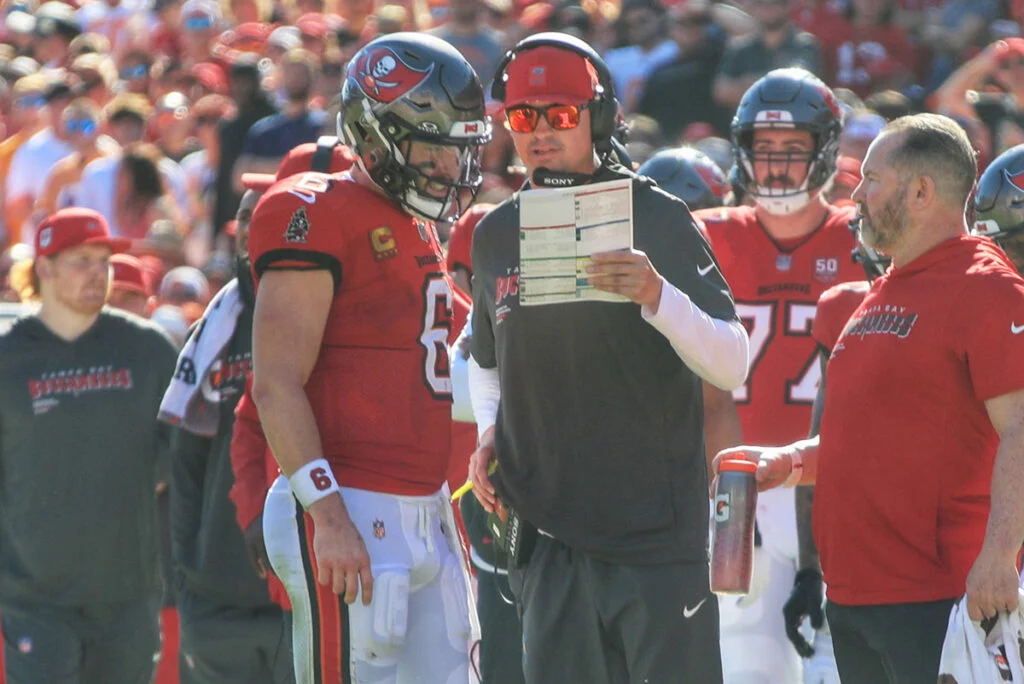
Bucs QB Baker Mayfield and former OC Josh Grizzard – Photo by: Cliff Welch/PR
Mayfield’s completion percentage plummeted to 63.2%, which was even lower than the 64.3% mark under Dave Canales in 2023. As a result, his average yards per pass fell from 7.9 yards in 2024 to just 6.8 yards last season due to more incompletions. And Mayfield threw for nearly 1,000 fewer yards last year with just 3,693 yards compared to 4,500 yards in 2024. Mayfield’s touchdown total also fell from 41 in 2024 to just 26 last year.
Zac Robinson wants to get the ball out of Mayfield’s hands faster with more short and intermediate passes into the hands of the team’s playmakers, similar to the type of plays Coen was calling two years ago. If Mayfield can do that and complete a higher percentage of his passes, it will result in the chains moving more often with longer scoring drives, and those drives hopefully ending in more touchdowns than field goals or punts.
RB Bucky Irving: Pass protection
Irving had a sensational rookie season in which he ran for 1,122 yards and eight touchdowns, showing tremendous elusiveness and a nifty running style that made defenders miss while he averaged 5.4 yards per carry. Last year he improved as a receiver out of the backfield despite foot and shoulder injuries costing him seven games in 2025.
In 2025, Irving caught 30 passes for 277 yards and his first three receiving touchdowns, including a 72-yard score on a wheel route versus Philadelphia. And he improved his receiving average from 8.3 yards per catch in 2024 to 9.2 yards in 2025. But the area that Irving needs the most work is in pass protection, and he needs to really show improvement in this area when the pads come on.
Irving’s 5-foot-9, 192 pounds work against him as a pass protector, but he can improve by working on his technique. He had a 28.9 pass protection grade per PFF in 2024 and that number regressed to 22.6 last year. Irving will lose snaps on third down to Kenneth Gainwell largely because of this aspect of his game, as Gainwell is superior in pass protection. If Irving wants to truly become a three-down back, he needs to be better on third down and hone his pass protection technique.
RB Kenneth Gainwell: Absorb the playbook
Gainwell is coming off his best NFL season in Pittsburgh, where he totaled over 1,000 yards from scrimmage and was the Steelers team MVP despite not even being a starter. Gainwell wasn’t even the leading rusher, yet beat out Jaylen Warren and some established Steelers legends like T.J. Watt and Cameron Heyward for that honor. The team views him as an upgrade over Rachaad White, who wasn’t re-signed in free agency.
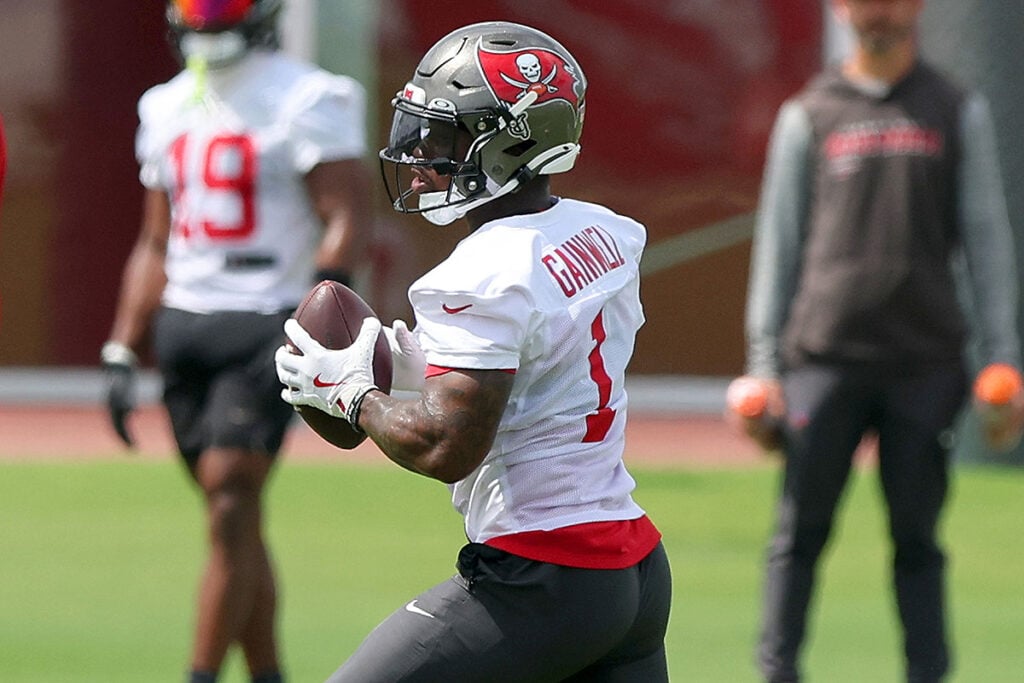
Bucs RB Kenneth Gainwell – Photo by: Cliff Welch/PR
The Memphis product is an accomplished runner, receiver and pass protector. Now he just needs to continue to immerse himself in Zac Robinson’s playbook to where he knows the scheme as good or better than Bucky Irving or Sean Tucker. That’s the key to truly getting more playing time and taking snaps away from the other backs.
Gainwell got a head start this offseason with Irving sidelined as he recovered from shoulder surgery and made a very good first impression, especially as a receiver coming out of the backfield. That needs to continue in training camp and the preseason. The more mistake-free play he exhibits the more trust he’ll build with Robinson and running backs coach Skip Peete.
RB Sean Tucker: Sense of urgency
Tucker had the most carries of his career last year with 86, which was an increase from the 50 he had in 2024. But his average fell from a team-high 6.2 yards per carry in 2024 to a pedestrian 3.7 average last year. Part of that was due to his increased usage as a short-yardage and goal line back last year where naturally his average would dip.
Yet that role did help Tucker lead the Bucs with a career-high eight touchdown runs. But despite being the fastest running back on the roster, Tucker only had three runs of 15 yards or longer last year, which matched his 2024 output in that category despite having 36 more carries. The arrival of Kenneth Gainwell and Bucky Irving’s return to health will mean limited touches again for Tucker in 2026.
So he needs to make the most of his every carry and have a “swing for the fences” mentality when he runs the ball. Tucker needs to play with an increased sense of urgency and eliminate the runs for little or gain from his play, as he’s in a contract year and will be a free agent in 2027. He needs to show that he’s essentially a starting running back trapped as RB3 on Tampa Bay’s depth chart and get his rushing average back up to over five yards per carry.
FAB 2. Where The Bucs Must Improve In Camp: Offensive Line
Now let’s took a look at the starting offensive linemen. It would be too tedious to go through all of the reserves, who truly need to improve in a multitude of ways to improve their stock and their chances of making the 53-man roster.
LT Tristan Wirfs: Consistency
Wirfs is a five-time Pro Bowler and is already an elite offensive tackle, but it takes work to stay elite. Wirfs has always been a dominant pass protector, but had a career-high 91.6 run blocking grade in 2025 per PFF.
His previous best was a 77.1 run blocking grade as a rookie in 2020, and last year was a vast improvement over Wirfs’ 62.8 run blocking grade in 2024. So the challenge for Wirfs is to maintain his dominance in both the pass and the run game on a weekly basis with consistent fundamentals and a perfectionist mindset. That needs to be his focus in camp: consistent domination.
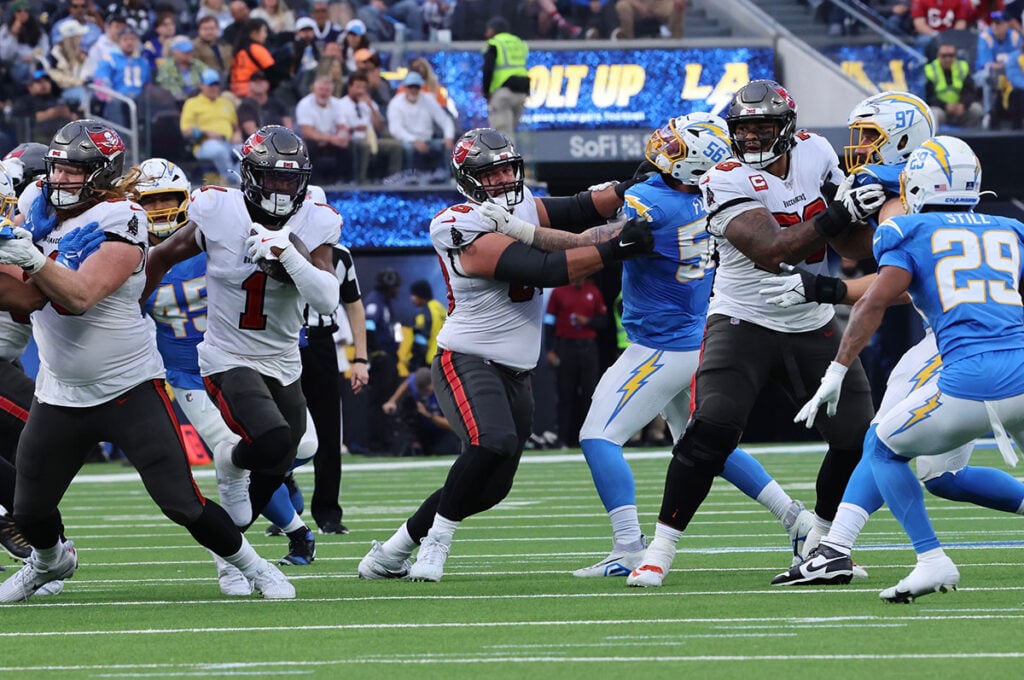
Bucs OL Cody Mauch, Ben Bredeson, Tristan Wirfs and RB Rachaad White – Photo by: Jeffrey Jones/PR
LG Ben Bredeson: Run blocking
Pro Football Focus is not the gospel when it comes to evaluating NFL players, especially offensive linemen. But it’s the best tool currently available. There was a stark contrast to Bredeson’s run blocking grades and pass protection grades last year.
He earned a 44.1 run blocking grade and a 76 pass protection grade in 2025. So whether it’s hand placement, taking the right angles, body positioning and technique, finishing blocks, or other areas, it seems like Bredeson’s run blocking as a whole could use plenty of work in training camp once the pads come on.
C Graham Barton: Core strength
On his appearance on the Pewter Report Podcast this offseason, Barton said that his goal this year is to improve his ability to anchor in pass protection. He’s spent the offseason lifting weights and getting stronger in his core and his lower body. Now he needs to combine that functional strength with great technique in pass pro.
Sometimes what hurts Barton is firing his hands a split second too late and that allows defenders to get into his chest too quickly and rock him backwards before he can anchor his lower body. So beating defenders to the punch will enable his improved core strength to kick in quicker and thus make him more effective. Seeing how Barton has improved when going up against Vita Vea in one-on-one drills will be interesting to watch.
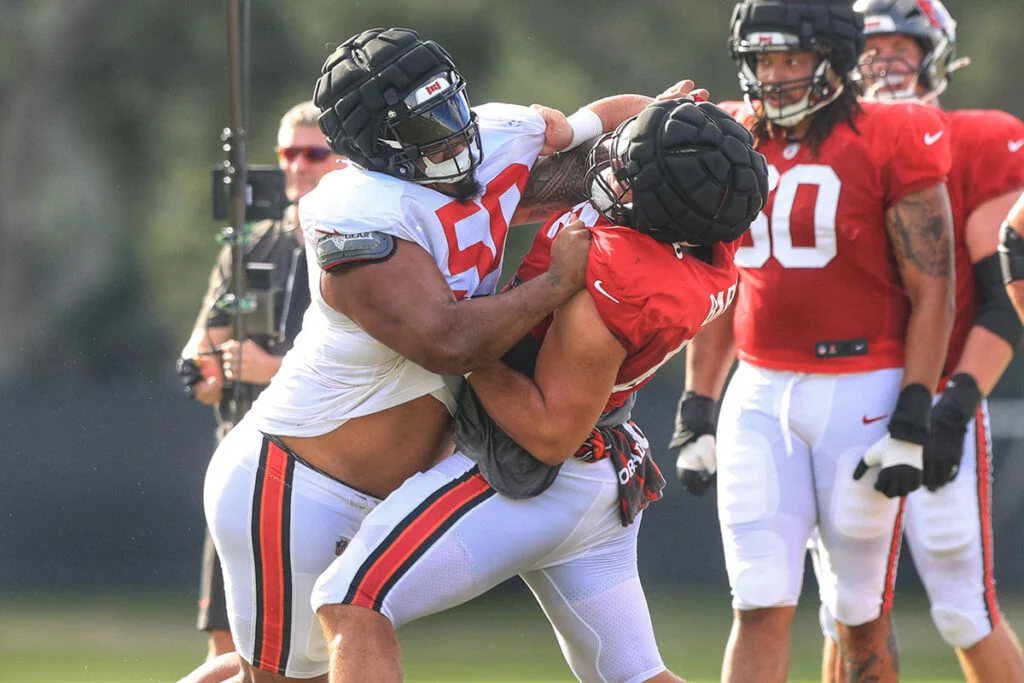
Bucs DT Vita Vea and C Graham Barton – Photo by: Cliff Welch/PR
RG Cody Mauch: Shaking off the rust
Mauch was on his way to ascending to becoming a potential Pro Bowl guard in 2025, after a very good second season in Tampa Bay. He improved his PFF grade from 43.9 as a rookie in 2023 to a 74.6 grade in 2024. He had an okay start to the 2025 season with a 63.4 grade in the first two games of last year but needs to shake off the rust of missing all but two games last season from a torn meniscus and get back to his 2024 form.
Mauch has added some needed size this year and is about 325 pounds – his biggest since becoming a Buccaneer. We’ll see how much that helps him in 2026 starting in late July. What Mauch needs to focus on is the present and the future. He needs to mentally put his knee injury behind him and play like it didn’t even happen.
RT Luke Goedeke: Pre-snap focus
Goedeke has led the Bucs in penalties in each of the last three years, and this is still after missing six games last year and four games in 2024. Goedeke’s penalties have decreased each year from 10 in 2023 to nine in 2024 to just eight last year, but again, he also missed quite a bit of time, which undoubtedly aided his reduction in penalties.
Goedeke’s biggest infraction each year are false starts. He had six in 2023, four the next season and five last year. Better pre-snap focus can help reduce or eliminate these penalties and that can begin in training camp in 11-on-11s.
FAB. 3 Where The Bucs Must Improve In Camp: Wide Receivers
Next let’s focus on the wide receivers most likely to make the 53-man roster and the areas that they need to improve in, starting with the first training camp practice on July 29.
WR Chris Godwin Jr.: Find a way to recapture explosiveness
Age and injuries have undoubtedly robbed the 30-year old Godwin of some of his speed and explosiveness. Being a full year removed from a gruesome ankle injury should help recapture a bit of his burst to make yards after the catch and that needs to continue this year as he must prove he’s still productive enough to justify his $22 million salary.
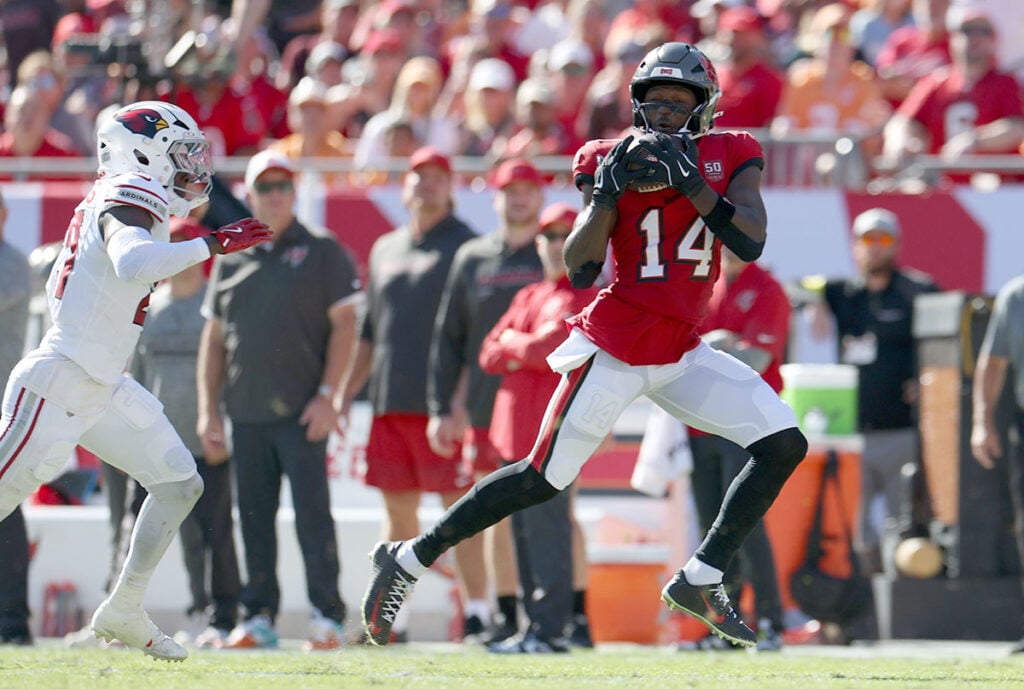
Bucs WR Chris Godwin Jr. – Photo by: USA Today
After averaging a paltry 7.6 yards per catch prior to Week 13, Godwin had a 31-yard catch-and-run against Arizona, followed by a 21-yard grab versus New Orleans the next week. In Week 17 at Miami, Godwin had a 59-yard catch-and-run in his lone 100-yard game of the season and he wound up averaging 10.9 yards per catch on the year as a result. But is that a sign of things to come?
Godwin is moving better this offseason and could possibly be getting closer to what he was in 2024 which was a receiver averaging 11.5 yards per catch. He’s smart enough and experienced enough to win in the slot against nickelbacks, linebackers and safeties. Godwin just needs to be able to show a little more juice and be more than a chain-moving possession receiver in 2026 to justify sticking around as a high-priced receiver next year.
WR Emeka Egbuka: Beat man coverage
Egbuka had a sensational rookie season in 2025 as the team’s first-round pick, leading the Bucs in catches (63), yards (938) and touchdowns (six). It would be easy to point out stamind as the area in Egbuka’s game that needs to be worked on so he can finish, as he had all six of his TDs in the first nine games of the season – and didn’t have a game with more than 64 yards receiving over the final eight games of the year.
But Egbuka has already worked on his conditioning this offseason to help in that area. And it should be noted that he was coming off an extended college year in which Egbuka won the national championship at Ohio State as a senior, which explains why he hit a rookie wall and his production faded down the stretch.
The area that needs the most work is beating man coverage, as Egbuka thrived in zone. Working on his route-running and learning to better snap off his routes will help him create more separation, and thus be a more effective receiver in man coverage in 2026.
WR Jalen McMillan: Continue to get open
While Emeka Egbuka struggled against man coverage last year, McMillan thrived against it. He got open versus man coverage at a higher rate than any other Bucs wide receiver. McMillan only played in the last four games of the season in 2025 after recovering from a fractured neck injury he suffered in August, but hauled in 12 catches for 178 yards for an impressive 14.8-yard average. He also recorded his first 100-yard game as an NFL receiver at Miami.
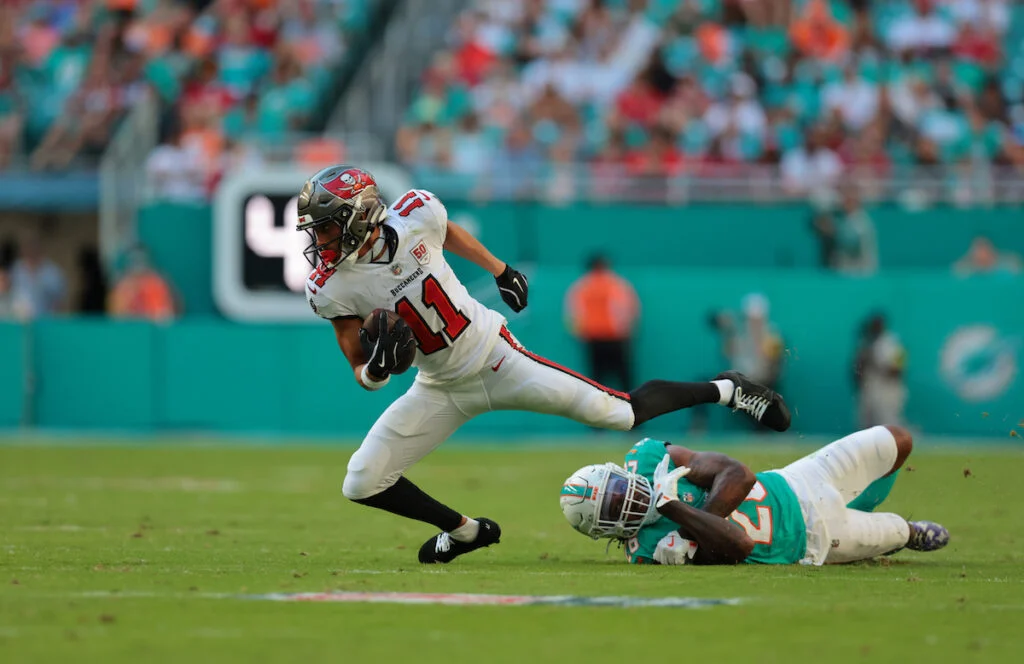
Bucs WR Jalen McMillan – Photo by: IMAGN Images – Sam Navarro
McMillan might get lost in the shuffle a bit with a $22 million receiver in Godwin ahead of him on the roster, in addition to Egbuka, last year’s first-round pick. But Baker Mayfield has shown the willingness to throw to the open receiver and doesn’t discriminate. If McMillan is open, he’ll get the ball. Just as he did at the end of his rookie season when he finished with seven touchdowns in the final five games of the 2024 campaign.
McMillan needs to continue to refine his routes and become a better technician as a receiver. He has the natural twitchiness that allows him to create separation. McMillan can enhance that with attention to detail in training camp and become an even more effective man-beater on the perimeter.
WR Ted Hurst: Continue to prove you’re ready
We’ll add one rookie to this group because Hurst, the team’s third-round pick, will make the 53-man roster and see some playing time as a rookie. However, the Bucs don’t need Hurst to be a big contributor as a rookie. There are currently four receivers ahead of him on the depth chart in Chris Godwin Jr., Emeka Egbuka and Jalen McMillan.
Yet at this time last year, Egbuka was WR4 on the depth chart, and due to injuries, he wound up leading the Bucs in catches, yards and touchdowns. So Hurst needs to be prepared for a similar situation just in case injuries at the receiver position strike again. The good news is that he made a strongly favorable impression right out of the gate in the rookie mini-camp, OTAs and the mandatory mini-camp with several eye-opening catches.
Hurst’s hands and route-running ability were better than expected coming from Georgia State and he’s shown early signs that he can certainly contribute and earn quite a bit of playing time during his rookie season. That trend needs to continue when the pads come on, and he needs to shine under the lights in the preseason in August. If those things happen, Hurst will see plenty of action in 2026.
WR Tez Johnson: Master the playbook
Johnson hit the ground running last year as a rookie receiver, finishing with five touchdown catches, which was second on the team behind Emeka Egbuka’s six. Those five scores equaled the combined touchdown production of both Mike Evans (three) and Chris Godwin Jr. (two) last year. When the Bucs spent a seventh-round pick on Johnson they expected him to be WR5 on the depth chart last year behind Evans, Godwin, Jalen McMillan and Egbuka.
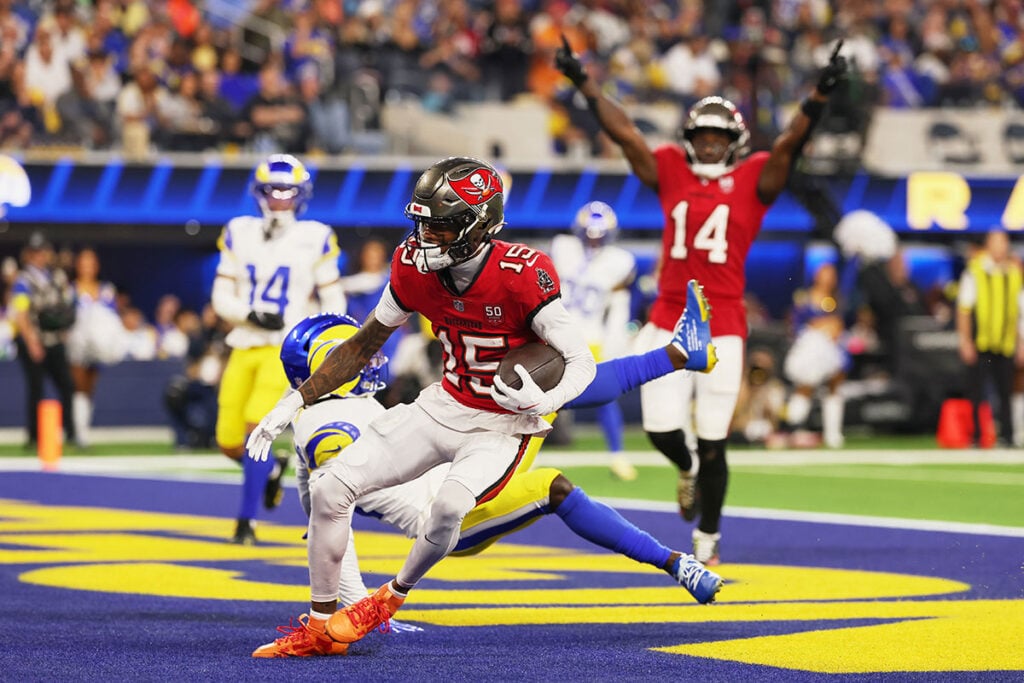
Bucs WR Tez Johnson – Photo by: USA Today
But injuries to Evans, Godwin and McMillan meant than Johnson saw plenty of action – even more playing time than the team envisioned. Johnson wound up starting eight games and was at times WR2 due to the myriad of injuries at the receiver position. While he hauled in 28 catches for 322 yards (11.5 avg.), Johnson made plenty of rookie mistakes, too.
Those mistakes led to running the wrong routes and either not getting the ball or leading to incompletions when Johnson broke off his routes at the wrong depth. There were even some instances where his mistakes caused him to run too close to other receivers, which led to entire plays being blown up and wasted. Those rookie mistakes were understandable and forgiveable – last year. But Johnson needs to show he can be a student of the game and be assignment-sound.
WR Kam Johnson: Improve as a returner
Johnson made the 53-man roster as WR6 on the depth chart, and lived up to the promise he showed during an injury-riddled rookie season. Staying healthy for all 17 games in his second season in Tampa Bay, Johnson won the kick and punt returner positions and led the Bucs in both categories. He also caught his first touchdown last year in a key win against San Francisco, and finished the year with four catches for 64 yards, as well as two end-arounds for 13 yards.
The Bucs don’t need Johnson to be a dynamic force at wide receiver. There are five more talented and more accomplished receivers ahead of him on the depth chart. That’s not to say that he couldn’t – or shouldn’t – develop as a receiver on offense during training camp and the preseason. The better and more well-rounded a player is, the more likely they are to make the 53-man roster.
But Johnson won a roster spot due to his return ability and that will be how he remains a Buccaneer in 2026 if that is his fate. He averaged a respectable 11 yards per punt return and a 25.4-yard average on kick returns. Tampa Bay has a new special teams coordinator in Danny Smith, so Johnson will have to prove himself all over again this year and really make some even more dynamic returns in practice and the preseason to keep his roster spot.
FAB 4. Where The Bucs Must Improve In Camp: Tight Ends
The Bucs tight ends figure to be more involved in the passing game in 2026, but exactly how much more depends on what happens in training camp and how each tight end improves.
TE Cade Otton: Run blocking
Otton signed a three-year, $10 million contract extension because he does two things well. First, he’s available and plays a high amount of snaps. Otton has missed just four games over the past three seasons, making him very reliable. Second, he does a lot of things well. Not great, but well. He’s versatile enough to be an effective receiver and a blocker, but he’s better as a pass blocker than he is as a run blocker.
He could still use some work in that area of his game, as he earned a 56.1 run blocking grade from PFF last year after posting a career-high 65.2 run block grade in 2024. Otton is a willing blocker who uses pretty good tehcnique, but could generate more power at the point of attack to get movement off the line of scrimmage, and as a run-blocking finisher this year.
TE Payne Durham: Show something as a receiver
The good news for Durham is that he has spent the last two seasons really honing in on his role as a primary blocking tight end. He’s carved out a spot on the roster as Tampa Bay’s TE2 as a result. While he’s passed Ko Kieft on the depth chart, Durham has become very one-dimensional and backed himself into a corner with his lack of versatility.
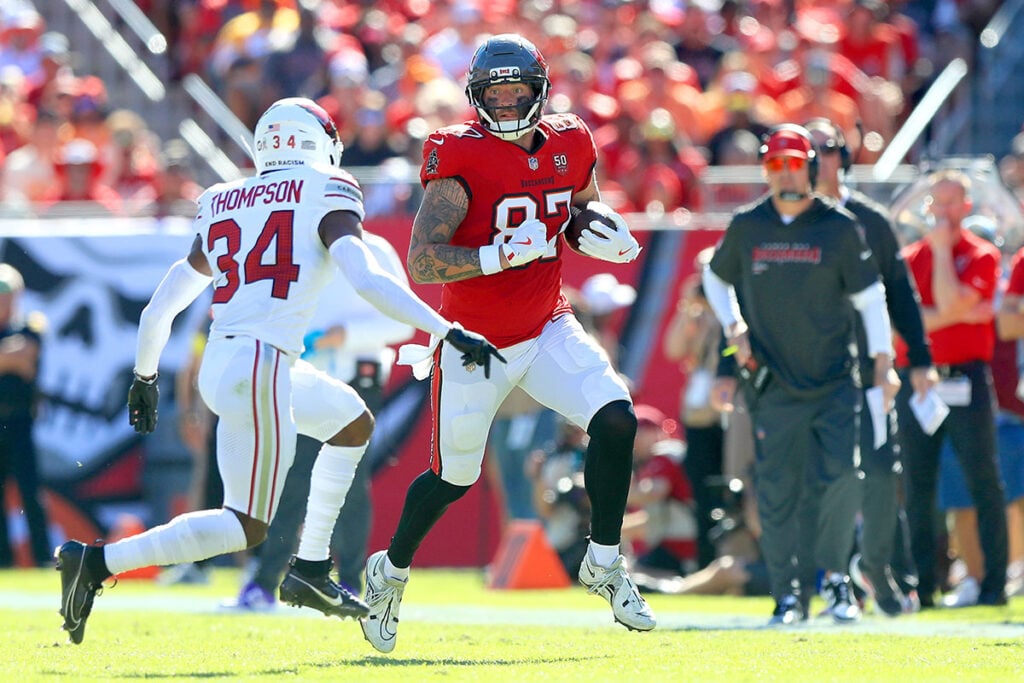
Bucs TE Payne Durham – Photo by: Cliff Welch/PR
Durham is entering a contract year and needs to really increase his value to the team and his worth on the free agent market by being more versatile. While he lacks ideal speed to be a dynamic playmaker on offense, what Durham can do is become a reliable receiver. Even though he may not deliver yards after the catch, Durham is in a situation where he needs to at least catch everything his way during training camp to help his cause.
TE Bauer Sharp: Continue to find the end zone
Sharp, the team’s sixth-round pick, is the second rookie to make this list within this SR’s FAB 5. Why? Because all he did during the rookie mini-camp, OTAs and mandatory mini-camp was get open and score touchdowns. Sharp scored more touchdowns in practice in Tampa Bay in May and June than he did the last two years at Oklahoma (tw0) and LSU (two), which opened plenty of eyes on the coaching staff and in the personnel department.
Sharp is known to be a complete a tight end who is adept at blocking as well as being a good receiver. He appears to be the closest thing to starter Cade Otton that the Bucs have on the roster. He’s a high-energy tenacious player who is expected to excel when the pads come on. Sharp will likely push Devin Culp off the roster, and if he proves to be a quality receiver who continues to show a nose for the end zone he could move up the depth chart past Ko Kieft and Payne Durham this August and contend for TE2 duties.
TE Devin Culp: Finally become a blocker
Culp generated a lot of buzz when the Bucs drafted him in the seventh round in 2024, especially after he blazed a 4.47 time in the 40-yard dash. But that speed has failed to translate into success on the gridiron. In two seasons under two different offensive coordinators, Culp’s inability to block has prevented him from getting on the field and only resulted in six catches for 94 yards (15.7 avg.) including one touchdown, which came on his lone catch during the 2025 season.
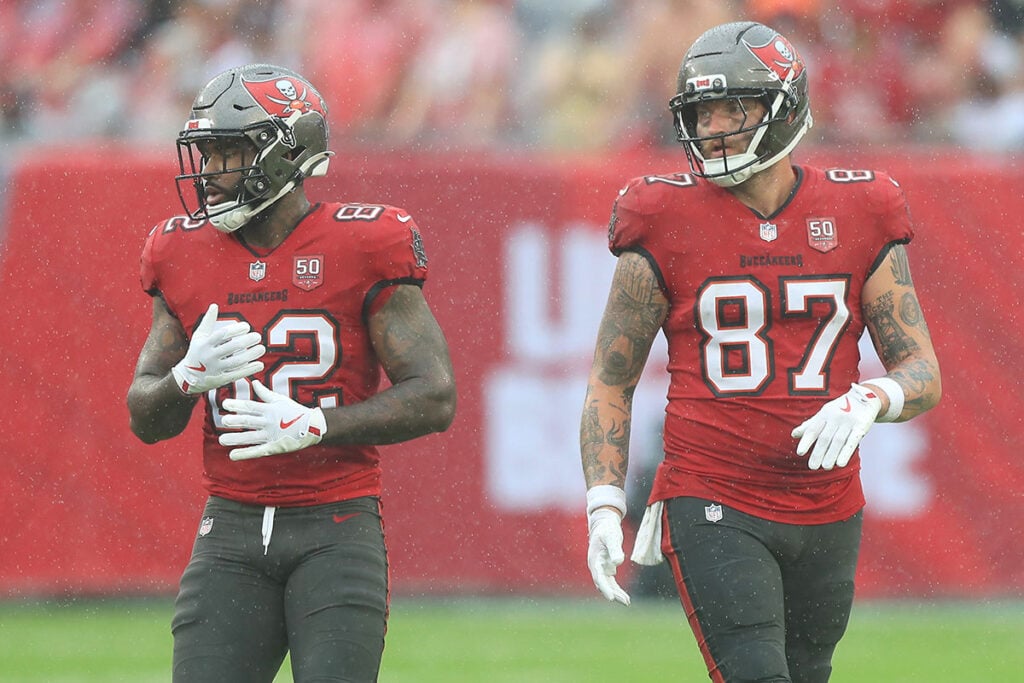
Bucs TEs Devin Culp and Payne Durham – Photo by: Cliff Welch/PR
Culp, who was a backup tight end at Washington, needs to have a breakthrough training camp and show that he has the strength and improved technique to be more than just pigeonholed on the roster as a receiving tight end. Culp also must prove that he can be an effective contributor on special teams. Rookie Bauer Sharp was one of the most impressive players during the OTAs and mini-camp, which Culp missed due to a hamstring injury. Culp needs the camp of his life to stay on the roster.
TE Ko Kieft: Prove to be a dominant special teamer
Kieft has shown that he’s not much of a receiver in his four seasons in Tampa Bay. He’s just never developed his hands to the point where he can consistently catch the ball, nor can he consistently get open as a route runner. But he’s a strong, effective blocker in the running game, although his presence on the field is usually a tell to the opposing defense that the Bucs will be running the ball.
Kieft was re-signed on a cheap, one-year deal to improve the team’s coverage units on special teams. That’s an area that took a hit when he was lost for the year early in the season due to a broken leg. With a new special teams coordinator in Danny Smith, Kieft will have to maintain his reputation as a core special teams player and one of the unit’s top tacklers. Kieft isn’t just competing against other Bucs tight ends for a roster spot, he’s actually competing with linebackers, edge rushers and safeties for a special teams spot.
FAB 5. Where The Bucs Must Improve In Camp: Special Teams
Rounding out this week’s SR’s FAB 5 with where the team’s top special teamers must improve heading into the 2026 season.
K Chase McLaughlin: Focus on the field, not the money
The Bucs are either going to let McLaughlin play out his contract year or they’ll extend his contract in August prior to the start of the 2026 campaign. Either way, the man known as “Money” McLaughlin due to his ability to come through with clutch kicks, needs to just focus on putting kicks through the upright rather than a looming pay day.
P Riley Dixon: Speed up the process
Dixon had two punts blocked last year, including one returned for a touchdown in a one-score loss to Philadelphia. While the Bucs special teams blocking was subpar last season and contributed to Dixon’s plight, the veteran punter was too methodical at times in his delivery and needs to show a greater sense of urgency when punting the ball. He needs to speed up his process, and hopefully new special teams coordinator Danny Smith can help make that happen in camp.
LS Evan Deckers: Show you’re still the man
Deckers, a third-year long snapper, enters training camp as the team’s two-year starter. He’s done a reasonably well job as a long snapper on punts, field goals and extra points, but he’ll have to beat out Scott Daly, a newcomer who was signed to be camp competition. The number one trait a long snapper can have is reliability, and that needs to be Deckers’ focus in August.

Scott Reynolds is in his 30th year of covering the Tampa Bay Buccaneers as the vice president, publisher and senior Bucs beat writer for PewterReport.com. Author of the popular SR's Fab 5 column on Fridays, Reynolds oversees web development and forges marketing partnerships for PewterReport.com in addition to his editorial duties. A graduate of Kansas State University in 1995, Reynolds spent six years giving back to the community as the defensive coordinator/defensive line coach for his sons' Pop Warner team, the South Pasco Predators. Reynolds can be reached at: [email protected]
 Point-Counterpoint: Which New Bucs Player Will Have The Biggest Impact?
 Is 2026 The Year Yaya Diaby Reaches Double-Digit Sacks?