
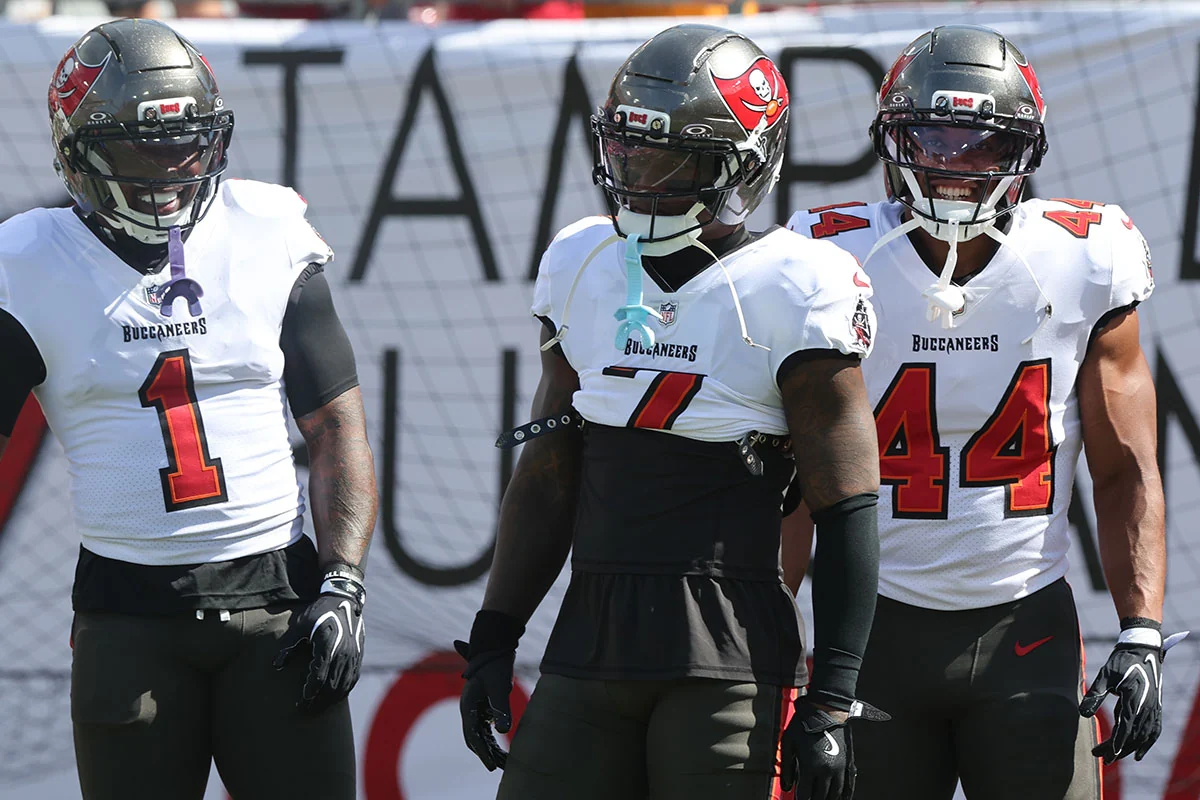
There is plenty to criticize about the Bucs’ offense approaching the midway point of the season, but one bright spot is becoming increasingly difficult to overlook: Tampa Bay’s success on the ground.
While the Bucs have the NFL’s worst passing attack, averaging just 150.4 yards per game, their rushing offense has emerged as one of the league’s best. Tampa Bay ranks second with 1,025 rushing yards and third with 146.4 rushing yards per game. Under offensive coordinator Zac Robinson, establishing the run has quickly become the offense’s identity, helping power recent wins over the Cowboys and Panthers.
In this week’s Slivon’s Slant, I take a closer look at an underrated trend fueling the Bucs’ success on the ground, with exclusive insight from tight end Bauer Sharp on how it’s making a difference.
Bucs Opting For Heavier Personnel Sets Is Working Wonders For Run Game
Watching the Bucs run wild for 241 yards in Dallas in Week 5 and 258 yards in Carolina in Week 7 had me thinking.
What changed compared to earlier in the season?
One adjustment stood out, and that is Zac Robinson deploying 12 and 13 personnel sets at a much higher frequency. That means using two tight ends (12 personnel) or three tight ends (13 personnel) alongside a running back, giving Robinson more blocking muscle without necessarily sacrificing versatility.

Bucs TE Payne Durham – Photo by: IMAGN Images via Reuters Connect
Pulling the numbers from SumerSports helps explain why. Between Weeks 1-4, Tampa Bay only ran 12 personnel on 39 plays and 13 personnel on seven plays. Much of that came in Week 3 against Minnesota, as Robinson utilized extra tight ends in an attempt to neutralize Vikings defensive coordinator Brian Flores’ blitzes.
Since Week 5, 12 and 13 personnel sets are becoming more of an offensive staple.
Week 5: 22 total plays from 12 personnel, 1 play from 13 personnel
Week 6: 21 total plays from 12 personnel, 3 plays from 13 personnel
Week 7: 18 total plays from 12 personnel, 11 plays from 13 personnel
It might seem like a minor schematic wrinkle, but it has paid dividends in setting up running backs Bucky Irving, Kenny Gainwell, and Sean Tucker to find more running room and rack up yards. After averaging just 1.42 yards per carry on 19 attempts running 12 personnel between Weeks 1-4, that number has spiked to 6.13 on 48 attempts running 12 personnel between Weeks 5-7.
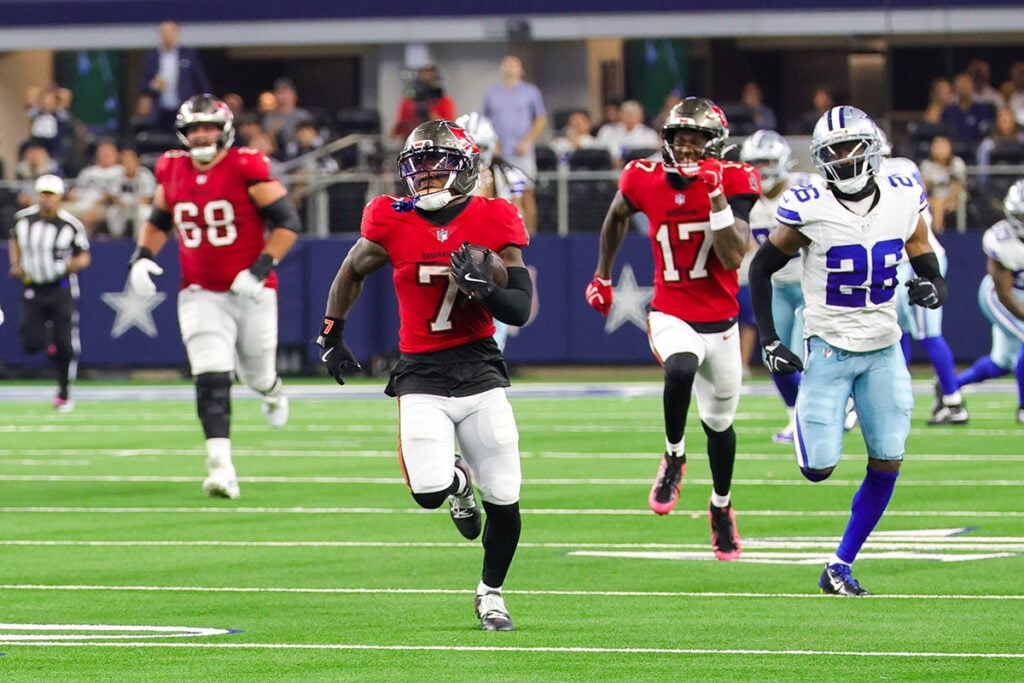
Bucs RB Bucky Irving – Photo by: IMAGN Images via Reuters Connect
That includes a success rate — measured by plays generating positive expected points added (EPA) — that has jumped from 10.5% to 41.7%, along with six runs of at least 12 yards, two touchdowns, and picking up 10 first downs.
I’m not trying to nerd out with too many numbers here, but it is obvious that involving tight ends Payne Durham and Bauer Sharp has brought a noticeable spark. On Tucker’s 46-yard touchdown run in the last game, Sharp did a pre-snap motion to the left, with Durham pulling to take on inside linebacker Bobby Okereke. By putting more tight ends on the field, Robinson can force defenses to account for additional blockers while still using motion and formation changes to create favorable angles in the running game.
It was a textbook setup to spring Tucker to the end zone.
Bauer Sharp, Payne Durham, Tristan Wirfs, Ben Bredeson pic.twitter.com/cCmrC2gAsf
— Josh Queipo (@JoshQueipo_NFL) October 25, 2026
Just throwing it out there, but Cade Otton isn’t too shabby of a run blocker, either.
Don’t take my word for it?
That was one of Trevor Sikkema’s biggest takeaways after watching the Bucs put up 43 points on the Panthers.
My goodness. This Cade Otton blocking tape from yesterday is a CLINIC. This man was putting up impact blocks against Devin Lloyd, Patrick Jones, Derrick Brown, Tre'von Moehrig, you name it. What a game
— Trevor Sikkema (@TampaBayTre) October 26, 2026
During his Thursday press conference, I asked Robinson how having extra tight ends on the field has added versatility to the running game.
“All those guys can block,” Robinson said. “Cade [Otton] is a great blocker. He can do everything. Then Payne [Durham], you mentioned the physicality at the line of scrimmage, and Bauer [Sharp] has done a great job. I mean, he is not scared. He’ll go in there, he’ll throw his face in the fan, and he’s had some opportunities to do so, and he’s handled it every time he’s been out there. So, we’ve got to keep giving him opportunities.
“Obviously, every week is different in terms of what you’re trying to attack or what you think the best way to attack is. Is it 12, 13, 11? You know, all those different mixes you’re trying to figure out from a game plan standpoint. I love the way that those guys have been playing at the tight end spot, and we’ll keep kind of elevating and seeing where it can go.”
Zac Robinson Setting The Tempo Early In Games Has Helped Bucs Offense, Too
After calling out the Bucs’ offensive identity crisis in last week’s column, there is finally a clearer picture of what this unit can be.
While much of early-game play sequencing has brought frustrating results this season, Zac Robinson proved he didn’t just have a one-hit wonder in Dallas. Tampa Bay’s first offensive drive in that game went 15 plays and took nearly 11 minutes off the clock. The first offensive drive in Carolina was similar, going 14 plays and taking up over half the first quarter clock. Of those 14 plays, Bucky Irving had 10 carries for 47 yards, capping off the drive with a touchdown.
Setting the tempo early in each game helps make any quarterback’s job easier, especially in unique situations.
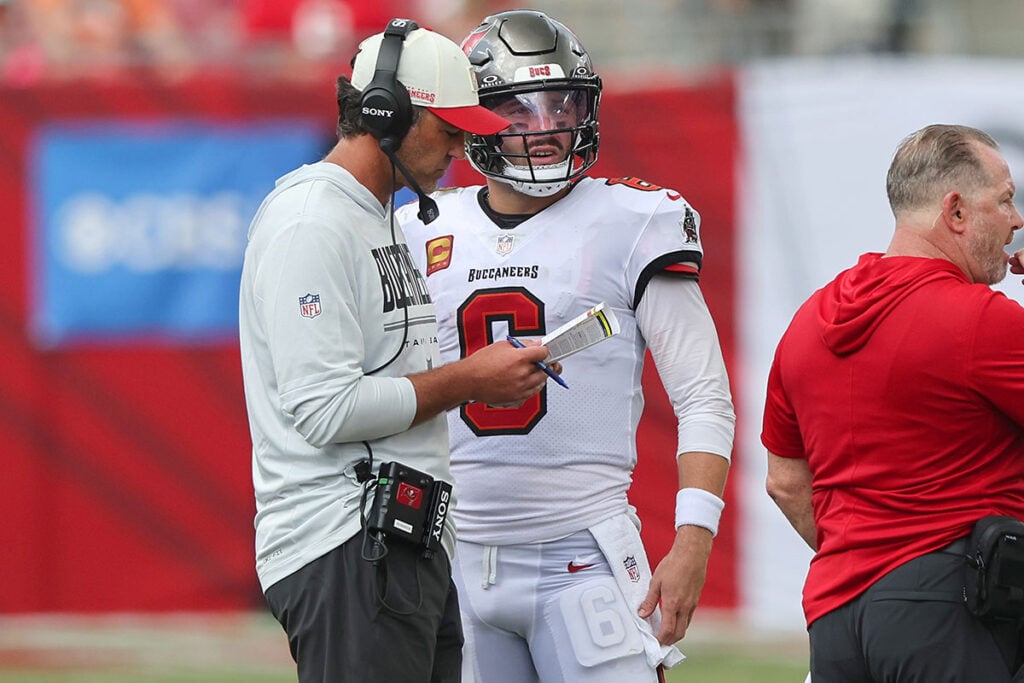
Bucs OC Zac Robinson and QB Baker Mayfield – Photo by: Cliff Welch/PR
Establishing the run complemented Jalon Daniels when he had to pass, as the undrafted rookie looked like a savvy veteran in his first NFL win. When Baker Mayfield returned to action this past week, he didn’t have to do much besides handing the ball off. Taking pressure off the passing game could position it for future success, especially as Mayfield has a game under his belt and can start airing it out a bit more.
It is important to note that I am not completely sold on this turnaround just yet.
They put up their best rushing performances of the season against a 31st-ranked Cowboys run defense and 27th-ranked Panthers run defense. In between those games, Irving was held to just 2.4 yards per carry against a 13th-ranked Steelers run defense. Given that Tampa Bay faces a fourth-ranked Falcons run defense on Sunday, this will be a big test in proving they can have success against better outfits.
With rain expected to play a significant factor in altering each team’s approach, that makes it even more critical for the Bucs’ offensive line (and tight ends) to impose their will up front and control the line of scrimmage.
Bauer Sharp Discusses Increased Playing Time, Progress During Rookie Year
One of the biggest beneficiaries of Zac Robinson’s personnel adjustments has been rookie tight end Bauer Sharp, who is getting an opportunity to make an impact without needing the football in his hands. Sharp might only have one catch this season (for 21 yards), but he is making his presence known in other ways. As noted above, Sharp is holding up well as a blocker and is a core special teamer on Danny Smith’s unit.
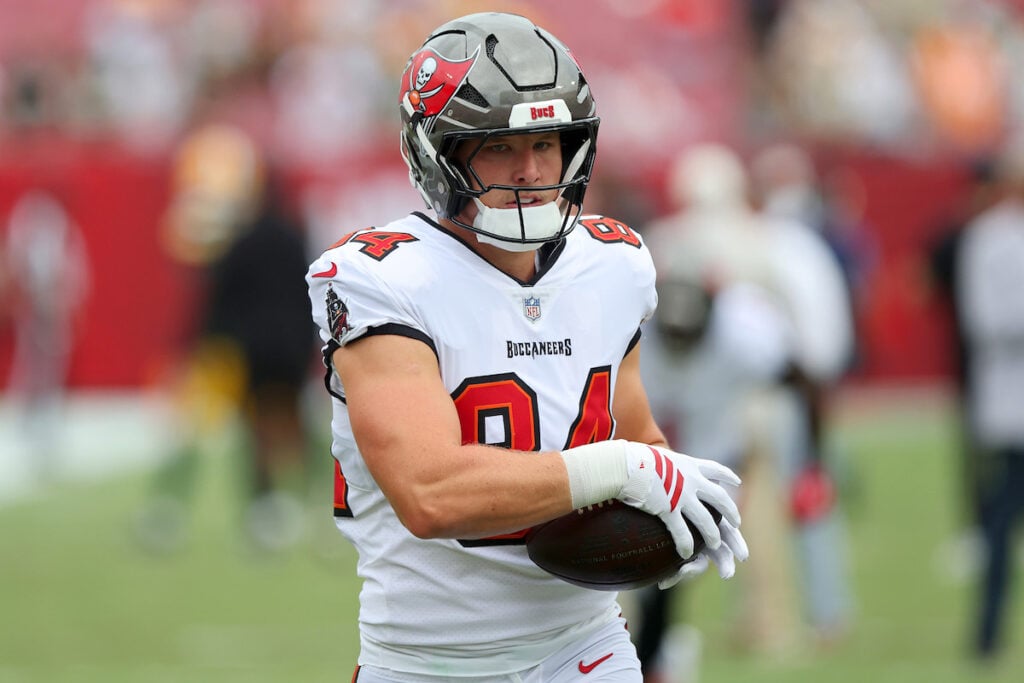
Bucs TE Bauer Sharp – Photo by: Cliff Welch/PR
When I spoke with Sharp this week, he made it clear that he’s enjoying his increased offensive role, regardless of what he’s asked to do.
“I mean, it’s a blast,” Sharp said. “Fun is an understatement, you know, playing with those guys. But yeah, that’s just what we do, put it on our backs. Whatever they ask us to do, we’re going to do it the best of our ability.”
Sharp has put his head down and worked hard to help establish the run, playing with a tenacious edge to take any assignment on.
“I mean, that’s kind of the motto of our team,” Sharp added. “We got three dang good running backs in the backfield. So, whatever they ask us to do, we’re going to block for those guys and open up the holes so they can do what they do. We want to be the more physical team from the first half of the game to the last. And so, if we can do that, establish the run, I think, you know, things will work out.”
Many sixth-round picks fail to make much a dent in their first NFL season. Tampa Bay’s decision to trade up on Day 3 to select Sharp was a bet on his physical traits and potential as a player who was still finding his footing as a tight end after starting his college career as a quarterback. Going forward, he shared with me his focus for the rest of his rookie year.

Bucs TE Bauer Sharp – Photo by: Cliff Welch/PR
“I’ve been really taking pride in how I prepare for this game. So that, I mean, it can’t slow down for me as I’m progressing and become an older player here in the future, you know? The goal is to execute my job and what they ask me to do to the best of my ability and ultimately be the best teammate I can be.”
Sharp is still developing, but he is leaning on and learning a lot from the other tight ends in the room.
“87, Payne, you know, is my guy. He’s awesome. He’s a good leader. And Cade, Cade’s outstanding — probably the best guy I’ve ever met in my entire life. You know, even Ko, like, I was telling my dad the other day, like, I’m blessed to be in a room with the guys that I was blessed with, if that makes sense.
“It doesn’t really come regularly that these tight ends that I’m here with, these vets, are as nice and inviting as they really are for a rookie. I do not take it for granted at all. I soak it all in every single day, and they probably get tired of how many questions I ask. But yeah, they’re awesome.”
Closing Slant
Zac Robinson has been under fire for much of the season, but he deserves credit for making adjustments and finding a formula that has helped the Bucs’ running game take off.
Leaning into heavier personnel sets might not be the flashiest way to move the football, but it is proving to be an effective one.
Tampa Bay’s tight ends are doing the dirty work, and the running backs are reaping the rewards. The offense is finally dictating terms to opposing defenses instead of playing into their hands. Perhaps most encouraging is that the Bucs aren’t relying on one running back to carry the load. Bucky Irving, Kenny Gainwell, and Sean Tucker have each benefited from the physicality up front, and the emergence of Payne Durham and Bauer Sharp as reliable blockers has given Robinson more ways to keep defenses guessing.
Of course, beating up on two of the NFL’s worst run defenses is one thing. Doing it against the Falcons’ fourth-ranked unit is another. Sunday will reveal just how sustainable this approach really is.
The Bucs still have plenty to figure out through the air, and they are not going to bulldoze their way past every opponent. Still, for an offense that spent much of the first half of the season searching for answers, establishing a physical identity is a meaningful step forward.
If Tampa Bay’s tight ends keep opening holes and making life miserable for opposing defenders, perhaps the biggest key to unlocking this offense won’t be a new wrinkle in the passing game.
It might just be putting another tight end on the field.

Adam Slivon has covered the Tampa Bay Buccaneers for five seasons at PewterReport.com, serving as a Bucs beat writer, social media manager, and podcaster. He joined Pewter Report as an intern during the 2022 season while studying Sport Management at the University of Tampa, graduating in May 2023. His reporting includes covering practices and press conferences, conducting exclusive player interviews, and breaking news on the Bucs.
In addition to his written coverage, Adam regularly appears on the Pewter Report Podcast, hosts a weekly YouTube series, Top 10 Takeaways, and manages Pewter Report's social media platforms.
A Wisconsin native, Adam spent his entire childhood growing up on a farm. In his free time, he enjoys watching the Brewers and playing sports video games. His Pewter Report colleagues call him "Sly" - which is a fitting nickname for someone whose favorite actor is Sylvester Stallone.
Follow Adam on X at @AdamLivsOn.
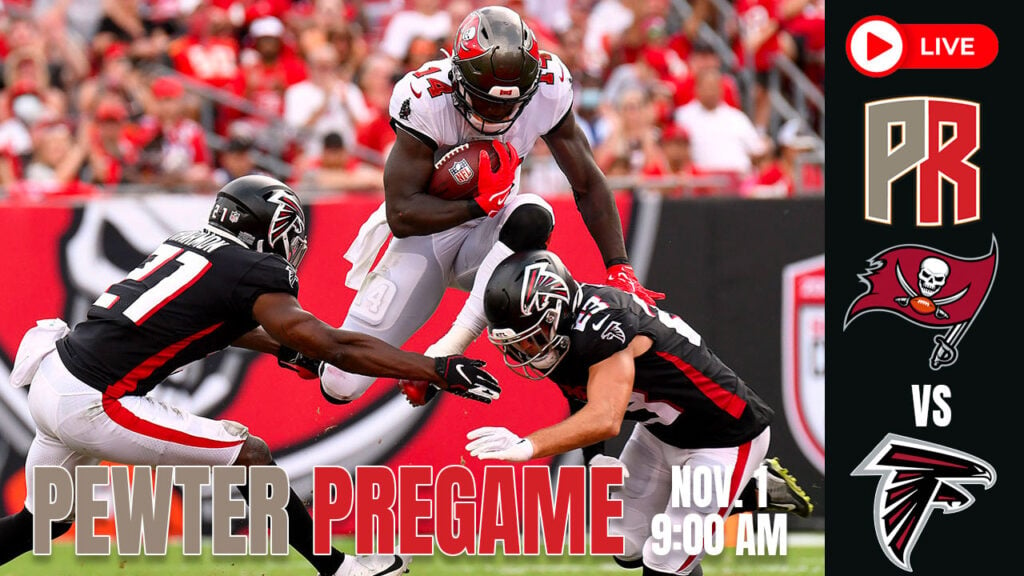 Pewter Pregame: Bucs vs. Falcons - Watch TOMORROW 9 AM ET
 Bucs Record Watch 2026: Week 8 vs. Falcons