
In the NFL, Cover 4 refers to a defensive coverage that aims to cover four deep zones on the field. Following that lead, I’m going to provide you with the same coverage of the Bucs – your favorite football team. Each Wednesday morning I’ll cover four areas as they apply to Tampa Bay: 1. a short film breakdown, 2. a finance angle, 3. a look forward at what’s to come, and 4. a bit of fun.
Film: Elijah Roberts’ Sophomore Season
Elijah Roberts had a strong rookie season. Especially for a fifth-round pick. Due to Calijah Kancey’s injury Roberts was thrust into a bigger role, playing over 500 snaps. And Roberts showed the pass rushing chops that had Tampa Bay interested in him when he was an edge rusher at Southern Methodist University. Roberts had 23 pressures and two sacks in his first professional season.
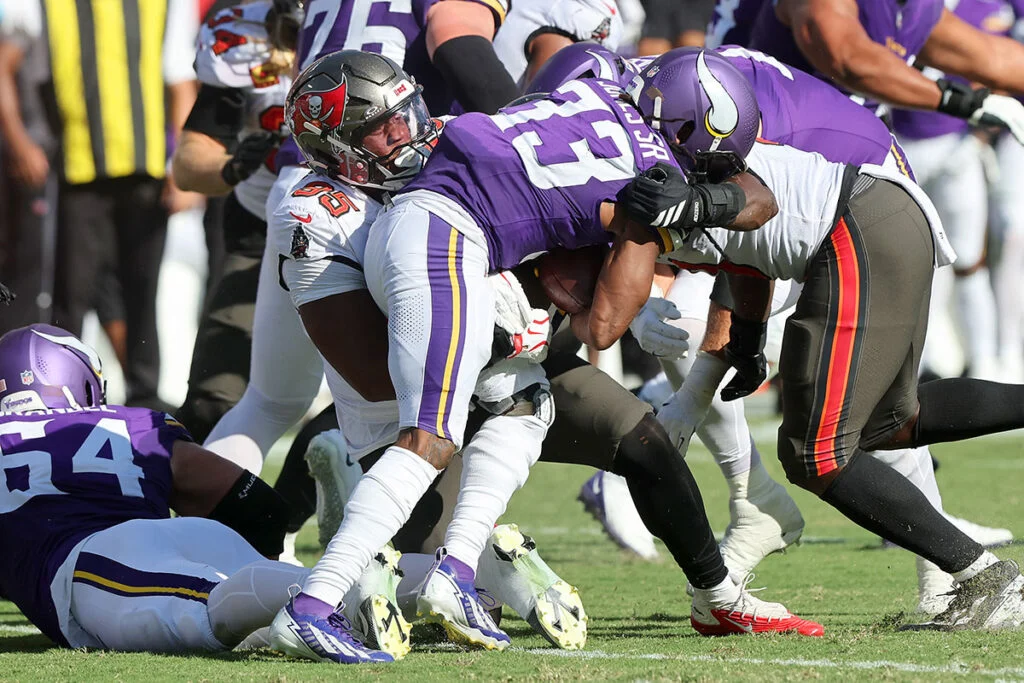
Bucs DT Elijah Roberts – Photo by: Cliff Welch/PR
The Bucs were hopeful he would continue to put pressure on quarterbacks in his sophomore season as part of an improved two-deep depth chart along the Bucs’ defensive front. But the production as a pass rusher has been conspicuously absent through the first nine games of the season. He has just two pressures and no sacks over 54 pass rushes as his pressure rate is half of what it was last year.
What’s changed with Roberts? And has he improved in any other facets of his game?
Pass Rushing
Part of the change has been in usage. Last year Roberts played on obvious pass situations (second-and-long + third down) 11.8 snaps per game. With Kancey healthy and A’Shawn Robinson added to the roster those opportunities have dropped significantly to just 3.4 per game. With fewer chances come less opportunities to get into a groove, set up a pass rush plan, and learn his opponent’s tendencies to counter them.
That can account for some of the change in his get-off. Next Gen Stats measures his get off this year at 1.10 seconds. That’s almost a tenth of a second slower than last year.
In addition, the tape is out on Roberts, and he hasn’t found a changeup yet. Roberts’ big winner in 2025 was his hand fighting. He kept guards off his chest by swatting their punches and often displaced them with a powerful club move. This year he continues to try those maneuvers, but offensive linemen are ready for those attacks.
As a converted EDGE, Elijah Roberts lacks the power to consistently win with a bull rush. Since entering the league in 2025, he is still searching for a complement to his quick hands and club move. https://t.co/vmQl6Tc6L2
— Josh Queipo (@JoshQueipo_NFL) November 19, 2026
Run Fitting
While Roberts’ hasn’t improved as a pass rusher and his production has fallen off as a result, he has made strong strides as a run defender. His stop rate has improved from just over 2.0% last year to 7.6% this year. And with that improvement, the Bucs have trusted him on run downs more. Roberts’ run defense snap share has moved from 35% to 49% year over year.
Roberts’ anchor is noticeably stronger this year. He isn’t getting displaced by doubles nearly as often. As a matter of fact, Roberts is starting to find ways to not just stalemate doubles, but beat them by splitting them.
Elijah Roberts splitting the double team for a TFL. https://t.co/BkXICxO4ND
— Josh Queipo (@JoshQueipo_NFL) November 19, 2026
His best trait as a run defender is when working against wide zone. Roberts has an impressive ability to get lateral, working ahead of reach blocks, using arm-overs to work against offensive linemen angles, and back-dooring blocks to find ways to penetrate gaps and find his way to ball carriers.
Roberts has turned into a player the Bucs can use on all three downs, but the lack of progress as a pass rusher is concerning. The Bucs should try to find more opportunities for him to work on pass-obvious downs and I would love to see more reps with him and Calijah Kancey working together on the inside.
Finance: Finding The Bucs An X Receiver In 2027
Thanks to extensions they handed out to Baker Mayfield and Vita Vea on the eve of the 2026 season, the Bucs won’t have much in the way of extra cash for the 2027 season. They will have to fill holes on their roster by finding underrated players on cheap deals in addition to their draft resources. One of their most glaring needs at this point in time is an X receiver. I still have high hopes for Ted Hurst III’s development. But it is smart to add options and diversify their strategy of filling roster holes.
There are going to be some talented options in the draft, but if the Bucs want to keep their options open and find an affordable option who can play on the line, helping put Emeka Egbuka in the best spot to succeed, there is an intriguing option who is a pending free agent in 2027. He’s a 6-foot-2 and 225-pound former first-rounder who should be available for less than $8 million.
Treylon Burks has made some highlight reel plays since leaving Tennessee for the bright lights of Washington. Burks’ statistical profile is modest for sure. He’s played in 15 games, catching 24 of his 45 targets for 390 yards and three touchdowns. But under the surface Burks has performed well this year in the role the Bucs need to improve their receiver room.
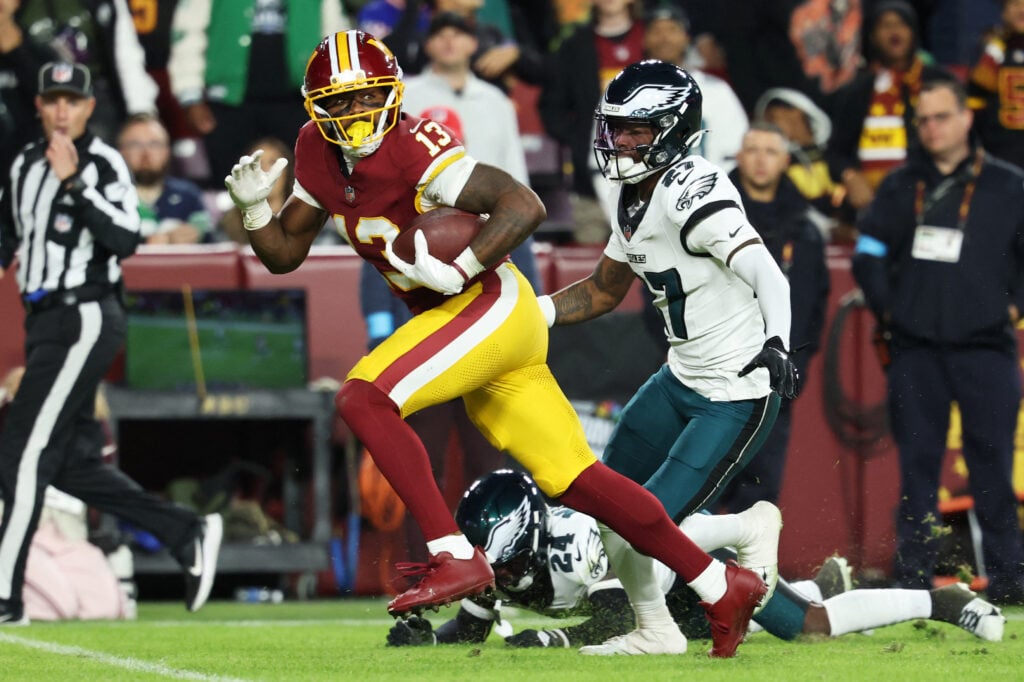
Commanders WR Treylon Burks – Photo by: IMAGN Images via Reuters Connect
It’s a small sample size, but Burks has performed well on the line this year. Over 106 routes he has 12 catches on 18 targets for 245 yards and two touchdowns. His 2.31 yards per route run is 18th among all receivers.
It’s not an exciting proposition, but $5 million plus incentives on a one-year deal for a 26-year old who can push Hurst and help the rest of the receiver room line up in their best positions is a smart move at the margins that can upgrade a passing game that is struggling.
Forecast: The Bucs Will Try To Extend Graham Barton
The Bucs will have limited funds to improve their roster in 2027. They will need to replace the potential loss of several key starters such as Cody Mauch, Yaya Diaby, A’Shawn Robinson and Chris Godwin Jr. This won’t leave them with much to extend younger players looking to stay beyond their rookie deals. Three players from their 2024 draft class have strong cases for an extension. They are Tykee Smith, Bucky Irving and Graham Barton.
Of the three, the player I think the Bucs look to lock down first in Barton. That’s not to say they don’t try to extend Smith and Irving as well. But Barton will be entering the fourth year of his rookie deal, and the team is unlikely to exercise his fifth-year option. Not because Barton has played poorly. On the contrary, he has turned into a top 10 center in the league.
But the way the NFL quantifies those option prices doesn’t factor in the specific position on the offensive line a player lines up. The center market isn’t nearly as robust as the tackle market, but tackles dictate the fifth-year option for all offensive linemen.
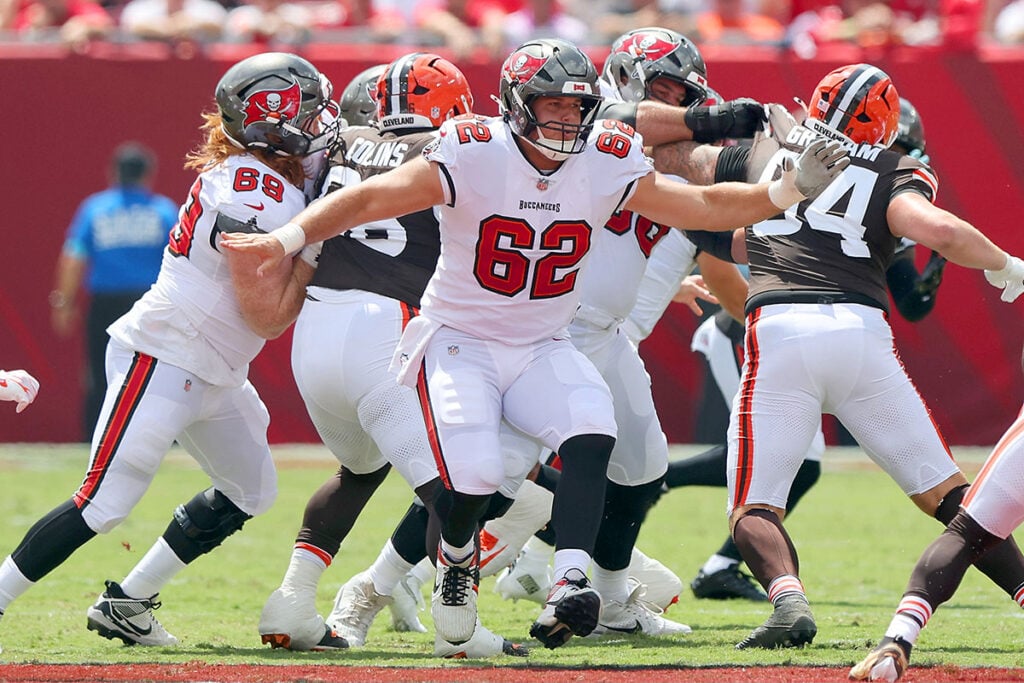
Bucs C Graham Barton – Photo by: Cliff Welch/PR
As it stands right now, Barton’s fifth-year option will cost $22.121 million. Only one center in the league has an APY in excess of that amount. That’s Raiders pivot Tyler Linderbaum. And no center, not even Linderbaum, will make that much in cash in 2028 when Barton’s hypothetical option would go into effect.
An extension for Barton, if structured similarly to those the Bucs did with Luke Goedeke and Zyon McCollum, wouldn’t cost the team much additional cash in 2027, and the 2028 cash outlay would be less than the option price.
The interesting decision the Bucs may be forced into is which of those three players they want to prioritize. Based on my own projections all three players are going to command a similar APY of $14-16 million.
And while Smith has been more consistent since joining the Bucs, and Irving has shown to be a higher peak player, Barton plays a position that is more difficult to replace with above average play. And Bucs general manager Jason Licht has traditionally prioritized trench play.
Fun Fourth Down: Jaxon Smith-Njigba’s Historic Pace
There has never been a 2,000-yard receiver in the history of the NFL. The closest anyone has ever come was Detroit legend Calvin Johnson in 2012 when he posted 1,964 yards. Cooper Kupp came close to breaking that record and eclipsing the 2k mark in 2021 when he tallied 1,947. But 2026 may be the season that a receiver hits that vaunted mark.
Jaxon Smith-Njigba has already amassed 79 catches for 1,207 yards and 10 touchdowns through 10 games. His 120.7 yards per game puts him on pace for 2,052 yards. JSN has the benefit of a 17th game to get him over the hump. Johnson averaged 122.75 yards per game during his historic season, just edging Smith-Njigba’s current pace.
Hitting the magic 2,000-yard mark is a combination of several amazing feats. First, he has to have the opportunities to catch the ball at an elevated rate. Smith-Njigba’s 104 targets are second only to CeeDee Lamb. And his 34.2% target rate is also second in the NFL, just behind Puka Nacua. Then a receiver has to maximize those opportunities with strong efficiency, combining a high catch rate and yards per reception.
JSN’s 76% catch rate leads all wide receivers and is third among all players behind tight end Trey McBride and running back Ashton Jeanty. But while McBride’s average depth of target is 6.0 and Jeanty’s is 1.7, Smith-Njigba’s is in the double digits at 10.6.
Smith-Njigba has been the focal point of the Seahawks offense through two quarterbacks and defenses still struggle to bottle him up. It’s incredibly fun watching him develop into the best receiver in the NFL and we should all enjoy watching history potentially being made.

Josh Queipo joined the Pewter Report team in 2022, specializing in salary cap analysis and film study. In addition to his official role with the website and podcast, he has an unofficial role as the Pewter Report team’s beaming light of positivity and jokes. A staunch proponent of the forward pass, he is a father to two amazing children and loves sushi, brisket, steak and bacon, though the order changes depending on the day. He graduated from the University of South Florida in 2008 with a degree in finance.
 Critical Details Emerge About Baker Mayfield's Injury