
In the NFL, Cover 4 refers to a defensive coverage that aims to cover four deep zones on the field. Following that lead, I’m going to provide you with the same coverage of the Bucs – your favorite football team. Each Wednesday I’ll cover four areas as they apply to Tampa Bay: 1. a short film breakdown, 2. a finance angle, 3. a look forward at what’s to come, and 4. a bit of fun.
Film: “Pepe” Williams Possible Rosterable Player
The Bucs cornerback depth is the talk of the town right now. Benjamin Morrison has not been able to practice and the team declined to find their annual back-of-the-roster veteran corner (shout out Kindle Vildor, Bryce Hall, Tavierre Thomas and Ryan Smith). Instead, the team has brought in two previously unheralded cornerbacks who have been making plays and turning heads.
Last week I profiled rookie undrafted free agent Ayden Garnes in my Saturday Scouting profile. Today I wanted to look at the quasi-veteran Damarion “Pepe” Williams.
Williams is a former fourth-round selection of the Baltimore Ravens in 2022. He played 225 snaps in his rookie year, suffered an injury in 2023 that contributed to him not playing that year and he’s been chasing a roster spot ever since.
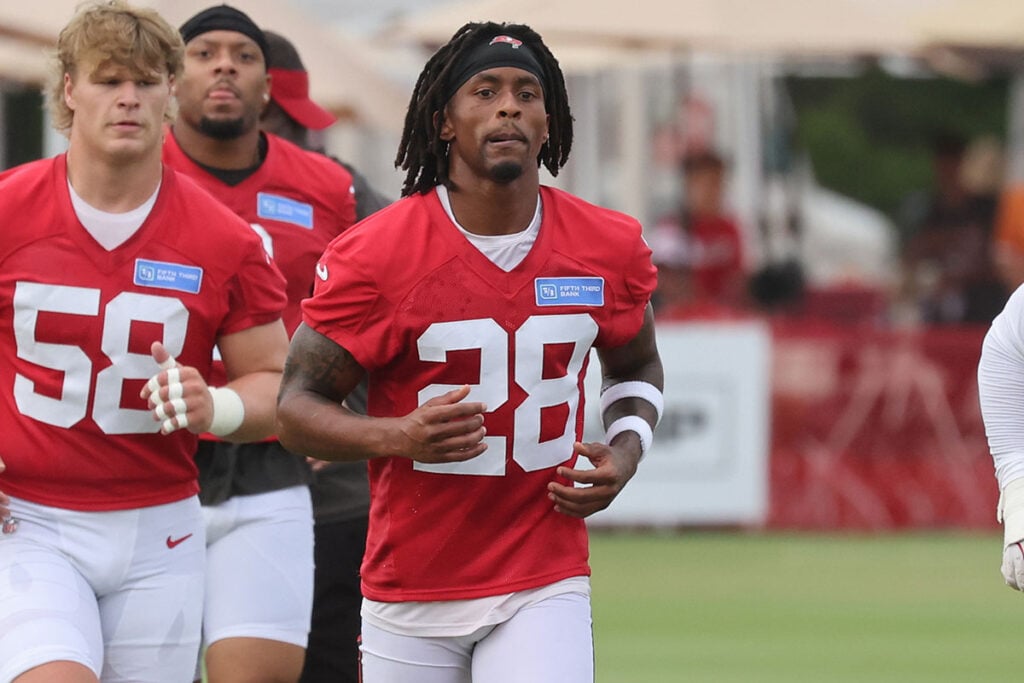
Bucs CB Pepe Williams – Photo by: Cliff Welch/PR
Athletic Profile
Pepe Williams tested as a good-but-not-great athlete when coming out of Houston.
Damarion Williams was drafted with pick 141 of round 4 in the 2022 draft class. He scored a 6.2 RAS out of a possible 10.00. This ranked 762 out of 2001 CB from 1987 to 2022. https://t.co/iiteQSv3MB #RAS #Ravens pic.twitter.com/IZ9j6gpGwi
— RAS.football (@MathBomb) April 30, 2022
And after watching his recent tape I would qualify Williams as a player where the athletic profile tells an accurate tale of who the player is.
2025 Preseason
Going back to his 2021 college days, or even his rookie tape, seemed obsolete, so I watched Pepe Williams’ three preseason games from last year when he was with the Seahawks to see who he is as a player now as a 28-year-old. In an impressive showing that ultimately did not pay off with a roster spot, there are expected plusses and minuses to his game.
Over 146 snaps (84 in coverage) Williams recorded 13 tackles, missing just one and six defensive stops. He was targeted in coverage 12 times, allowing eight catches for 36 yards while breaking up one pass (his lone forced incompletion). He allowed a 67% catch rate, 0.43 yards per coverage rep while allowing a 70.1 passer rating when targeted.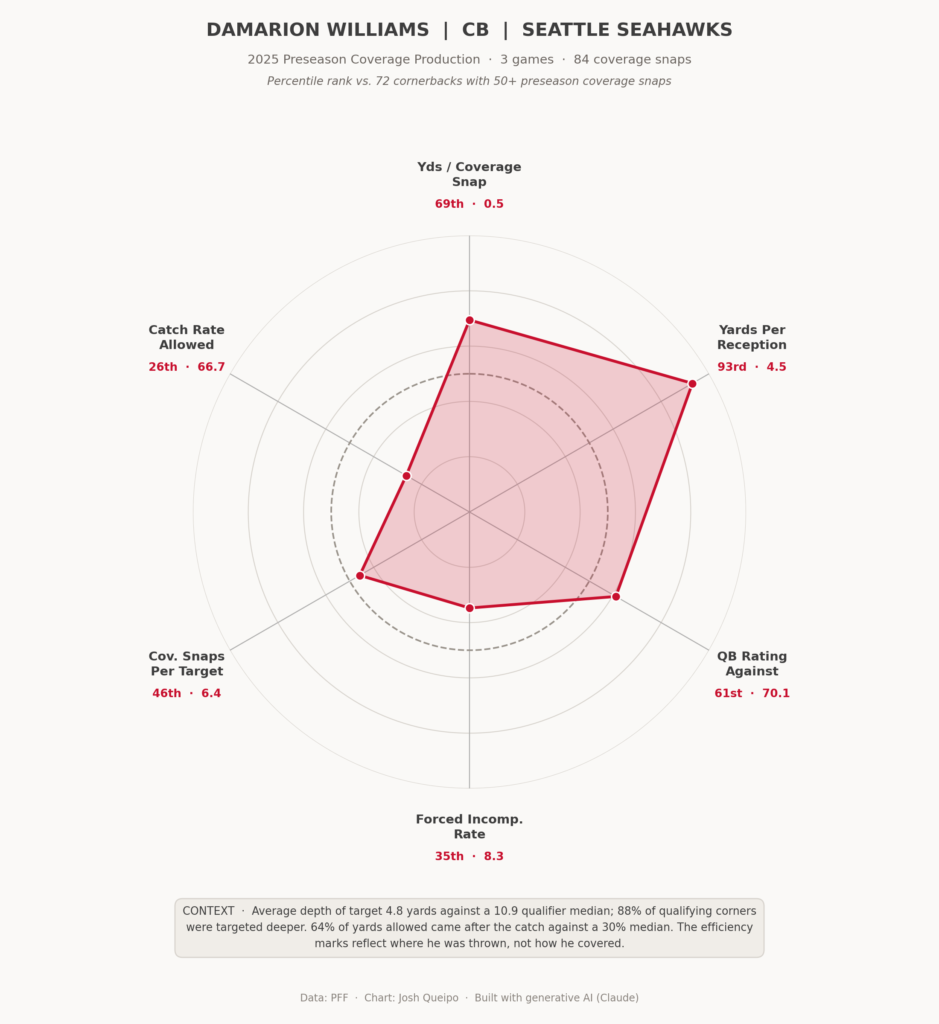
From this small sample size there are some things I genuinely like about his game. And the first thing is just how much tenacity Williams plays with. His size does not factor in how he attacks the ball or plays the run. Williams gives every rep that requires physicality his all.
Pepe Williams plays downhill like he's two inches taller and 20 pounds heavier. pic.twitter.com/8Mde1YKlre
— Josh Queipo (@JoshQueipo_NFL) August 12, 2026
He is quick to diagnose perimeter screens and even quicker to try and help in the run game. Williams understands that playing through blocks is a better strategy then running himself out of a play trying to run around them. Where other corners shy away from contact, he invites it. And he understands his place in the leverage game against offenses that try to win horizontally.
Beyond that, as a coverage player Williams’ best reps are when he is asked to play the flat in Cover 2. He has great feel for routes behind him and he isn’t afraid to sink deep to take away explosives, trusting his ability to click and close against drags and outlet passes.
Probably my favorite thing about Pepe Williams is how he plays the Cover-2 flat. He has a real feel for sinking to eliminate the sideline hole but keeps aware of the flat itself to come down hard and fast. pic.twitter.com/7Y7C90gSYk
— Josh Queipo (@JoshQueipo_NFL) August 12, 2026
Where I have my concerns about Williams’ ability to hold up against better NFL receivers is when he is in one-on-one matchups, either in straight man or press-man, or after zone matches. His size limitations show up on tape. As tenacious as he plays, Williams is still a sub-190-pound guy trying to live in a world where he is giving up height and weight. When receivers get physical with him, they can create easy separation and when he attempts to make a tackle he can bounce off or be left holding on for help. He’s sound as a tackler, with good form and an accurate targeting system. He just lacks the pop to consistently bring down ball carriers solo.
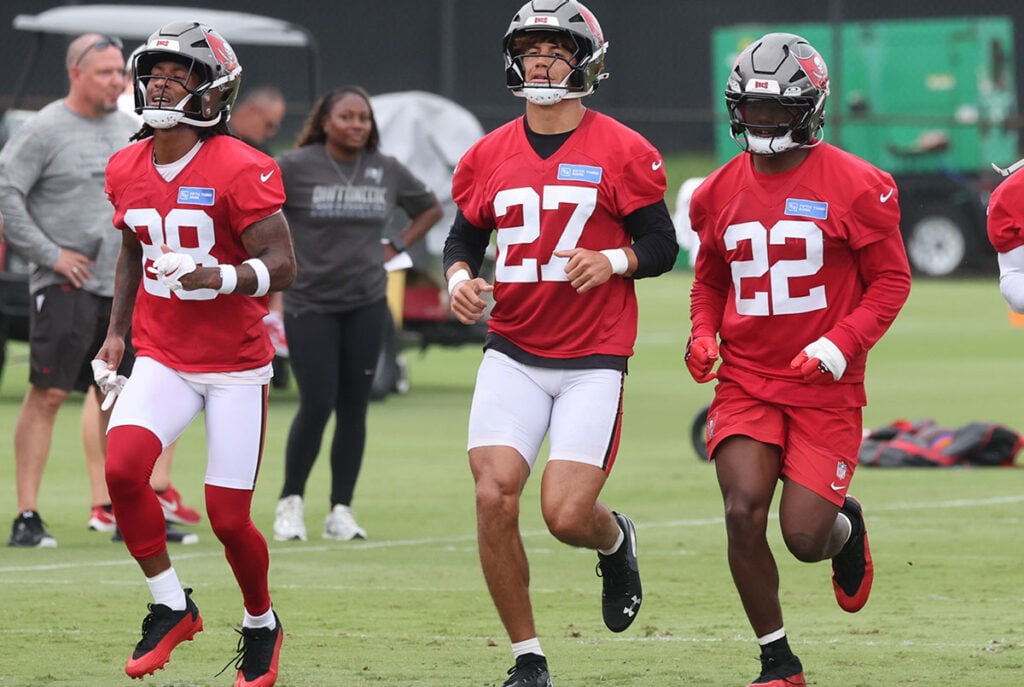
Bucs CBs Pepe Williams, Zyon McCollum and Keionte Scott – Photo by: Cliff Welch/PR
His athletic limits show up both in what he can’t do as well as how he has to play to account for that. Williams will turn early when he feels a vertical developing to make sure he isn’t outgunned in long speed. It’s an understandable trade-off but leaves him struggling to adjust to curls and comebacks. Living in this world requires his processing skills to be elite, and his are not that strong.
The athletic limitations pop up even when he is on top of the stem and doesn’t have to contend with a push. Williams’ de-acceleration and change-of-direction across a single plane is lacking and leads to additional separation.
Pepe Williams tested as a good, not great athlete coming out of college. You can see his limitations when he has to decelerate and change directions. pic.twitter.com/p8clXIIvew
— Josh Queipo (@JoshQueipo_NFL) August 12, 2026
And he leaves too much space on in-breakers. Across the three games I watched he struggled to cover slants from a mirror press, jammed press and from a cushioned position. It’s clear he feels most comfortable when receivers are releasing outside and less so when he has to follow them inside.
There is certainly a lot to like about Williams as a back-of-the-roster option. He’s smart, knows when to take chances and plays assignment sound football. He’s a better tackler than Ayden Garnes but lacks the same coverage upside. As of right now, I’d bet he’s the first man out for a final 53-man spot (providing Morrison starts the season healthy), with Garnes getting the 53-man spot and Williams on the practice squad.
Finance: Cap 101 – LTBE and NLTBE Incentives
Many teams and players bake bonuses into contracts. How these bonuses impact the team’s salary cap accounting depends on many variables. Many roster bonuses come with a full accounting in the year they are earned. Signing bonuses and option bonuses are prorated over multiple years. But I want to get into two different and inextricably related kinds of bonuses this week. These are referred to as “likely to be earned” (LTBE) and “not likely to be earned” (NLTBE) bonuses.
Both of these bonuses hinge on a necessary question. Did this player accomplish the feat the bonus is tied to last year? If the answer is yes, then the bonus is considered likely to be earned this season for cap purposes.
If the answer is no, then it is considered not likely to be earned. From there the NFL applies the cap charge for likely to be earned bonuses up front for the league year where the player is eligible to earn the incentive. If he doesn’t earn it, the team receives a credit for that cap charge the following year.
If the bonus is considered not likely to be earned, the team is not charged the cap hit for the bonus in the present year. If the player hits the incentive the charge is applied to the following year. I know that’s a lot of conditional information, so let’s do two examples to illustrate the process.
Assume a receiver has a $1 million bonus if he catches 50 passes in 2026. The piece of relevant information is whether he caught 50 passes in 2025. In scenario one we are going to say yes, last year he caught 52 passes. This would be a “likely to be earned bonus” and the team would have to account for the full $1 million cap charge in 2026. If that receiver fails to reach 50 catches in 2026 the team would get a $1 million cap credit in 2027.
Now let’s say the receiver only caught 45 passes in 2025. Then the bonus qualifies as “not likely to be earned” and there is no cap charge in 2026, even if he does reach 50 or more receptions later in the season. In that event, the team has to apply that $1 million cap charge to their 2027 salary cap accounting. If he does not reach the 50-catch threshold no other cap transactions occur.
Bucs quarterback Baker Mayfield has several incentives tie to his contract this year. They add up to as much as $5 million in additional compensation for him. But only $1 million of it is being charged to this year’s salary cap as likely to be earned.
Now $500,000 comes from being top 10 in the NFL in touchdown passes OR top five in the NFC. Mayfield was tied for seventh in the NFL in touchdown passes last year with 26. Another $500,000 comes from being top 10 in the NFL in passing yards OR top five in the NFC. He was 10th in passing yards last year.
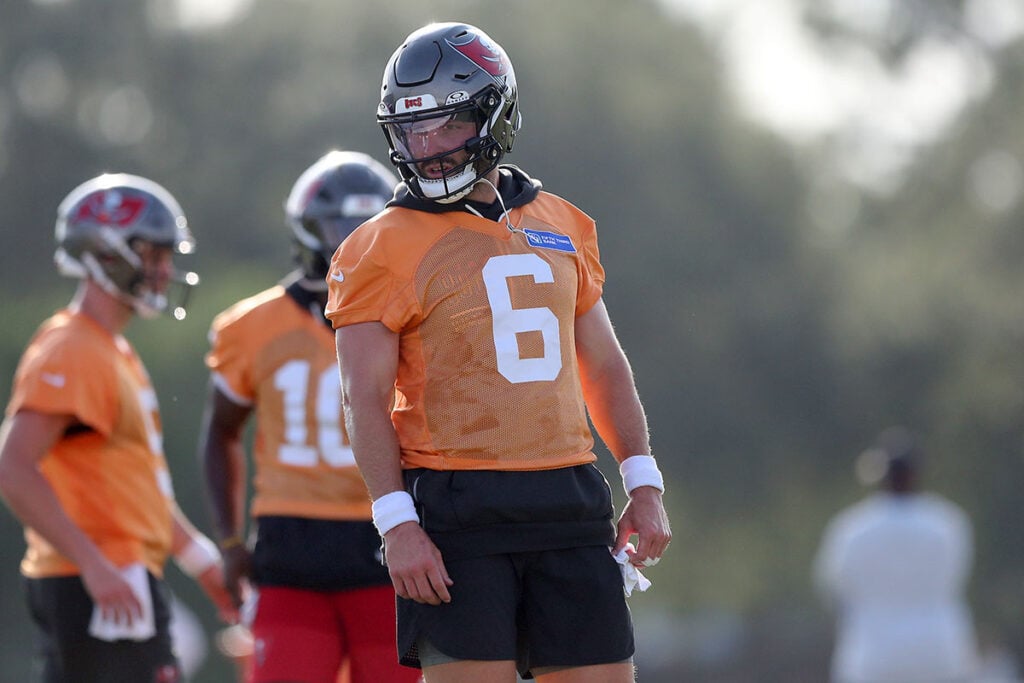
Bucs QB Baker Mayfield – Photo by: Adam Warren/PR
The other $4 million in incentives Mayfield can earn this year are tied to feats he did not accomplish last year. They are:
- Top 10 (NFL)/Top five (NFC) in passer rating (21st/12th last year) – $500,000
- Top 10 (NFL)/top five (NFC) in completion percentage (25th/14th last year) – $500,000
- Top 10 (NFL)/top five (NFC) in yards per pass (23rd/13th last year) – $500,000
- Win a wild card game (playing 75% of the snaps) – $500,000
- Win a divisional round game (playing 75% of the snaps) – $750,000
- Win the conference championship (playing 75% of the snaps) – $500,000
- Win the Super Bowl (playing 75% of the snaps) – $750,000
Per Game Roster Bonuses
There is one type of bonus that can simultaneously acts as both likely and not likely to be earned. Those are per game roster bonuses. The league treats them as both likely and not likely on a proportional basis based on how many games the player played the year prior. An example:
Player B has $510,000 in per game roster bonuses (this is a common number due to the league having 17 games per season – $500,000 even divides out into an ugly $29,411.76 per game whereas $510,000 is an even $30k per game). Let’s say he played in 13 games in 2025. In this case $390,000 of those roster bonuses would be treated as likely to be earned and would be charged up front to the 2026 salary cap. The $120,000 balance is considered not likely to be earned.
The team would take on $30k in salary cap charges in 2027 for every game past 13 the player plays. But if he fails to play in at least 13 games in 2026 the team would get a $30k credit on their 2027 salary cap for each game he falls short of 13.
Forecast: Benjamin Morrison’s Role With The Bucs In 2026
Concerns are mounting about cornerback Benjamin Morrison’s missed practice time in training camp. Coming into camp he was considered the team’s third cornerback in so much Jaccob Parrish was the front runner for the CB2 job opposite Zyon McCollum in base personnel. The idea was unless Morrison could beat out Parrish for that starting outside corner role, he would be the third corner to come in for nickel packages and would play outside while Parrish kicked in to the slot.
The Bucs have done this before under Todd Bowles, notably with Jamel Dean acting as the “nickel” while Sean Murphy-Bunting actually moved from outside to inside during Tampa Bay’s Super Bowl run in 2020-2021.
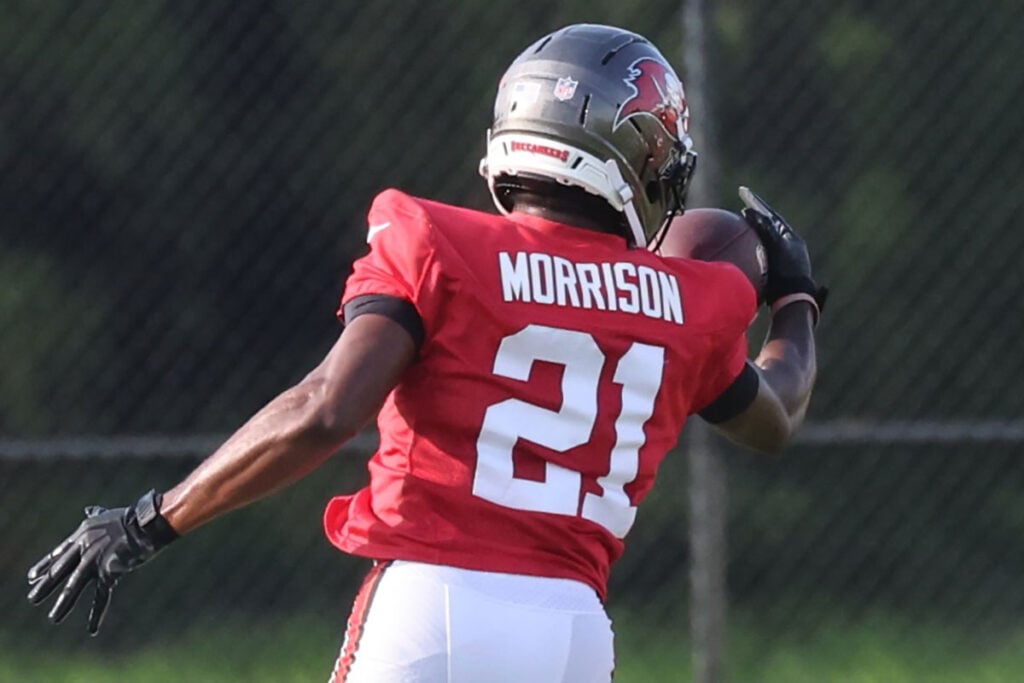
Bucs CB Benjamin Morrison – Photo by: Cliff Welch/PR
But with 2026 fourth-round draft pick Keionte Scott as a real option as the team’s starting nickelback in the slot, Morrison’s role is more up in the air than ever. The team doesn’t have him on the “Physically Unable to Perform,” suggesting the hamstring injury isn’t major and could be resolved soon. But with each missed practice Morrison falls further behind.
Last year was a rollercoaster for him during his rookie season. His Eagles tape was phenomenal in Week 4. Later in the year against the Patriots and Bills he allowed too many explosive plays, including two long touchdowns.
Morrison needs these practice reps in camp and the preseason to better understand when he can and can’t take chances. More importantly, he needs these reps to best communicate with the rest of a still very young secondary. If he can’t return to practice by next week he will become the team’s fourth corner, effectively cementing Scott as the starting nickel.
Should an injury occur to any of Parrish, Scott or Zyon McCollum, he would be the first off the bench as the outside cornerback in nickel defense. But for a 2025 second-round pick to be looking up from the CB4 spot this early in his career is both disappointing and a stark reminder of injuries being a great equalizer in the NFL.
Morrison is talented. He was considered by many to be a first-round talent during the draft process last year. The Bucs felt like they were getting that caliber of player when they selected him 53rd overall in the 2026 draft. Getting him in the second round represented the injury risk premium they knew he came with.
Unfortunately, he has lived up to the concern so far in his NFL career. There is still time for Morrison to become a good NFL player. But the time is running out for Tampa Bay to rely on him as a core part of their defense to start this season.
Fun Fourth Down: My Bad Draft Takes
Almost every part of being an analyst means projecting the future. It’s something I thoroughly enjoy. But projections are just that. It’s not future telling. It’s making an educated guess with the best information available. I have certainly hit on some projections; both contract and draft based. But boy, have I missed as well. And it’s always good to give oneself a healthy dose of humble pie.
I looked back at past draft boards I put together and chose three players that I missed on by a MILE. I am listing what I saw in them and where I think I went wrong.
After reading this I encourage you to do two things. 1) Roast the hell out of me for being so blind/dumb on these players. But only do that IF you are willing to supply your own bad draft take. Can’t have the give without the take. Now let’s have some fun.
Bad Draft Take No. 1 – QB Kenny Pickett
The 2022 NFL Draft was the first year I compiled a draft board. Inspired by Scott Reynolds and Jon Ledyard’s love of the draft I was excited – and so, so naive. Naive to think that every draft class has to have at least one first-round quarterback. Now my first-round grade on Pickett had less to do with his actual talent and more to do with his positional value. But nevertheless, I own the grade.
What I Liked: His deep ball accuracy, decision-making and pocket navigation.
Where I Went Wrong: I didn’t give enough weight to all of the throws his arm couldn’t make, negating a lot of the deep accuracy hope I had for him. I also undervalued the importance of being able to make off-script throws.
Pickett hasn’t panned out, and while he is the most accomplished quarterback of his draft class to date (although Malik Willis may very well overtake him for that acclaim by the end of this year), he was certainly not a first-rounder. Mike Tomlin and I got that one dead wrong.

Bad Draft Take No. 2 – RB Roschon Johnson
Bijan Robinson was clear cut the best running back in the 2023 NFL Draft class. Jahmyr Gibbs was the clear cut No. 2, right? Not according to this guy! I had another running back from Texas as my RB2. Gibbs was RB5 for me!
What I Liked: Johnson sold me by maintaining a high missed forced tackle rate himself (although nowhere near the level of Robinson). His contact balance and pass blocking were also attributes I was a fan of. I hold pass blocking in higher regard than most analysts because I try to keep in mind that it’s a part of the minimum entry to playing time. If you can’t block you are going to have a hard time finding the field.
Where I Went Wrong: Roschon’s burst and vision have done him in to this point in his career. He’s struggled to find holes leading to just a 3.8 yards per carry average and only two totes in 2025. Meanwhile that Gibbs fella is now the highest-paid running back in NFL history…
Bad Draft Take No. 3 – WR Jalen McMillan
McMillan was WR16 in an admittedly stacked 2024 draft class. I had him behind – among others – Javon Baker, Malachi Corley, Xavier Leggette and teammate Ja’Lynn Polk.
What I Liked: I was a fan of McMillan’s intermediate-to-deep route running and noted he had a strong second gear that allowed him to open up late.
Where I Went Wrong: It’s not that I didn’t like McMillan. I liked a lot of receivers in that class. And the Bucs took him 93rd overall, which is exactly where he was on my board! But he has been much better than the 16th best receiver in that draft class.
My worries with McMillan rested on two concerns. One, he was not a great contested catch receiver in college. That followed him into his rookie season. But last year McMillan showed a different gear when it came to making tough catches.
The second concern I had was related to him beating man coverage. But McMillan has shown to be a savvier and more physical route runner than I believed him to be, and he may just be the best man-beater on the Bucs’ roster now that Mike Evans is gone.
As it stands, McMillan was the 12th receiver taken. He currently ranks 15th in that group in receptions, 13th in receiving yards, tied for sixth in touchdowns and 11th in yards per route run. All of that despite dealing with injuries that have limited to only half the potential games he could have played in. It’s safe to say I was wrong about McMillan.

Josh Queipo joined the Pewter Report team in 2022, specializing in salary cap analysis and film study. In addition to his official role with the website and podcast, he has an unofficial role as the Pewter Report team’s beaming light of positivity and jokes. A staunch proponent of the forward pass, he is a father to two amazing children and loves sushi, brisket, steak and bacon, though the order changes depending on the day. He graduated from the University of South Florida in 2008 with a degree in finance.
 Bucs Camp Studs And Duds: 8/12
 Bucs Camp Insider 8-12: Bucs Dominate End Of Practice, Emeka Egbuka Hurt