
In the NFL, Cover 4 refers to a defensive coverage that aims to cover four deep zones on the field. Following that lead, I’m going to provide you with the same coverage of the Bucs – your favorite football team.
Each Wednesday morning I’ll cover four areas as they apply to Tampa Bay: 1. a short film breakdown, 2. a finance angle, 3. a look forward at what’s to come, and 4. a bit of fun.
Film: Bucs Secondary Depth Bolstered By 2025 UDFA
Last week I profiled second-year corner Benjamin Morrison’s rookie season and where he can grow in 2026. Morrison is one of several young defensive backs who figure to have a role this year. Many wonder if Tampa Bay has enough depth in the secondary to hold up over the long grind of an 18-week season.
On the outside they have three capable corners in Zyon McCollum, Jacob Parrish and Morrison, giving the team some depth in case of injury. In the slot the depth chart is genuinely impressive with Parrish, rookie Keionte Scott, and safeties Tykee Smith and Antoine Winfield Jr. all showing to varying degrees they can man the position well.
But safety is where much of the concern lies. The one-deep at safety is impressive with Winfield and Smith. But beyond those the Bucs don’t have any proven talent. But that doesn’t mean there shouldn’t be reason for optimism.
The team was very high on 2025 undrafted free agent JJ Roberts out of Marshall. Roberts had a strong summer in rookie minicamp and OTAs. He built on that with a fantastic first preseason game where he mainly manned the slot against the Titans. His final line from that game according to Pro Football Focus was 27 coverage reps, 7 targets, 1 catch allowed for 13 yards, 2 pass breakups and a 39.6 passer rating allowed. And the tape backed up those stats.
I get the concerns around BMo and McCollum and the excitement for Parrish and Scott.
But man, we should talk more about JJ Roberts coming back this year. pic.twitter.com/r6tI5oXDdu
— Josh Queipo (@JoshQueipo_NFL) May 26, 2026
What’s interesting is that as good as Roberts looked at nickel in that one game, before injuring his knee the following week in practice and going on injured reserve for the season, the team has decided to move him to safety in 2026. Assistant general manager Rob McCartney said as much during his draft weekend press conference.
Roberts played safety his final two seasons in college, so this isn’t a foreign position move for him. But given how good he looked last year in a sample size it bears wondering whether this is the best spot for him. I went back to his preseason tape, plus watched two of his 2024 games (Ohio State and Coastal Carolina) to see which traits fit both spots, and where the gaps emerge.
JJ Roberts’ Best Traits
Roberts has the speed and fluid body mechanics to work well in both the slot as well as a top-down safety as either the post safety in single-high or working half-field reads when the defense stays in two-high. He ran a 4.41-second 40-yard dash at his Pro Day and paired it with a 40.5-inch vertical to show he has an explosive spool up to get to his impressive top speed.
The preseason slot reps showed a quick pedal and an even quicker transition out of it. With loose hips and quick feet, he can stay in his pedal longer, keeping his eyes in the backfield and forcing receivers to declare their stems before he has to break on routes. And because he can spool up so easily, he doesn’t have to worry about turning early on verticals.
All of these traits translate well at deep safety. Being the best athlete on the field in the Sun Belt Conference, he could wait until the last second for route combinations to develop before breaking on the ball to make a play. That helped him to 14 pass breakups in his final year of college ball.
Roberts’ play against Coastal Carolina showed the natural culmination of those athletic traits paired with a strong understanding of route concepts and a fearless nature in attacking the ball.
J.J. Roberts vs Coastal Carolina was a masterclass of arriving to the ball at the catchpoint. PFF charted him as being targeted 6 times, allowing 3 catches and 13 yards with 3 pass breakups across 44 coverage reps. 0.30 yds/cov rep. pic.twitter.com/ebN7rfU5HC
— Josh Queipo (@JoshQueipo_NFL) May 27, 2026
The most impressive of those clips was him defending the Flood concept by showing a double on the vertical route early to push the quarterback to the intermediate, only to find Roberts had driven down on that route forcing him to move to the third read – the checkdown.
Marshall, primarily using a two-high shell, consistently had Roberts shaded to the field or concept side of the formation, asking him to match against the heavy side of the route concept. That’s where teams want their best cover safeties – helping to sort, process and defend the complex side of the passing offense. And his processing is up to the challenge.
Roberts’ full package as a coverage safety is a solid processor, with plus athleticism who can match against the most athletic receivers in man, and who is willing to make plays on the ball in zone coverage. That’s an ideal free safety in a classic NFL defense.
The problem though, is that there are very few, if any, defenses playing a classic version of safety these days.
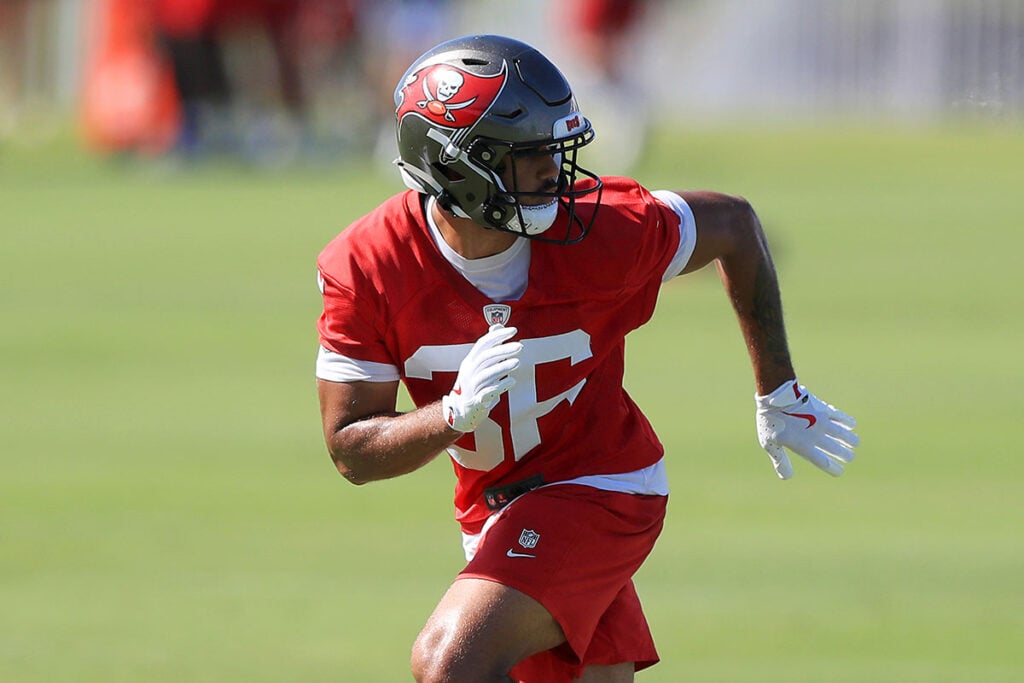
Bucs DB J.J. Roberts – Photo by: Cliff Welch/PR
Most NFL defenses, the Bucs included, need safeties to be interchangeable in roles and responsibilities. The modern deep defensive back has to be equal parts box enforcer and centerfielder. Offenses use motions and shifts so much that defenses are constantly rotating, both reactively and proactively, to keep up. And because of that, there is very little need these days for just the classic post safety without a complementary skillset.
And that’s where Roberts’ evaluation becomes difficult. The Ohio State tape is the biggest signal as to why he went undrafted. It’s also why he may be solid depth, but a concern as a fill-in starter.
JJ Roberts’ Weaknesses
Ohio State was the toughest competition Roberts faced in his collegiate career. No longer the best athlete on the field by a country mile, the pursuit angles Roberts could take against Georgia Southern and Coastal Carolina were no longer up to snuff against a much higher caliber of athlete. And Roberts couldn’t figure out how to adjust. Play after play he would try a direct line to the ballcarrier only to find he had horribly misjudged where he needed to be. This led to multiple explosive plays for the Buckeyes.
JJ Roberts vs Ohio State, the best competition he faced in '24, was comfortably his worst game of the season. Better athletes exposed his pursuit angles rep after rep. Missed tackles and big plays followed. pic.twitter.com/yr5Q5D8Ida
— Josh Queipo (@JoshQueipo_NFL) May 27, 2026
The clearest example came in the second quarter. Roberts was the deep half safety over a trips formation. At the snap, his first step came down toward the slot, anticipating play-action. The handoff went the other way, and his angle was already wrong. He chased the back to the sideline, made contact at the 5-yard line, couldn’t wrap, and watched an 86-yard touchdown go in the books.
Those pursuit angle issues contributed to a poor tackling performance too. Pro Football Focus marked him for three missed tackles on nine attempts. I would say they were generous with that line.
In addition to the angle issue, Roberts has a penchant for trying to tackle high and he struggles to stay wrapped up. It leads to more yards after contact and catch than coaches are going to be comfortable with. His 10.0% career missed tackle rate would tell you I am either nitpicking or just flat out wrong.
But when you look more closely at his toughest matchups over the last two years (2024 Ohio State and Virginia Tech, and 2023 Virginia Tech and NC State) that missed tackle rate balloons to 22.6%. And some of those concerns did show up in my watch of the Titans preseason game from last year.
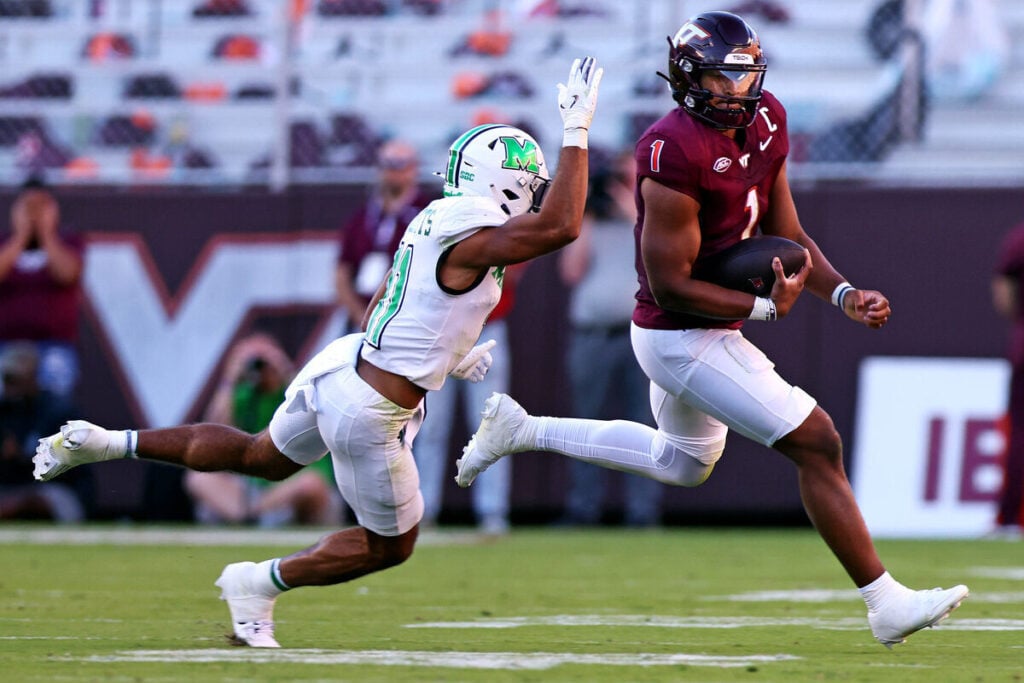
Bucs S JJ Roberts – Photo by: USA Today
Ultimately, my biggest concerns lie in his ability to fit the run. He lacks pop in most of his hits, struggles to wrap up and takes those questionable angles. None of that improves against NFL-level competition. It goes the other way. And a safety who has to stay deep and can’t defend the run is a safety who will struggle to get on the field and will be a liability offenses will try to exploit when he is on the field.
The Bucs aren’t asking Roberts to start. Behind Winfield and Smith, they need a third safety who can hold up in spot duty without the bottom falling out. Roberts has the trait profile to fit that role specifically. The athletic tools and processing chops let him work as a deep half or single-high safety in passing situations.
The slot tape from the Titans game suggests he can fill in there too if the situation calls for it. And on a UDFA contract coming back from injury, that’s real roster construction value for a team carrying premium money everywhere else.
What he probably can’t be is the third safety asked to play meaningful base defense snaps against quality offenses. The tackling profile against elite competition is the cap, and it’s the kind of cap that doesn’t disappear without a fundamental change in his run defense approach. Can that happen? Yes. Will it happen? We’ll see.
The Bucs secondary depth concern isn’t an empty one. But the room isn’t as bare as the names you’ve heard might suggest. There’s a player coming back from injury who fits a specific role on this defense, and his return is one of the quietest reasons for optimism about the depth chart heading into 2026 – if he can improve his tackling this summer in training camp.
Finance: Choose Your Own Fighter – DL Edition
Last week I dove into the offensive line and the decision Jason Licht and Mike Greenberg are barreling toward with Cody Mauch and Graham Barton. This week I’m going to do the same thing on the other side of the ball. Because the Bucs have a similar problem on the defensive line, and the timing is even tighter.
Nose tackle Vita Vea is entering the final year of his contract. And outside linebacker Yaya Diaby, Tampa Bay’s most consistent edge presence, is also entering the final year of his rookie deal. Two expiring contracts, and like with Mauch and Barton, Jason Licht and Mike Greenberg probably can’t pay them both at the top of their respective markets. They will have to choose.
The Vita Vea Math
Vea will turn 32 next February. He is coming off a strong, two-year run with 11 sacks and 101 pressures (as charted by PFF), working as the lone constant on a defensive line that has been anything but in recent years. The case for paying him is straightforward. He is one of the two best nose-tackle-sized A-gap pass rushers in football, and the Bucs don’t have an obvious replacement for what he does.
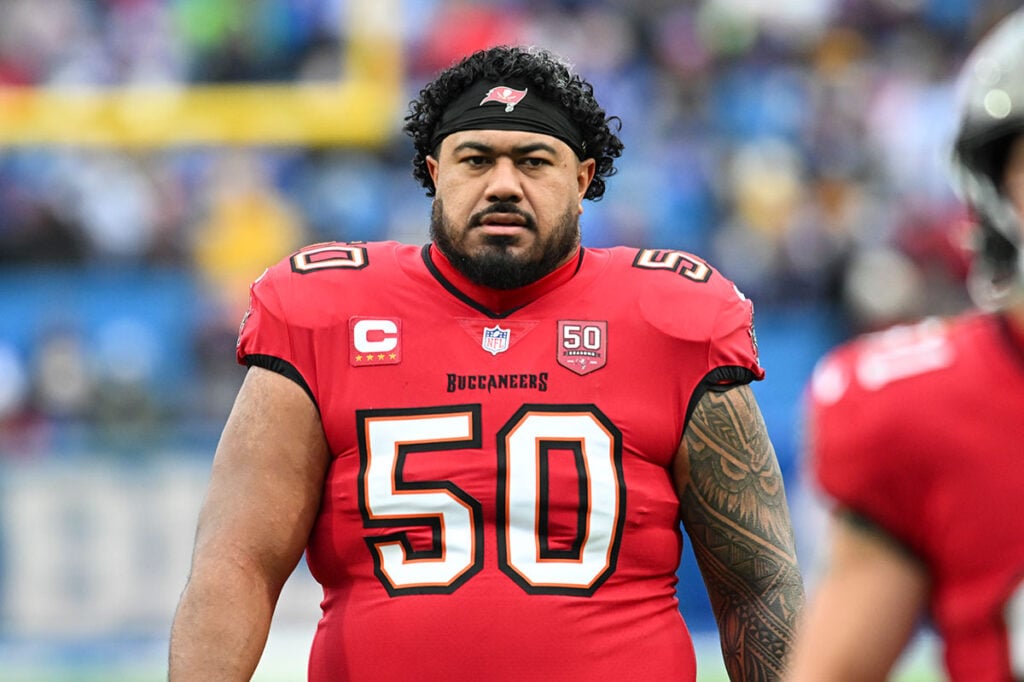
Bucs DT Vita Vea – Photo by: USA Today
The case against paying him is also straightforward. He will be 32. He is built like a player whose body has to be the asset, and aging curves at his position are unforgiving. The contracts that go past age 33 at defensive tackle are often the contracts teams regret. The Calais Campbells of the NFL are few and far between.
My contract projection modeling calls for a two-year, $42 million extension if the two sides were to reach an agreement this offseason. If they wait until 2027, Vea likely pushes for three years. The market has recently borne that out for over-30 defensive tackles on their third contract.
The Yaya Diaby Math
Diaby just turned 26. He produced 127 pressures and 15 sacks across 2024 and 2025, with a 14.1% pressure rate that puts him in the same statistical neighborhood as Jaelan Phillips and Travon Walker, both of whom signed nine-figure extensions in the last 12 months. He is entering the final year of his rookie deal on a 2026 cap hit of $3.7 million. He is, in every sense the contract market measures, an ascending edge rusher about to get paid. The best projection I have for him is close to what Odafe Oweh just signed for: four years and $96 million.
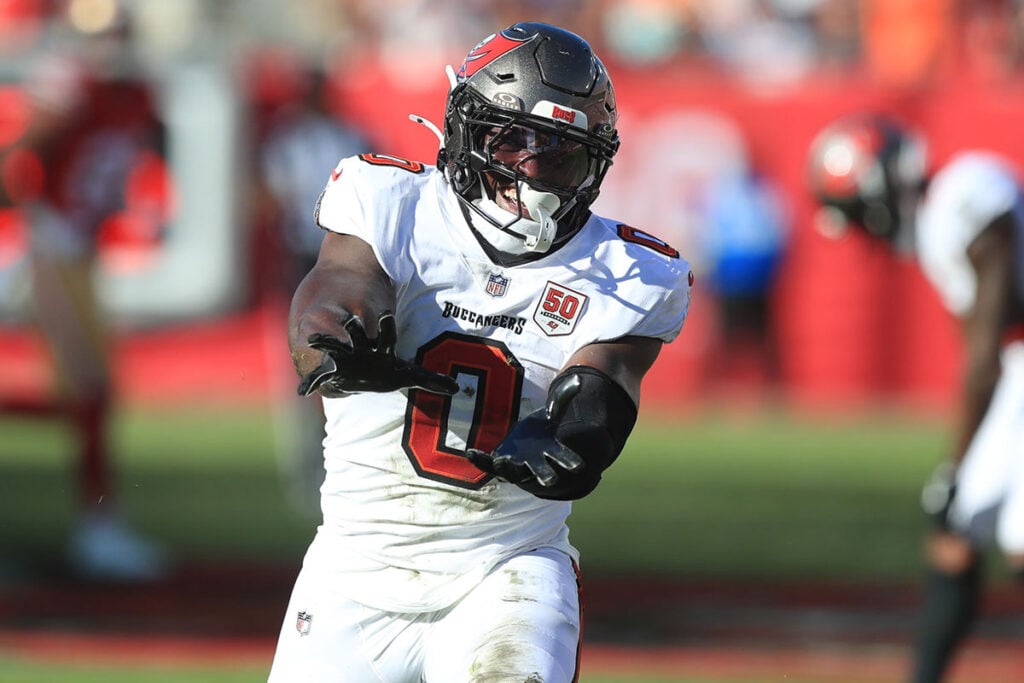
Bucs OLB Yaya Diaby – Photo by: Cliff Welch/PR
The Reality
The two players should command similar paydays, and the Bucs will need to choose which player is most important to the team. The veteran unicorn, or the good-could-be-great up-and-comer.
My bet is they go with Diaby.
Licht has signaled finding pass rush is his primary goal to turn around the defense. Diaby creates more consistent pass rush than Vea – and he should be counted on to do so going forward more often. Vea is entering the twilight of his career. Diaby is entering his prime.
The Bucs have taken small steps to prepare for a post-Vea life. They haven’t restructured his deal in several years, making a break more palatable from a cap standpoint. They have stockpiled young run stoppers in Jayson Jones, Elijah Simmons and DeMonte Capehart. Capehart brings a potential pass rush unlock that could replace some of what Vea delivers as a pocket pusher as well.
Yes, the Bucs drafted Reuben Bain Jr. this year. But if they let Diaby go in the following year, they are back to square one in the pass rush pursuit. And while Diaby would be on his big contract extension for the next four years, the Bucs would have Bain on his rookie deal for the next three prior to his fifth-year option year in which his salary would balloon. That’s an affordable mix at edge rusher for Tampa Bay through 2029.
Licht and Greenberg have another crossroads ahead. Vita Vea Boulevard or Yaya Diaby Drive? My bet is on the Drive.
Forecast: Danny Smith Is The “Special” In Bucs Special Teams
The Bucs special teams unit has been anything but for more than half a decade now. If not for kicker Chase McLaughlin these past three seasons it would have been a full-on travesty. Head coach Todd Bowles is now on his third special teams coordinator in five years with Danny Smith. And he finally has the man up to the task of turning around the moribund unit.
Smith spent the past 13 years with the Pittsburgh Steelers. His units are well-known for their prowess at blocking kicks with 21 such occurrences since 2013. 17 of those have come since 2017, ranking his unit tops in the NFL over that time period. He has developed quality return men and kickers alike over his time running the game’s third phase for former Steelers head coach Mike Tomlin.
And most excitedly, his 2025 unit held opponents to the fifth-worst starting field position following a kickoff in the league. That’s an important note for a Bucs squad that was so inept at covering kicks they gave up trying by the end of the year, opting to just kick the ball out of the end zone and allow the opposition to start at their own 30-yard line.
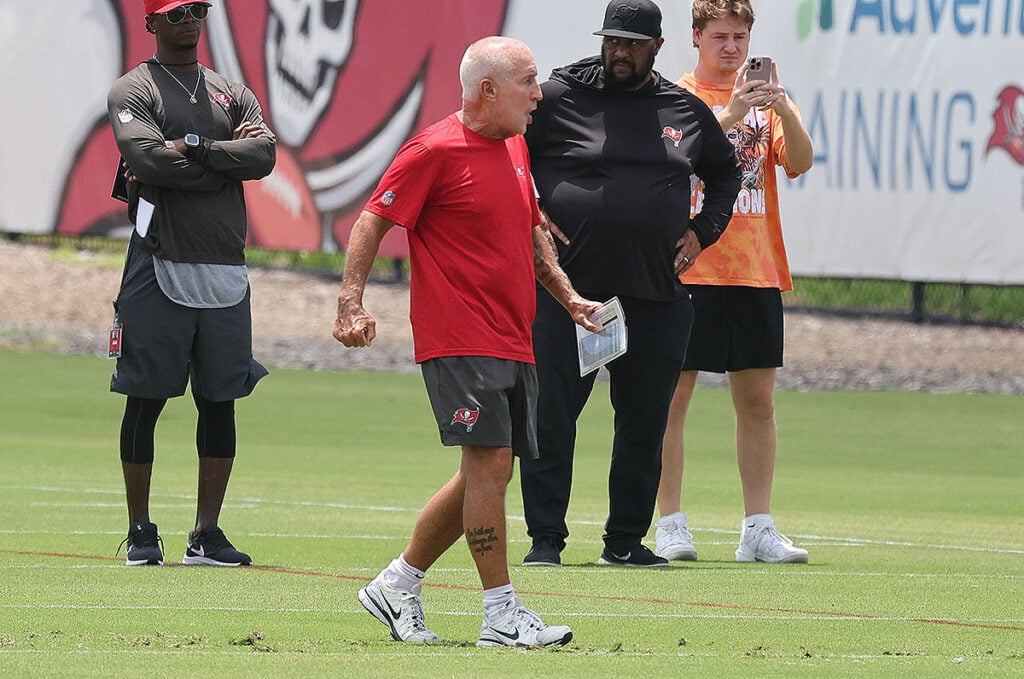
Bucs ST coordinator Danny Smith – Photo by: Cliff Welch/PR
Smith should bring discipline, technique and accountability to the special teams unit. His influence can already be seen in roster construction. It’s no coincidence his special teams ace for the past five seasons, Miles Killebrew, is now in Tampa Bay with Smith.
Previously the Bucs have been reluctant to roster a special teams ace at all. In 2024, Tavierre Thomas was close to that, but Tampa Bay saw him as a real part of the defensive depth chart. Killebrew is not a parallel to Thomas. The last time the Bucs really had a core special teams ace was Ryan Smith who was with the team from 2016-2020 before getting another cup of coffee with them in 2022.
With Killebrew in tow Smith is poised to bring the Bucs’ third unit back to respectability. Calling my shot here. They finish top 20 in starting field position allowed following a kickoff. They finish top 15 in net punt average. And they finish top 18 in PFF’s special teams grade. The Bucs were 30th in 2025 and have never finished better than 19th in the Todd Bowles era.
Fourth Down Fun
Recently, ESPN analyst Mina Kimes won $1 million for charity by winning “Celebrity Jeopardy!” The feat inspired me to put together a “Bucs Jeopardy!” game for you, our readers. Now I’m not going to put together a full board of 30 clues across six categories. But I did want to give you five clues. And the first reader to e-mail me at [email protected] with the correct answers to all six questions (or should I say the correct questions to the six provided answers) will win a Pewter Report t-shirt!
Please put in the subject line of your e-mail: “Cover 4 Jeopardy Answers.” Now without any further ado…
Draft Day Decisions – $100
This defensive tackle was the fifth defensive tackle taken in his draft class, and the second taken by the Bucs that year.
Canton – $200
From 1993 to 1997 the Bucs drafted this many players who would eventually go on to be enshrined in the NFL Hall of Fame.
Jersey Numbers – $300
Only three players have had their jerseys officially retired by the Buccaneers, and these are their three numbers.
Don’t Do That – $400
Raiders head coach Bill Callahan opted for simplicity over strategy when he made this grave mistake in Super Bowl XXXVII. Bucs head coach Jon Gruden took full advantage.
Bowles Says – $500
In the midst of his fourth midseason swoon in as many seasons, Bucs head coach Todd Bowles violated George Carlin’s 1972 standup routine by uttering two of the “Seven Words You Can Never Say on Television” this many times during a postgame media availability.
Good luck!

Josh Queipo joined the Pewter Report team in 2022, specializing in salary cap analysis and film study. In addition to his official role with the website and podcast, he has an unofficial role as the Pewter Report team’s beaming light of positivity and jokes. A staunch proponent of the forward pass, he is a father to two amazing children and loves sushi, brisket, steak and bacon, though the order changes depending on the day. He graduated from the University of South Florida in 2008 with a degree in finance.
 Pewter Report Podcast: Bucs Begin OTAs
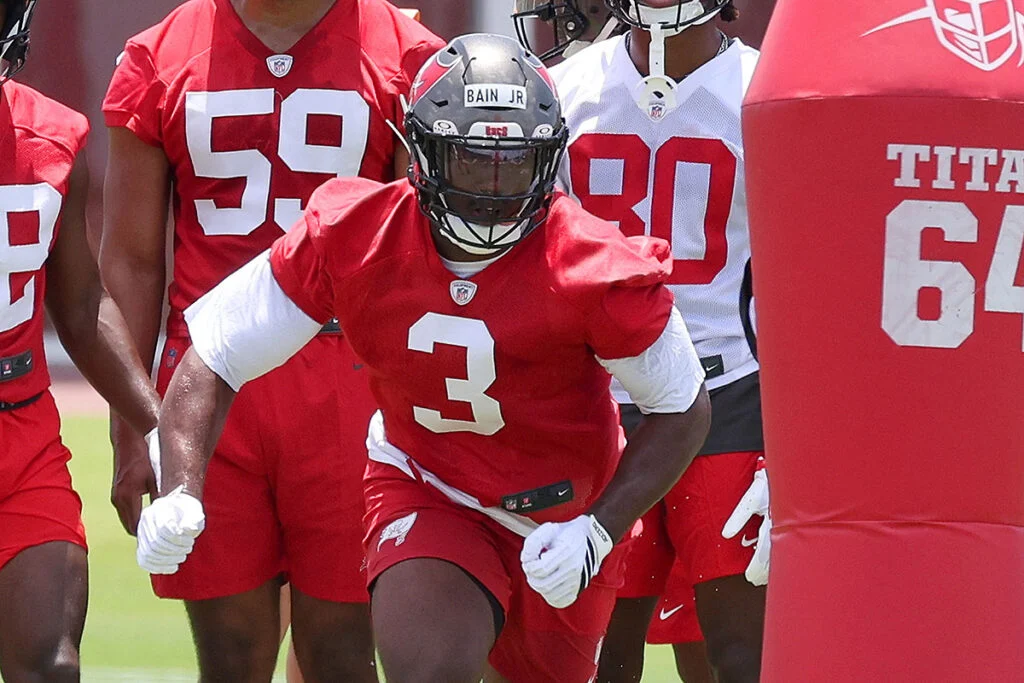 Rueben Bain Jr. Earns High Praise From National Champion Head Coach