
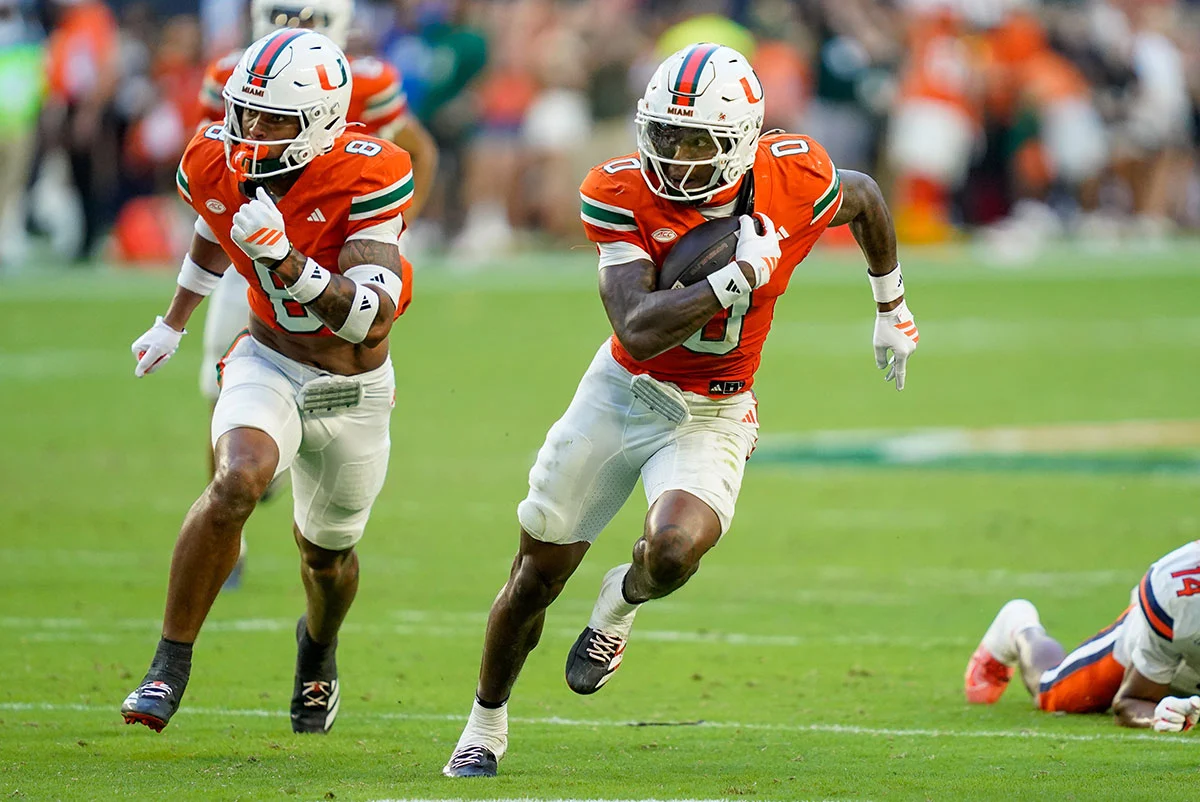
When Jason Licht and the Bucs went back to “The U” for the second time in three days and pulled defensive back Keionte Scott off the board at pick No. 116 in the 2026 NFL Draft, they had a vision and a plan. Miami edge rusher Reuben Bain Jr. fell to No. 15. And then Scott fell to Tampa Bay in the fourth round. Two Hurricanes who spent 2025 terrorizing college football offenses together are now set to do it again on Sundays – in the same uniform, on the same defense.
I went back through three of Scott’s games on the All-22. The National Championship loss to Indiana, the Florida State win in Week 6, and the Week 8 loss to Louisville. What jumps off the screen is not the 4.33 speed or the production. It is how Scott isn’t the traditional slot defender.
He’s more of a linebacker trapped in a defensive back’s body. And that’s okay, because the modern day NFL has plenty of homes for just such a player. And one of those homes is in Todd Bowles’ defense. Bowles already said on the Rich Eisen Show that Scott can play “anywhere from nickel to corner to safety to linebacker.”
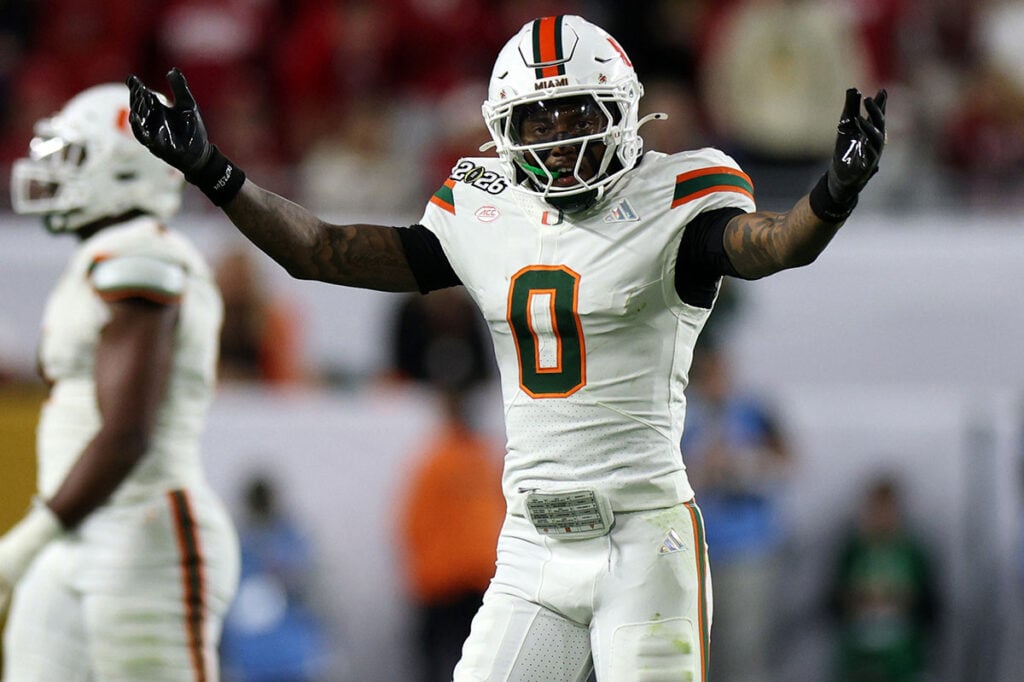
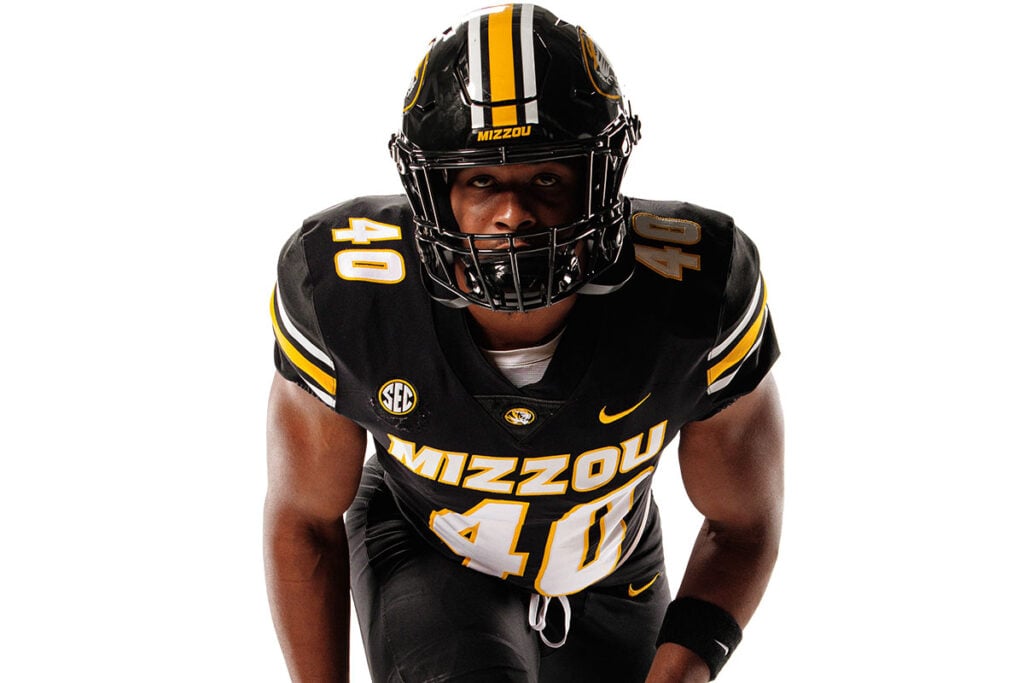
Bucs DB Keionte Scott – Photo by IMAGN Images – Jerome Miron
Now, some of that is hyperbole. But not completely.
In truth, he will primarily play nickelback. But he can bang in the box if the Bucs want to stay in nickel against 12 personnel. He can kick wide when offenses take non-receivers and put them on the perimeter. And he has the speed to rotate up top from time-to-time to get Antoine Winfield Jr. and Tykee Smith closer to the line of scrimmage on some exotic post-snap shifts. So Bowles isn’t technically wrong.
Let’s get into it.
Keionte Scott’s Superpower Lives Near The Line of Scrimmage
If you want to understand why Keionte Scott fits the Bucs so cleanly, you have to start at the line of scrimmage. He is a quasi-linebacker with the recovery speed of a true corner. That distinction matters because Bowles’ defense leans hard on overhang versatility, and Scott gives the staff a chess piece who can be deployed against tight ends, in the box, on the edge, or hanging in the slot – sometimes on consecutive plays.
In the run game, he sets a hard edge against tight ends without giving ground. He absorbs pullers without flinching. And he has a real knack for forcing offenses to commit two blockers to him on perimeter runs.
That last point is gold. When a nickel demands two blockers, you have effectively changed the box math for the rest of your front. Vita Vea, Calijah Kancey, and Yaya Diaby are going to feel that. Josiah Trotter and Rueben Bain Jr. are going to feel that as well.
How many nickels do you know occupying two blockers? Keionte Scott is one. pic.twitter.com/HoRSRmgpfR
— Josh Queipo (@JoshQueipo_NFL) May 1, 2026
Watch as he drives through not one, but two tight ends. Bain gets the tackle for loss on a play that is suspect in design. But Scott’s play is undeniable all the same.
It was so nice, he did it twice. https://t.co/hkfhF9lEIK pic.twitter.com/HmFo1A7sLy
— Josh Queipo (@JoshQueipo_NFL) May 1, 2026
The trigger here is what every Todd Bowles defender has to have. He sees the run key and doesn’t hesitate. Just to keep the structure of the play alive and second blocker has to commit to him.
Process -> Trigger -> Attack -> Finish
Keionte Scott is an impressive DB when fitting the run pic.twitter.com/Xl3e3AOyTY
— Josh Queipo (@JoshQueipo_NFL) May 1, 2026
The NFL is getting bigger on offense with 12 and 13 personnel becoming more popular with extra tight ends on the field. But it’s not to run the ball better. No, that trend has led to more explosive passing attacks because defenses have to personnel match with more linebackers who are weaker in coverage.
The Seahawks won the Super Bowl last year on the back of their dominant defense because they could stay in nickel where other defenses couldn’t. Their nickel defender, Nick Emmanwori, could act as a de facto linebacker to fit the run while giving a real advantage against the pass. Keionte Scott could provide the Bucs and Todd Bowles that same versatility.
A Weapon Waiting To Be Unleashed Upon Quarterbacks
Here is the stat that should perk up every Bucs fan reading this: all five of Keionte Scott’s sacks at Miami last season came when he was aligned to the same side of the formation as Reuben Bain Jr.
Five for five.
The Bucs did not just draft a nickel, they drafted Bain’s tag-team partner.
Scott had five sacks and 20 pressures on just 87 pass rushing reps in 2025.
That is a 23 percent pressure rate – from a defensive back.
Bowles is going to have a great time designing pressure packages around this, because Scott does not just blitz fast, he blitzes with savvy.
Keionte Scott – Pass Rusher pic.twitter.com/qOx4dn2RFi
— Josh Queipo (@JoshQueipo_NFL) May 1, 2026
Scott brings to the table everything you could want from a defensive back as a pass rusher. He displays elite processing that shows up in how he times the snap and reads the protection. Scott’s trigger and burst thrust him through the line and makes him difficult to account for. Scott makes pressure designs work because he has an innate feel for bringing heat. He can attack from a wider slot alignment, from depth or attack the B gap when Scott is aligned in the box if the offense motions the strength of the formation away from him.
Scott can slide around blockers without losing acceleration, and that is what separates the corner-blitz role players from the corner-blitz weapons. Most slot blitzers get rerouted by a chip or a pulling guard. Scott absorbs the contact, redirects, and still hits home.
Bowles loves to bring backside pressure off the slot when the quarterback’s eyes are working frontside. Scott’s burst allows him to get there before the protection can rotate. This is going to be a staple call against any Bucs opponent who tries to slow down the pass rush with play action.
Keionte Scott laying the lumber pic.twitter.com/6t73Nb6z9w
— Josh Queipo (@JoshQueipo_NFL) May 1, 2026
The finishing is not a bonus, it is part of the value. Scott does not just close – he punishes. And he punches the ball out. In a Bowles system that emphasizes takeaways at all three levels, that is the trait that turns a good fourth-round pick into a starter.
His 4.33 40-time made the headlines, but on tape what shows up is the functional closing speed in space. There is a real difference between a cornerback who runs fast in a 40 and a cornerback who diagnoses, breaks, and finishes in the same beat. Scott is the latter.
Talk about a Bucs fit. Kills the concept altogether. pic.twitter.com/25rP2VoL2J
— Josh Queipo (@JoshQueipo_NFL) May 1, 2026
This is the rep that screams Bowles fit. Scott reads the screen, breaks on the play and blows it up to the point that the quarterback abandons the play altogether and tries to grab a couple of yards with his feet.
Scott with the PBU. This is one of his best reps over the middle and in man coverage. pic.twitter.com/wo4N1KFutD
— Josh Queipo (@JoshQueipo_NFL) May 1, 2026
Over 1,000 words and I haven’t gotten to a defensive back’s coverage. Scott has a tendency to guess in man and can get caught leaning at the stem. These can lead to some low lights. But when he guesses right, he will make plays on the ball.
In zone, he has a strong trigger. Bowles plays a heavy dose of Cover 3 and Cover 6 with rotational match concepts on third down, and that is where Scott’s instincts should work well.
The Areas To Watch For With Keionte Scott
I am not going to sell anyone on Keionte Scott as a lockdown man corner, because he is not. The hips stiffen up at the top of the route, and when Scott gets hands on a power slot at the line, he tends to lean into the contact, which makes for hard transitions when the receiver works back across his face or through him. Power slots, the Cooper Kupp archetypes, gave him problems at Miami. He can get bullied at the top of the stem.
He also has a tendency to peek into the backfield in zone and drift wide on hook drops, which can leave the middle-of-field dig open behind him. That is a coaching point, not a fatal flaw.
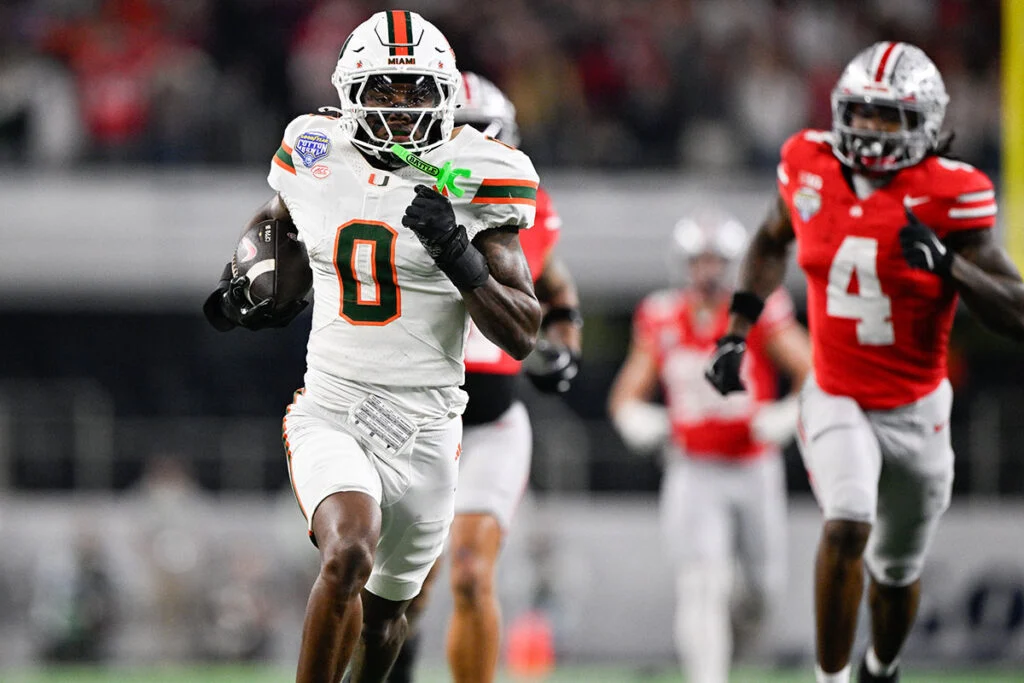
Bucs DB Keionte Scott – Photo by IMAGN Images – Jerome Miron
The good news for Bucs fans is that Todd Bowles is not going to ask Scott to be a man-cover specialist. He is going to ask him to live in zone, to blitz on call, and to set the edge against perimeter runs. That is exactly what Scott does best.
The Bucs lost Jamel Dean in free agency, Zyon McCollum had the worst year of his career, and Benjamin Morrison did not show the consistency the staff hoped for in his rookie season. With Jacob Parrish’s inside out versatility, Scott provides options for the staff to find the best arrangement in the defensive backfield.
If Scott does make the starting lineup the Bucs will have not one, not two, but three defensive backs who do some of their best work at and behind the line of scrimmage. That should enable Todd Bowles to throw out all sorts of pre- and post-snap rotations that will have defenders attacking from every possible angle while wreaking havoc.
Pair that with Rueben Bain Jr. coming off the edge on the same side that Scott was eating quarterbacks alive on at Miami, and you have the makings of a pressure package that does not need to be exotic to be effective – but still can be.

Josh Queipo joined the Pewter Report team in 2022, specializing in salary cap analysis and film study. In addition to his official role with the website and podcast, he has an unofficial role as the Pewter Report team’s beaming light of positivity and jokes. A staunch proponent of the forward pass, he is a father to two amazing children and loves sushi, brisket, steak and bacon, though the order changes depending on the day. He graduated from the University of South Florida in 2008 with a degree in finance.
 Bucs DB JJ Roberts Details Rehab, Outlines Expected 2026 Role
 Pewter Pulse: The Hard Truth About Bucs LB Josiah Trotter