
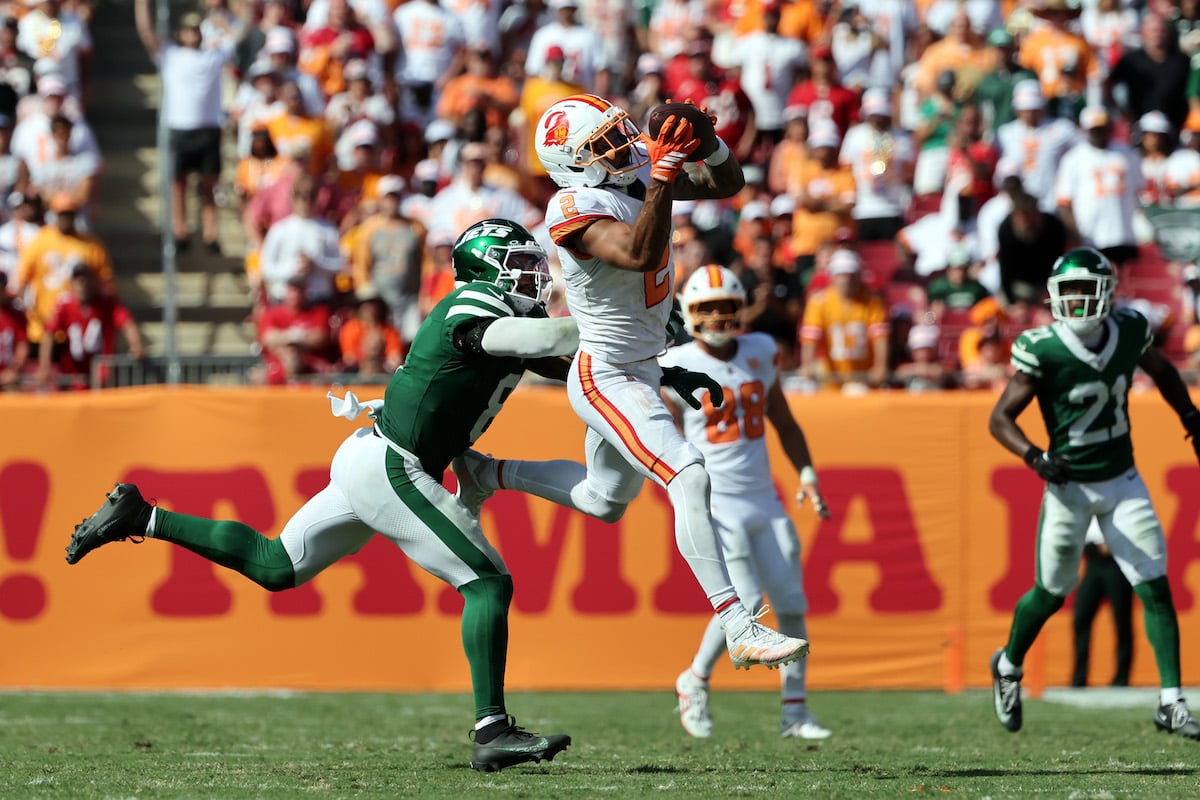
Bucs first-round pick Emeka Egbuka had an incredibly volatile rookie season. Through the first five weeks of the season, he was the odds-on favorite for NFL Offensive Rookie of the Year. Over that time period, he averaged five catches, 89 yards and a touchdown per game.
But the cool-off later in the season was a stark and steep drop. In his final five games, his averages fell to 2.2 catches, 29.4 yards per game and no touchdowns.
What drove the initial performance? And why did his play fall off so precipitously? And where does that leave him headed into 2026? How much of the Mike Evans-sized hole in the Bucs offense can he fill?
These are all questions I hope to find some answers to.
I’m going back and watching Egbuka’s 2025 rookie season again through each quarter of the season (Weeks 1-4, 5-9, 10-14 and 15-18) to find the highlights and opportunities in his play. What areas held up through the entirety of the season? Where did he improve and regress? What can be expected of him in 2026 and where are the limitations that might put a cap on his ability?
Let’s take a look.
Looking Back On Emeka Egbuka’s Bucs Rookie Season: Weeks 1-4
Emeka Egbuka came on strong in the first quarter of his rookie season. He had 18 catches for 282 yards and four touchdowns while averaging 2.0 yards per route run.
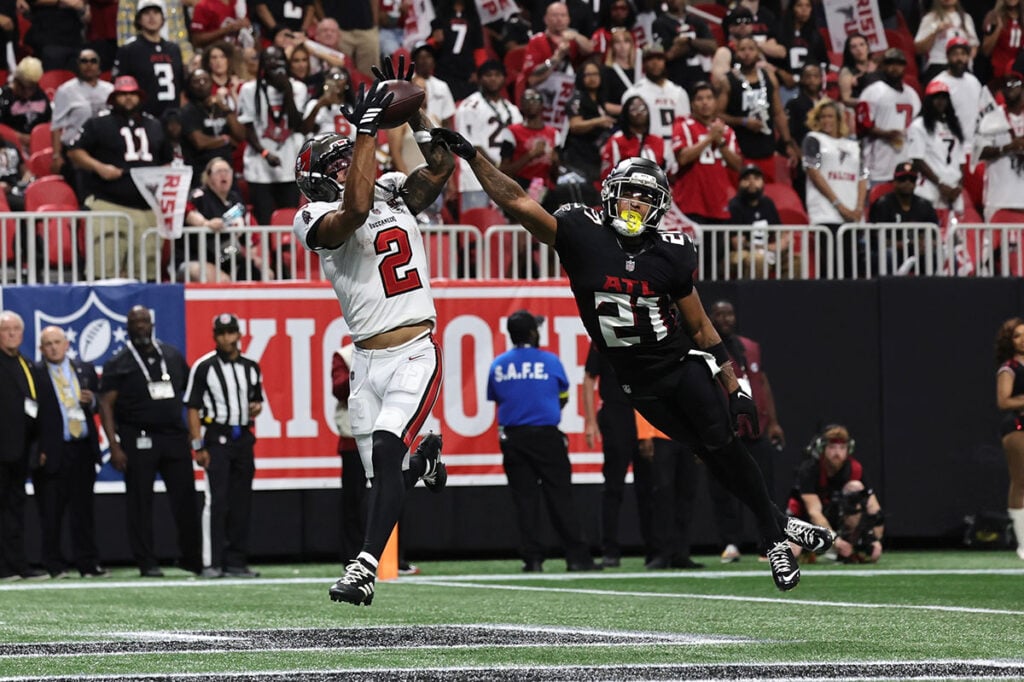
Bucs WR Emeka Egbuka – Photo by: Jeffrey Jones/PR
Strengths
Much of this production was fueled by a part of his game he wasn’t praised for much coming out of Ohio State. But the deep ball accounted 67% of his yardage and 75% of his touchdowns in the earliest part of the season. Two traits drove this positive in his game.
First, Egbuka’s feel for finding room in zone coverage was far and away his best skill over the first four weeks. Nowhere was this more present than on the two touchdowns against the Falcons in Week 1. Small head and hip twitches at the stem faking a corner route before snapping back to the middle on the post as he gained important leverage on the deep defensive back were the hallmarks of both scores.
His buildup speed was also impressive. It’s not the kind of short-area suddenness that uncovers against press, but more of a second gear that punishes a defender playing off or from depth. This helped him get on top of safeties and deep third corners quicker than they were expecting at around 7-12 yards into his route. But that’s why this receiver, who was winning downfield so often, had trouble in other parts of his game related to speed (more on that later).
That helped him find space down field that other receivers don’t always find. It’s a trait he shares with fellow Bucs receiver Jalen McMillan.
What’s interesting is that this runs counter to his athletic testing, as his 10-yard split in the 40-yard dash was in the 75th percentile, while his 40 itself was just in the 51st percentile. I’m not sure how to reconcile the two, but this was my observation.
Add in that he was making some truly impressive catches in some extremely tight windows and you start to get the profile of a player who can win in most situations. Egbuka had one of his most impressive plays of the first four games against the Jets where he hauled in a perfect pass one-handed on a deep fade with Sauce Gardner perfectly in phase.
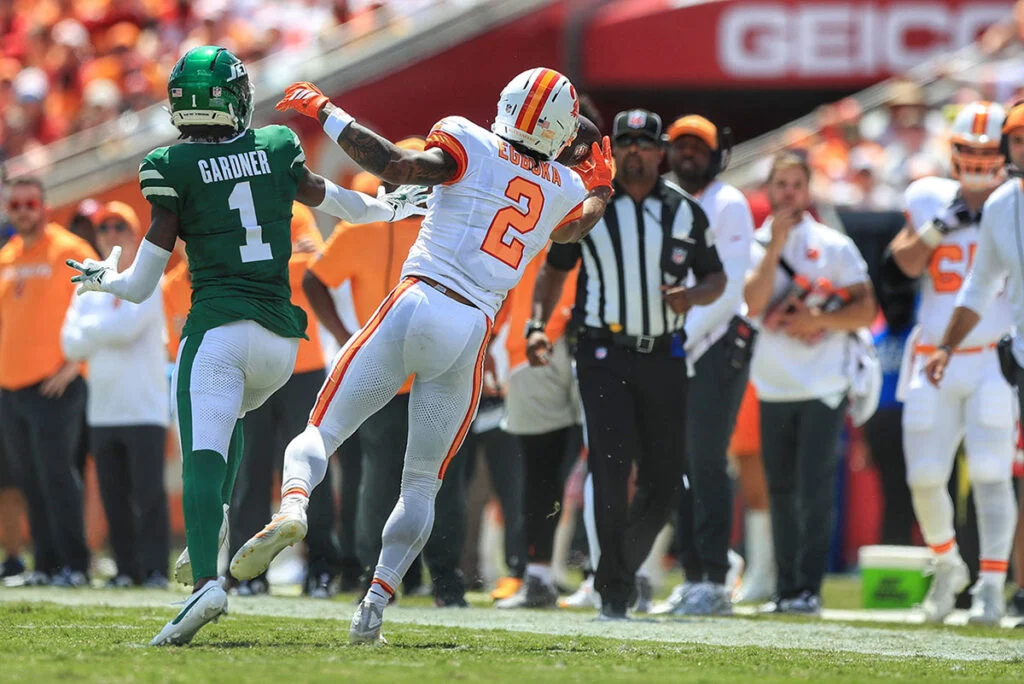
Bucs WR Emeka Egbuka – Photo by: Cliff Welch/PR
His late and strong hands were the key to him making the impressive downfield grab. By the way, it seems like those insane catches are here to stay if OTA’s are any indicator. Those tight window grabs helped him to a 5.7% catch rate over expected for the full stretch.
He was Tampa Bay’s preferred option in the manufactured touch game. With five catches for 26 yards and a score, the Bucs were force feeding him some action and on one big play against the Texans, he rewarded them for their faith.
Much of Egbuka’s success can be tied back to his versatility. While I don’t think he is cut out to be a true X lining up as the single man in 3×1 formations, he can move around the formation and win from a multitude of spots – condensed or spread, on the line or off. From a static position or in motion. His versatility also helps open up opportunities for other receivers.
He also showed he can beat jams against press man. Now, it’s in a very specific way with a small hop with a stutter step on the land. He throws it to the outside in order to cut off it to the inside. I observed Egbuka pull this move multiple times to gain inside leverage for slants, crosses and over the ball routes and it was effective every time.
What I am curious to see going forward is if defenders start to learn this move and cheat the inside. And if so, can Egbuka counter with a win to the outside? If so, my thoughts on him playing X might change, but for now I am still skeptical.
Weaknesses
Separation against man coverage was the biggest issue I saw on tape. Egbuka struggled to find much in the first quarter of the season. This was most prevalent against the Jets and the Eagles, who were more willing to put him on an island against strong man corners in Sauce Gardner and Quinyon Mitchell, respectively. That buildup speed against zone coverage from earlier was not available to him against the more aggressive corners who were willing to ride him from the line. Their size, physicality and willingness to challenge him from his release exposed his separation skills early in the route.
Egbuka was still able to find production in these games, but it wasn’t due to him separating from his defender. For the first four games of the season, PFF had him with just one catch on six targets for 15 yards and a score against man coverage. And that one catch was the tunnel screen against the Texans.
Conspicuously, for all of the success Egbuka was having on targets of 20+ air yards, he was struggling with his bread and butter from college – throws to the intermediate part of the field. In 2024, he earned his highest grade from PFF (97.3) on these plays, with 17 catches on 26 targets, for 296 yards and five touchdowns at Ohio State.
Over the first four games of 2025, he had just one catch on six targets for 18 yards on throws between 10 and 20 yards. And that catch was on a scramble drill, not a designed concept.
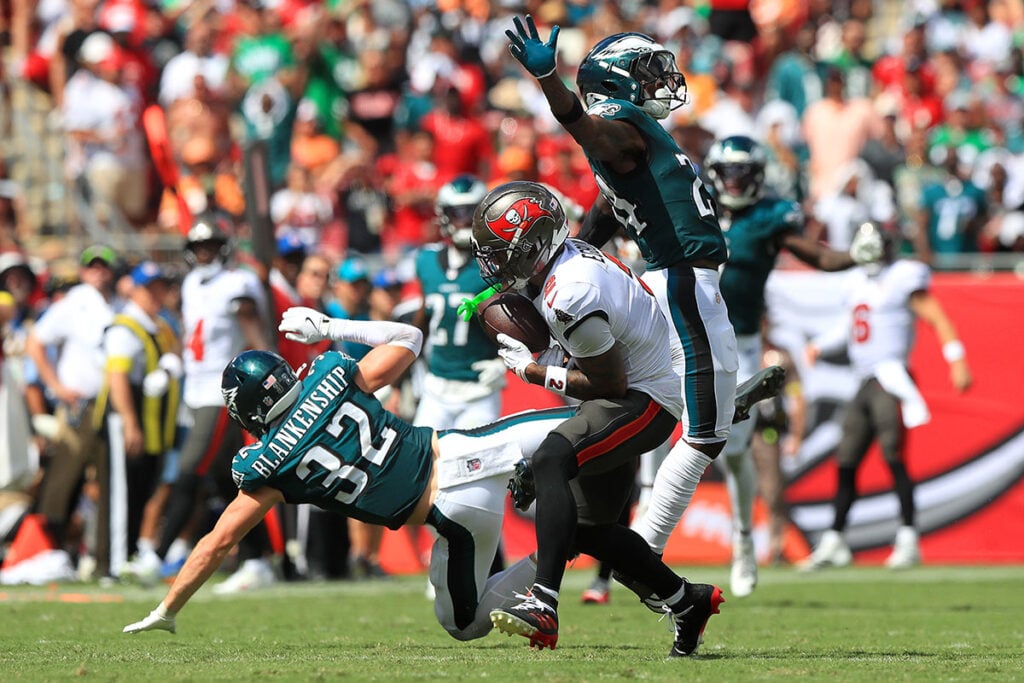
Bucs WR Emeka Egbuka – Photo by: Cliff Welch/PR
Part of that may be because it looked to me that Egbuka was surprised at the physicality of the NFL game. That’s not to say he can’t handle it. But it genuinely looked like he wasn’t expecting how often he had to contend with a linebacker chipping him as he got into his route, how willing corners and safeties were to step into his path and how eager they were to try and throw him at his stem.
In college, he had the benefit of being on a squad with superior athletes. He was one of those athletes. And as such most teams gave him a wide berth. Defenders were afraid to try and disrupt his path because it meant they, themselves, had to slow down to make contact and coming out of that contact there was a good chance they couldn’t keep up with him or the play. So there was little effort to disrupt his routes.
In the NFL, there is no such reluctance. Every middle of the field defender is going to try and slow the timing of your route while also trying to put some shots on your body. To me, this was a part of Egbuka’s welcome to the NFL. Keeping his balance through that contact and not letting it slow him as much is a big opportunity that he can easily master going forward.
While I praised his contested catch abilities earlier, I need to put a caveat on that trait. Most of those grabs were on the perimeter working away from the line of scrimmage. But there were several targets over this stretch working back to the quarterback or over the middle that he did not come up with because he had a defender coming over his back at the catchpoint.
Across those four opportunities, he brought in just one such pass. Pro Football Focus credited him with four contested catches over 12 opportunities during this stretch. That 33.3% catch rate was a far cry from the +50% rate he maintained at Ohio State.
What I’m Looking For In Emeka Egbuka’s Weeks 5-8
The first quarter gave me a clear profile and an equally clear set of questions. Here is what I’ll be watching for as the tape rolls into the second quarter of Emeka Egbuka’s rookie season.
Does the intermediate game come back? This is the one I care about most. The 10-to-20-yard range was his best work in college, and it was a dead zone to open his rookie year, one catch on six targets with the lone reception coming off a broken play. If Egbuka is going to be more than a deep threat and manufactured touch guy, this is where it has to show up. I want to see designed concepts in that range, and I want to see him win them.
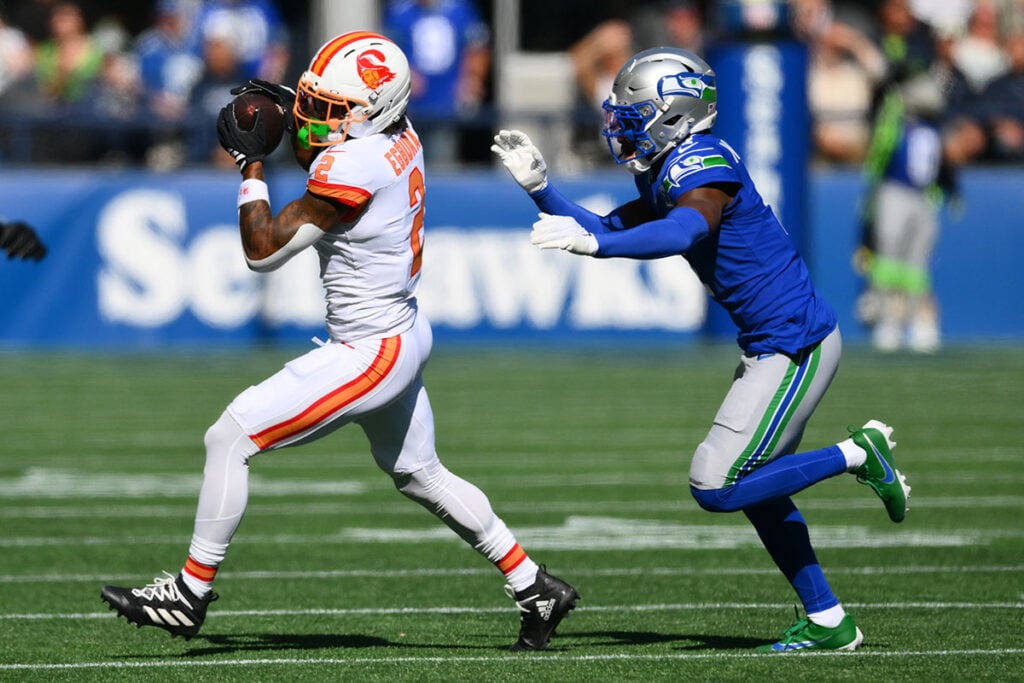
Bucs WR Emeka Egbuka – Photo by: USA Today
How does Egbuka respond to press man? I laid out the separation problem against Quinyon Mitchell and Sauce Gardner, and the specific release move he used to counter it. Two things to track. First, do defenses keep trusting structural zone against him, or do they start to bracket? Second, when they do press Egbuka, does the hop-stutter still work or have defenders started cheating the inside? If he flashes a counter back to the outside, my X skepticism softens.
Does the contact bother him less? I think the physicality was a welcome-to-the-NFL moment more than a true limitation. The test is whether the linebacker chips and the safeties stepping into Egbuka’s stem keep knocking him off his timing, or whether he starts playing through it. This is the most coachable item on the list, so if he is who I think he is, I expect to see growth here first.
Do the contested catches over the middle improve? Egbuka was strong working away from the line and shaky on anything with a defender coming over his back, one of four on those chances. That split is the difference between a complementary piece and a real every down threat. I want to see him start winning the contested rep when the defender has leverage on Egbuka, not just when the ball is placed away from traffic.
Is the deep ball real or is it variance? Two thirds of his yardage came on 20-plus air yard throws, and some of that was scheme and a blown coverage against the Eagles. I am not betting against the catch point skill, but four games is a small sample to hang 67% of a player’s production on. I want to see whether Egbuka’s deep production holds when defenses start accounting for it.

Josh Queipo joined the Pewter Report team in 2022, specializing in salary cap analysis and film study. In addition to his official role with the website and podcast, he has an unofficial role as the Pewter Report team’s beaming light of positivity and jokes. A staunch proponent of the forward pass, he is a father to two amazing children and loves sushi, brisket, steak and bacon, though the order changes depending on the day. He graduated from the University of South Florida in 2008 with a degree in finance.
 Pewter Report Podcast: Bucs OTAs – Week 2
 Queipo's Cover 4: Zac Robinson Staples, Bucs 53-Man Roster Projections