
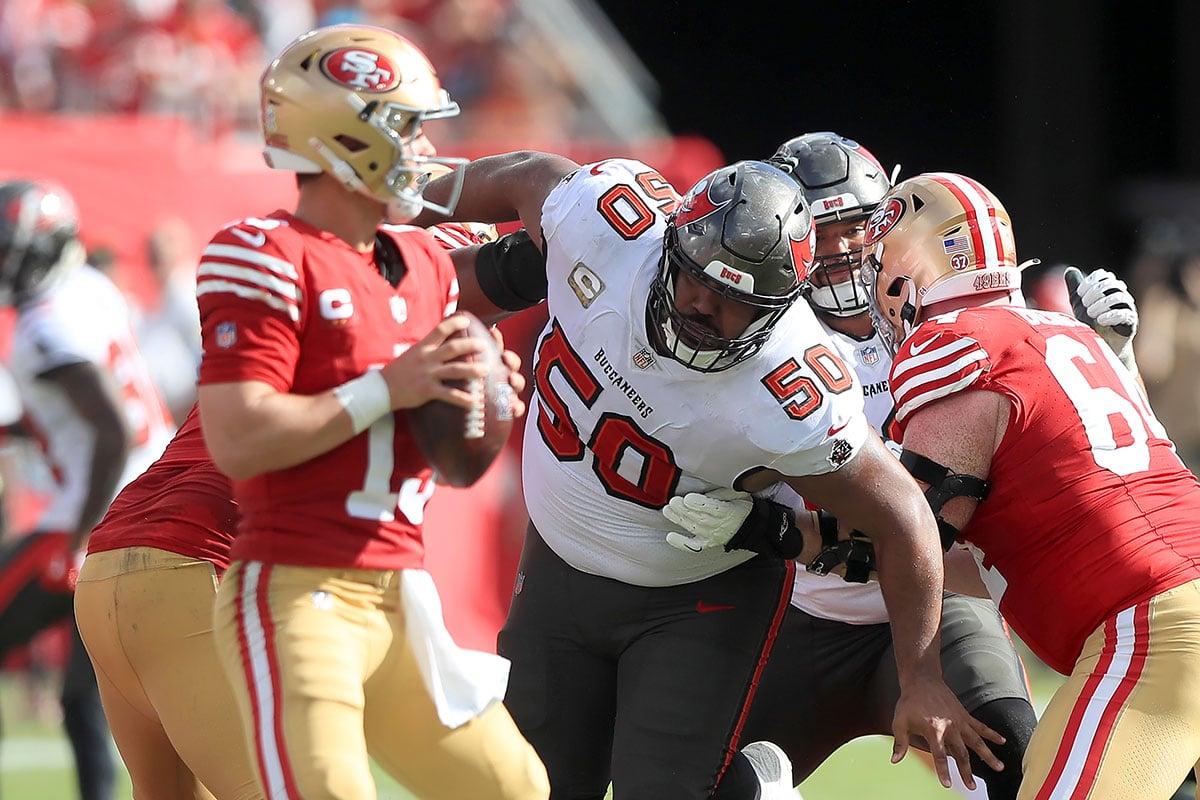
The salary cap details of Vita Vea’s contract extension with the Bucs are now coming to light. Greg Auman of Fox Sports originally reported, and we at Pewter Report can confirm, that the Bucs are using a $21.7 million bonus, prorated over five years, as part of Vea’s compensation for 2026.
That means his salary cap number this year will reduce drastically from its original $22,194,462. And the 2026 savings will help the Bucs manage some very large salary cap figures in 2027. Here are the details:
- Total cash for the deal is $48 million over two years
- 2026 full compensation is up from $18 million to $24 million
- The $21.7 million bonus, prorated over five years, nets just a $4.34 million salary cap charge for 2026
- Vea will also receive $2.3 million in regular salary. The entirety of this goes as a salary cap charge for this year.
- Vea also had $4,194,462 in prorated signing bonus cap charges from his most recent contract that remain parked in this year.
- His total cap charge for 2026 is now $10,834,462. That’s $11,360,000 less than what he was originally set to count against this year’s cap.
- In 2027 he will receive a $24 million salary, all of which will count against the 2027 cap.
- His 2027 cap number should be $30,624,000 ($24 million salary plus $4.34 million proration from this year’s bonus plus $2,284,000 of proration from his 2022 deal).
- Vea’s dead cap charge in 2028 will be $13,020,000
- The team was able to keep the $1 million of per game roster bonuses for 2026 in the new deal as well as apply them to 2027.
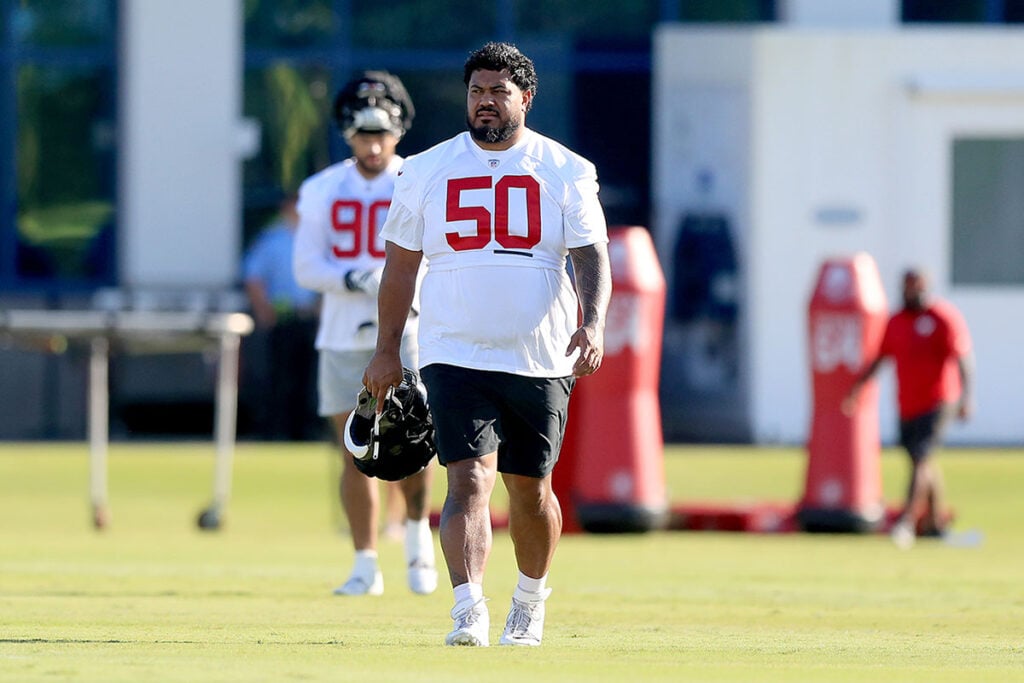
Bucs DT Vita Vea – Photo by: Cliff Welch/PR
How Vita Vea’s New Contract Impacts 2027 And The QB Franchise Tag
The cap savings in 2026 from this contract extension should push the team’s 2026 cap room to about $19.2 million. After accounting for upcoming injured reserve and practice squad charges for the year, the team should clear about $12.5 million of that to roll over to 2027. That’s important as the team looks ahead at a looming franchise tag for quarterback Baker Mayfield.
As it stands right now, the Bucs have about 37 players under contract for 2027 who are likely to make the roster, including Vea. Those 37 players represent about $270 million in salary cap charges. The Bucs also have $32.75 million in dead cap charges they must absorb, so long as they don’t extend Baker Mayfield prior to the end of the 2026 league year. This number was $35 million, but with Vea’s extension his dead cap charge is now represented as a part of his total 2027 cap number.
That totals to about $302.3 million in committed salary cap, including the dead cap money. I am currently estimating the 2027 salary cap at $330 million. That puts the team’s projected cap room in 2027 at $22.7 million. Add in the estimated $12.5 million of salary cap rollover and the team is planning on just over $40 million in cap room for 2027.
The franchise tag for Baker Mayfield in 2027 isn’t set in stone, as current estimates place it between $47 and $50 million. I believe it should land at about $48.5 million, leaving the team short $8.5 million in cap space.
From there the team has plenty of maneuvers they can employ to create additional space including restructures OR roster cuts in some cases of players like Chris Godwin, Tristan Wirfs, Antoine Winfield Jr., Ben Bredeson, Luke Goedeke, Zyon McCollum, Cade Otton and now Vita Vea. Those moves could create up to $82 million in cap space. That is more than enough space to handle Mayfield’s tag, the 2027 rookie class and filling in the roster with a few cheap veterans.
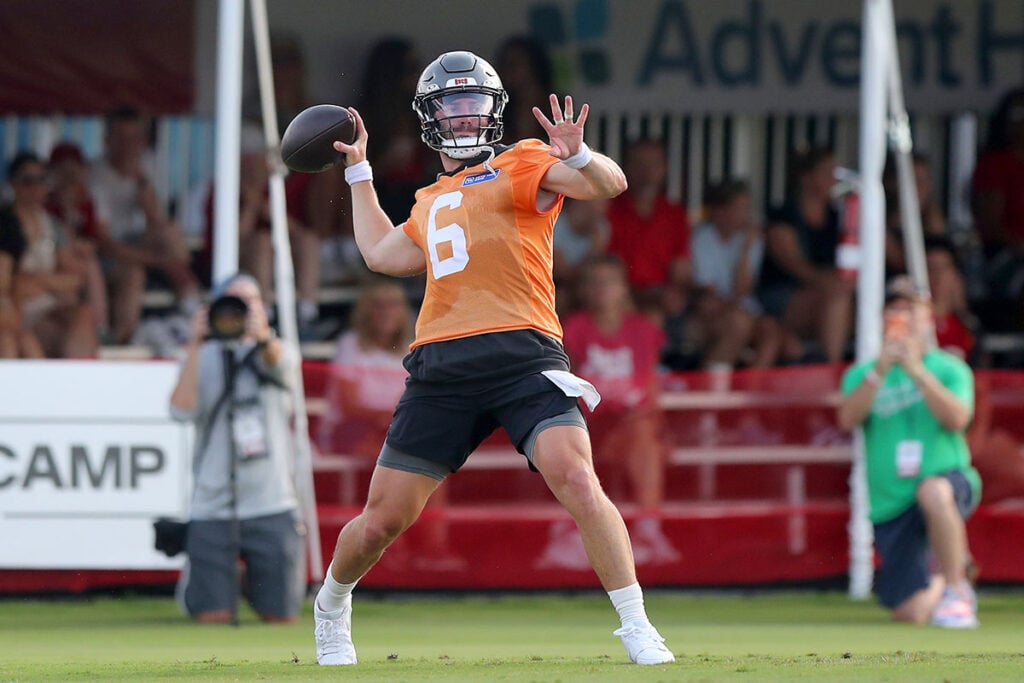
Bucs QB Baker Mayfield – Photo by: Adam Warren/PR
The important thing to note here is that the $30 million in dead cap from Mayfield’s current deal is not really $30 million. It’s actually $18 million. $12 million was going to hit the team’s salary cap in 2027 regardless of whether they extend him, tag him, or let him walk. The difference between an extension and the tag, in terms of dead cap, becomes the $18 million acceleration. But even that has no real bearing on their decision.
The Bucs have treated dead money as sunk costs for years. They don’t play the “let’s extend to push off dead cap charges” game that other teams play. For all intents and purposes that $30 million of dead cap doesn’t have a name next to it from the team’s perspective and it is no different than the over $50 million in dead cap charges they have absorbed in previous years from the contracts of former Bucs like Shaq Barrett, Mike Evans, Ryan Jensen and Tom Brady.
The decision, from the team perspective, is not a $78 million decision regarding Mayfield.
The net effect of this deal, strictly speaking from a cap perspective, is twofold. First, the team saves just over $11 million in cap space in 2026 that they can roll over into 2027. And secondly, that cap savings, plus the absorption of his previously dead charge, turns Vea’s $30.6 million cap hit in 2027 into a more palatable $18 million net cap hit in 2027. The Bucs have filled their starting nose tackle role with a still very good Vea while not hurting their cap flexibility to retain Mayfield on the franchise tag materially.
The Real Cost Of The Vita Vea Contract Extension
Let’s push past the salary cap. Because the real constraints aren’t tied to that accounting measure. This extension does have a larger impact because of the cash element. The cash owed to the 37 players I noted above now totals about $212 million. That doesn’t count Baker Mayfield because he’s not under contract (yet) for 2027.
And whether the Bucs get an extension worked out or use the tag, they will spend about $50 million in cash on him next year. That pushes their cash obligations to $262 million. Based on historical trends, the Glazers tend to tie cash spending closely to the salary cap.

Bucs OLB Yaya Diaby – Photo by: Cliff Welch/PR
Assuming they do that again in 2027, that leaves the team with just $68 million to fill out another 15 roster spots at about $1.2 million per spot, sign their rookie draft class, re-sign key players like Cody Mauch, Yaya Diaby and Chase McLaughlin and pay for their practice squad. Just budgeting for the practice squad, draft class and league min signings costs budgets $35 of that $68 million.
That leaves them with just $33 million left for Mauch, Diaby, McLaughlin and any external free agents they may want to pursue.
That’s not a lot of wiggle room.

Josh Queipo joined the Pewter Report team in 2022, specializing in salary cap analysis and film study. In addition to his official role with the website and podcast, he has an unofficial role as the Pewter Report team’s beaming light of positivity and jokes. A staunch proponent of the forward pass, he is a father to two amazing children and loves sushi, brisket, steak and bacon, though the order changes depending on the day. He graduated from the University of South Florida in 2008 with a degree in finance.
 Bucs Rookie CB Ayden Garnes Is Strictly Business
 Jalon Daniels Sparks Bucs In 16-15 Preseason Win Over Chiefs