
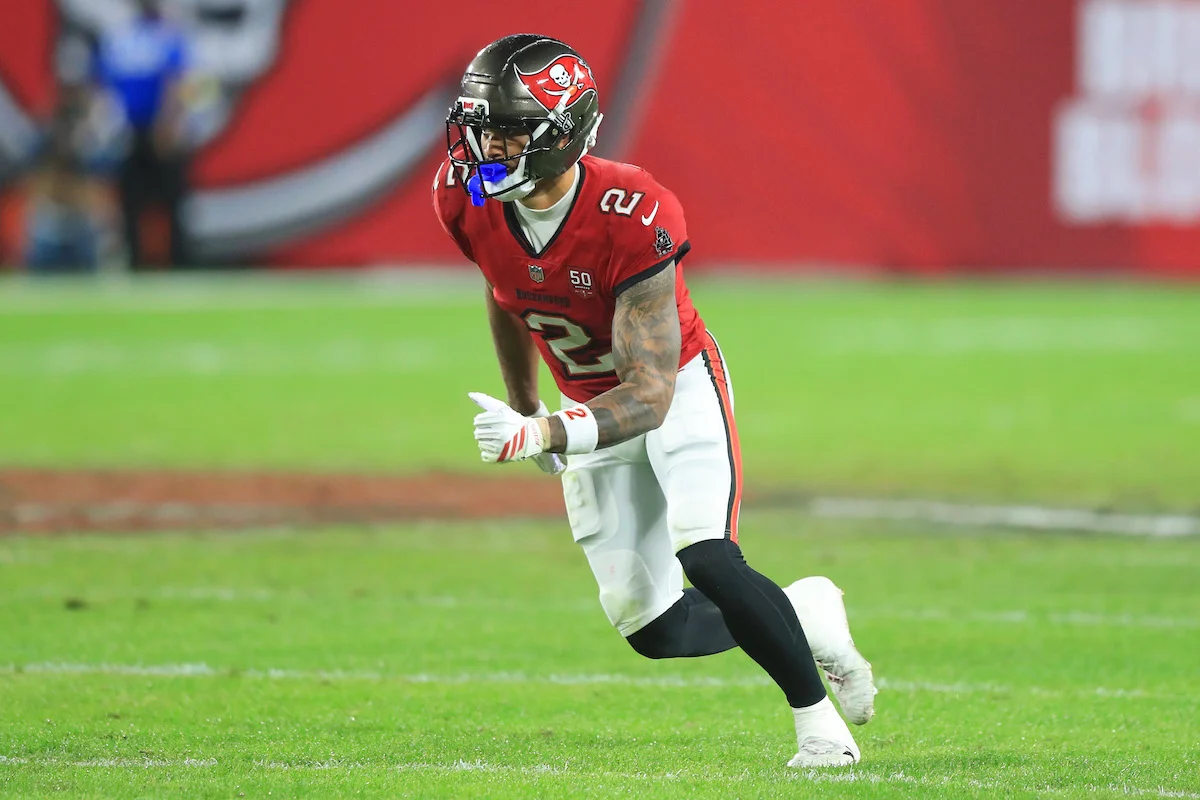
After looking at the first and second quarters of Emeka Egbuka’s rookie season, the back half of the season is where his production really cratered. We left off after week eight, which led into the Bucs’ bye week. Q3 represents a five-game sample from weeks 10-14.
The two active questions I had coming out of the second quarter:
- Can he beat press coverage? This gets answered loud and clear during this part of the season.
- Can he improve his finishing? Touch catches and preventing drops are key for a first-round receiver to live up to his draft billing. Can Egbuka meet that expectation?
Emeka Egbuka’s Q3 Per Game Production
I find it useful to frame his play within a production context. Here is Emeka Egbuka’s per game performance for each of the three quarters:
- Weeks 1-4 per game production – 7.75 targets, 4.5 receptions, 70.5 yards, 1 TD
- Weeks 5-8 per game production – 7.5 targets, 4.0 receptions, 70.0 yards, 0.25 TD
- Weeks 10-14 per game production – 9.4 targets, 4.0 receptions, 48.8 yards, 0.2 TD
With Mike Evans absent from the lineup, the Bucs were trying to replace him with Egbuka as much as they could. His target share went up, but it didn’t translate into additional production. In fact, his catch rate cratered, his receptions per game remained constant and his yards per catch decreased significantly. And the early season scoring frequency all but disappeared.
This creates a hypothesis for the second question — his finishing did not improve as his catch rate was less than 50% for this stretch. But that needs to be verified. If his targets were uncatchable balls, that’s not on him.
This also introduces an important third question. In Q1 his yards per catch was 15.7 and in Q2 it rose to 17.5. This was primarily fueled by him winning downfield. At 12.2 yards per catch in Q3, the question is — how did the downfield opportunities dry up?
Emeka Egbuka’s Struggles Against Gameplans Designed For Him
During this stretch, Emeka Egbuka faced a myriad of approaches to limit his impact. And for the most part they all worked. But by far the most effective was press coverage. Egbuka faced a strong series of press-man corners who effectively shut him out in with press coverage. Christian Gonzalez, Tre’Davious White, Will Johnson, Kool-Aid McKinstry, and Alontae Taylor, among others, held Egbuka to just one catch for eight yards over five games when they jammed him at the line.
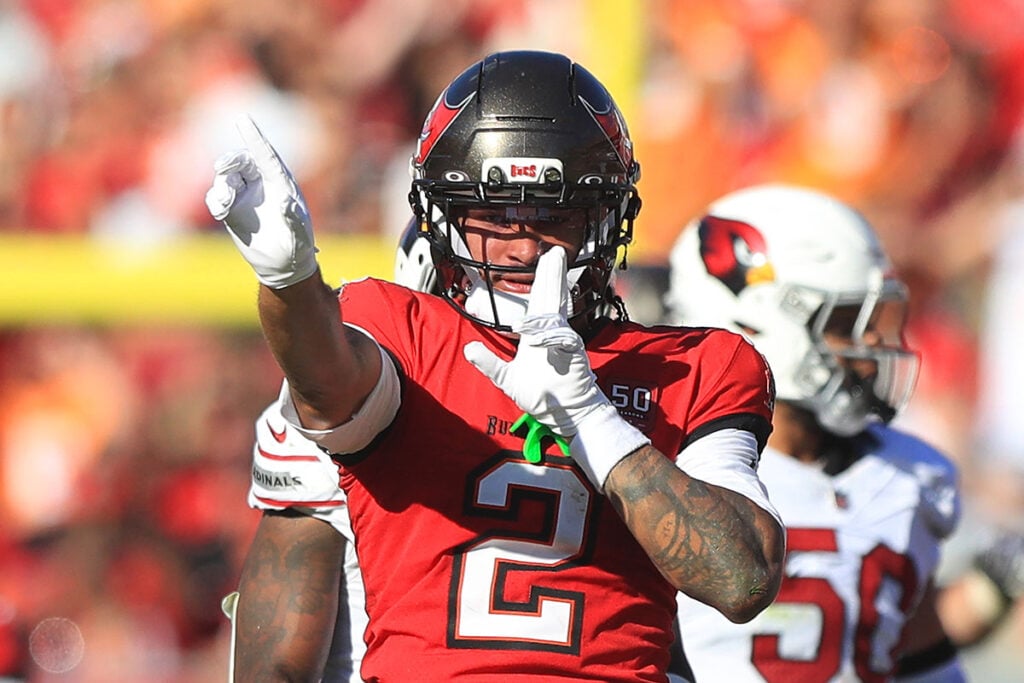
Bucs WR Emeka Egbuka – Photo by: Cliff Welch/PR
He struggled to detach from the jams, often creating next to no separation and effectively taking himself out of the play as an option. When he was targeted on these reps his catch rate was 14%. As long as defenses have a corner capable of jamming, it looks like an effective form of containment for the young Bucs receiver.
This answers one of the biggest running questions. It also shows a limitation to his game that, unless he fixes going forward, will cap him as a receiver. Egbuka’s best role is as an F or Z receiver. The Bucs were forced to mis-cast him as an X in 2025 because of Evans’ absence. This put him in position to face more press coverage which hindered his impact. There is no reason he can’t be a weapon in his more tailored roles, but it does show that if the team needs a press-man winner they will have to look elsewhere.
Former offensive coordinator Josh Grizzard learned this in real time last year. As Q3 of the season progressed, he would follow up a rep where Egbuka was pressed with his next route coming off snap-motion to prevent him from having to contest a line jam. And this is key for Egbuka going forward. More motion, less press.
Alternatively, when defenses switched to zone coverage, they often used brackets to limit Egbuka’s production. Placing a safety over the top killed his ability to win downfield. During the first four games of the season, 29% of his targets went beyond 20 air yards. That fell to 15% from weeks 5-8. And now in the third quarter of the season, that rate bottoms out to 4% — just two total deep targets in five games.
Finding His Intermediate Footing
The first quarter of the season was such an enigma for ‘Mek. Tons of deep targets and wins. But the area of the field he dominated at Ohio State was curiously absent. He had just three intermediate catches for 30 yards. But he started to regain his intermediate wins post-bye. The dig route was a particular winner for him as he caught 67% of his dig targets for 89 yards (36% of his entire yardage for the five-game sample) while averaging 22.3 yards per catch.
He was also getting open on crossing patterns, though he was only targeted once. These longer developing in-cuts are where he is at his best and should be how new offensive coordinator Zac Robinson tailors his game in 2026. Use Chris Godwin Jr., Jalen McMillan or Tez Johnson on a cross from the slot with Egbuka running a shadow over behind it. Those should get him open in space for catch and run opportunities. Alternatively, he could run these deep overs with rookie Ted Hurst threatening vertically on a dagger or salem concept which could also lead to him finding success.
The Finishing
This period of the season saw a plethora of issues conspire to reduce his catch rate. I counted nine targets that he had no real chance on. But he also dropped four passes, including an easy touchdown. That’s a hard pill to swallow for a quarterback looking for consistency from his receiver. Ultimately, I have his adjusted catch rate just north of 50% against the backdrop of a 42.6% catch rate overall. While it is more encouraging than the raw detail, it’s still a far cry from where a reliable receiver should be sitting.
Pro Football Focus had him catching just two of his five contested opportunities, which runs contrary to his college scouting report as a sure-handed pass catcher who can make the difficult grabs.
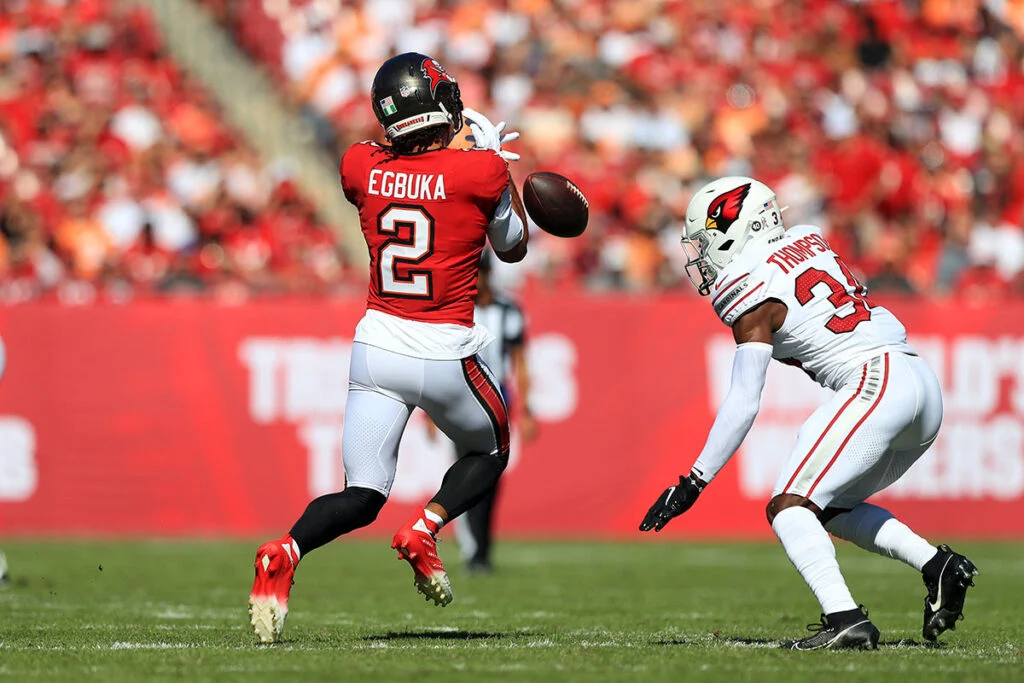
Bucs WR Emeka Egbuka – Photo by: Cliff Welch P/R
The Details
The two other contextual notes I have for this period come down to the details of playing receiver. The first centered on his route running. His route stems lacked consistency and, at times, a sharpness. This showed up mostly on deep corner and out routes. The stem depth oscillated from 14 to 16 yards.
This may be a part of the offense and based off of how defenders played the route, but my guess is that it was more an obtuseness to his route running that needs to be cleaned up — specifically on out-breaking routes. For what it’s worth it happened much less on the in-cuts, showing he has a preference for running those that showed up in his production.
The second was a timing issue with quarterback Baker Mayfield. Especially on quick developing plays like speed cuts to the sideline or quick seam-busters, Egbuka had a tendency of getting his head around late causing the ball to run up on him. This forced him into more body catches that have a lower chance of being held on to.
The good news is that based on reports of his work ethic and his body of work in college, both of these are easily correctable.
The Offense’s Impact On Emeka Egbuka – And His Impact On The Offense
A receiver can only control so much. He cannot control if, and when, the ball comes to him. One other thing that stood out to me were the number of routes he did win but was never targeted. Some of that can be explained by progression mechanics. If he wasn’t number one in the progression and that receiver was open, Egbuka shouldn’t have been targeted. But there was a fair number of times where he could have been targeted, but pressure — whether it be offensive line driven, or sometimes quarterback driven — prevented the ball from coming his way.
While he was still getting a lion’s share of targets, I’d argue some of the forced targets he did see were low quality and there were ample other routes that would have been of much higher quality that could have propelled the offense better. But at this point in the season almost nothing was working on offense, so chalk this up as just one more issue.
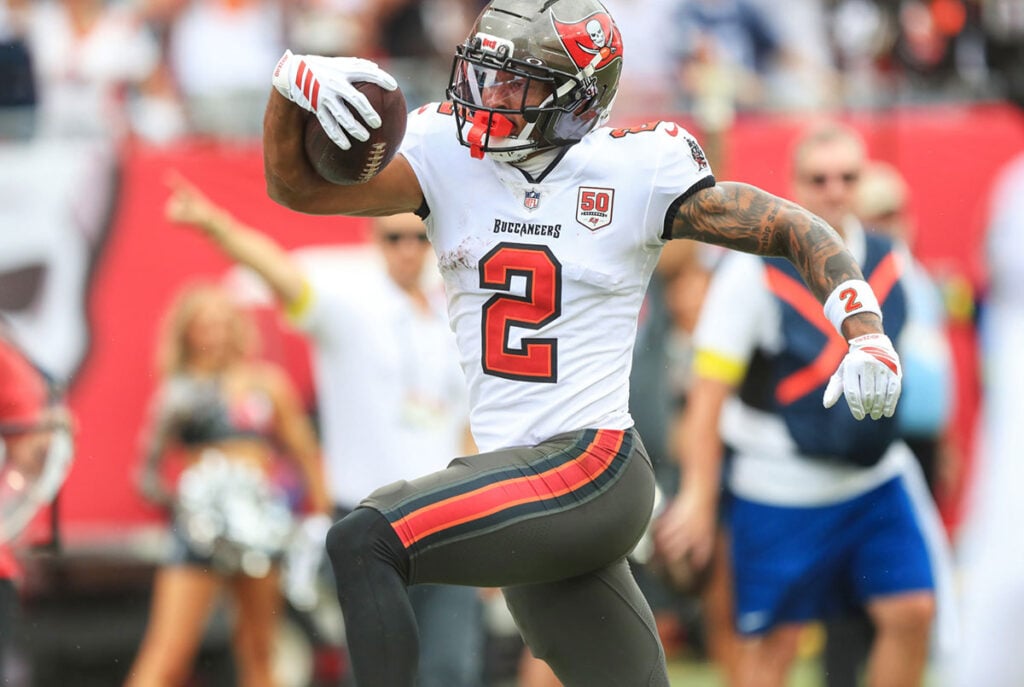
Bucs WR Emeka Egbuka – Photo by: Cliff Welch/PR
Through this five-game sample he continued to show he could find holes in zone coverage and present himself as an open target. The ball just didn’t always find him when he did.
One other note from an offensive scheme perspective was that Grizzard started to weaponize the threat of Egbuka. Two scores during this timeframe were direct results of the defense keying on him and Grizzard using that to get another player open for the touchdown, including the low redzone flat flip to Tristan Wirfs that would not have happened if Egbuka had not cleared the area on his slant. Receiver gravity is real, and Egbuka showed how it can help elevate other players.
Questions Headed Into Q4
Now headed into the final four weeks of the season, I am left with the following questions:
How does Mike Evans’ return change his role, routes, defensive adjustments, usage and production?
This is the whole ball game. He’s been miscast as an X for most of the season. He was crushing early on with Evans in the lineup. Does Evans’ return put him in more advantageous positions to bring back the early season wins? Does the deep threat return? How does he fare against more zone coverage and less press man?
Does his finishing improve?
Given the juxtaposition of how his rookie season has gone in this area against the backdrop of his college career, it becomes a running question that I’m not quite ready to shut the door on.
Can he beat man coverage against a lesser caliber of corner?
Most of his man reps through the middle of the season were against opponents’ top corners. Does he show he can win 1v1 matchups against the CB2 crop? If so, it adds a bit more ceiling to his current projection.

Josh Queipo joined the Pewter Report team in 2022, specializing in salary cap analysis and film study. In addition to his official role with the website and podcast, he has an unofficial role as the Pewter Report team’s beaming light of positivity and jokes. A staunch proponent of the forward pass, he is a father to two amazing children and loves sushi, brisket, steak and bacon, though the order changes depending on the day. He graduated from the University of South Florida in 2008 with a degree in finance.
 Slivon's Slant: Inside The 2026 Bucs Cornerback Room
 Saturday Scouting: 2027 NFL Draft Profile – Drew Mestemaker