
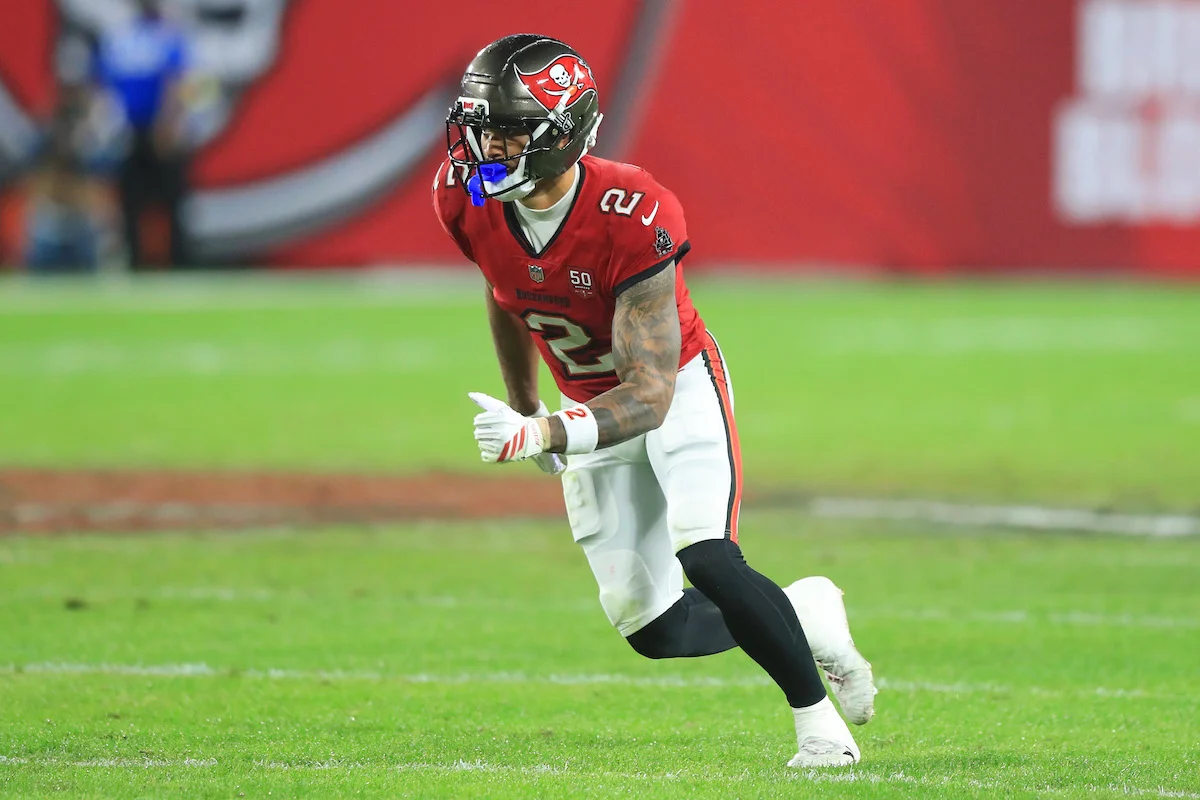
Coming off of an incredible first four games of his rookie season, Emeka Egbuka was establishing himself as a rising star. He had 18 catches for 282 yards and four touchdowns. But Mike Evans missed week four and wouldn’t really return until week 15. Egbuka was transitioning from more natural positions of the F and Z positions to take on the primary X role in Evans’ absence. Watching those first four games I was left with several questions.
- Would his play in the intermediate part of the field improve? For all of the success he had in weeks 1-4, most of that production came at the short and deep portions of the field. But in college he was an intermediate weapon. My theory was that Egbuka was still getting used to the physicality of the NFL game and after adjusting to it this part of his game would improve.
- Could he find a way to beat press? Quinyon Mitchell and Sauce Gardner gave him some trouble with jams. Would more teams try to use that to blunt his production? And could he develop a solution for it?
- Would his contested catch rate improve? Part of the middle of field success he had in college was his ability to make difficult catch-on-collision grabs. But to start his NFL career his efforts in this area were struggling.
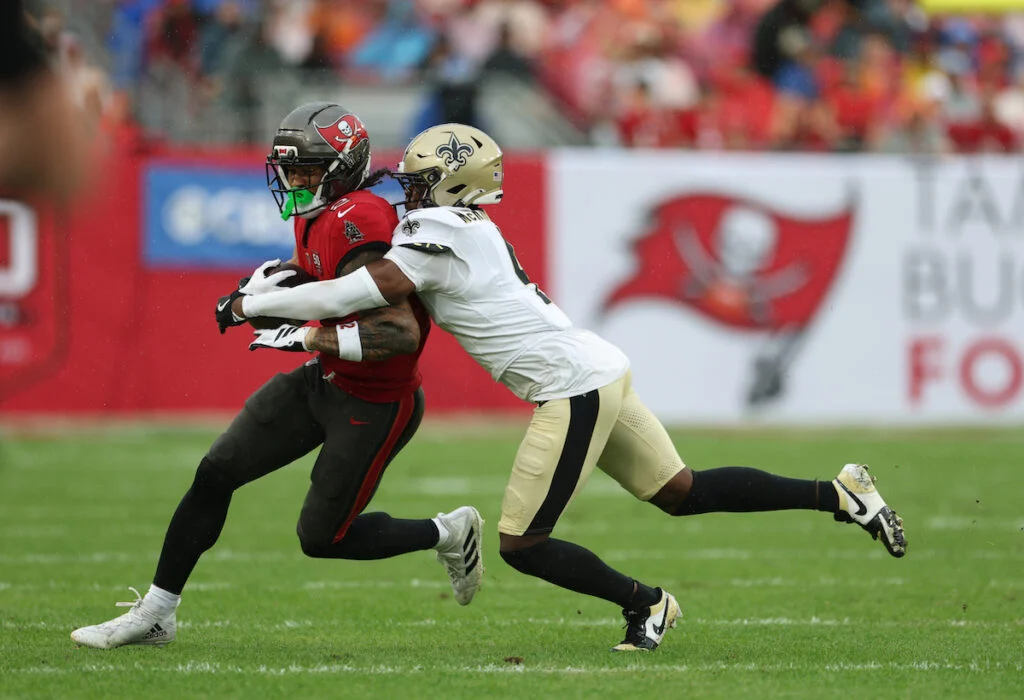
Bucs WR Emeka Egbuka – Photo by: USA Today
What Continued From Q1
The foundation of his game did not move. His best trait coming out of the first quarter was his feel for finding room in zone coverage, and that held up as the most reliable thing he does. Against Seattle he manipulated a Cover 3 rotation to settle an out-and-up into the safety’s blind spot for 24 yards. Against both Detroit and New Orleans he found the soft spot in zone for chunk gains, including a 24-yard catch-and-run with the Saints where he was knocked off his release, regained his balance, and still located the void. When he sees zone, he wins. That continued from weeks 1-4.
The deep ball also stayed a catch point and diagnosis skill rather than a pure speed weapon. The mechanism that produced his early touchdowns was the same one behind his 50-plus-yard reception against Seattle. He wins downfield with technique, leverage and hands, not by running away from people.
His versatility continued to show up, both as a movable piece and as a decoy. The Bucs repeatedly used his routes to move coverage for other people. Against Seattle his clear-outs sprang two separate 27-yard catch-and-runs for teammates. His play was helping the offense beyond his own stat-line.
And the central weakness from Q1 continued too. Separation against press man was the biggest concern coming out of the first four games, and nothing in the second quarter eased it. When a physical corner got his hands on Egbuka at the line, he struggled to detach, the same problem Mitchell and Gardner exposed early. If anything, it became the defining issue of the stretch, with Detroit and New Orleans leaning into press man against him.
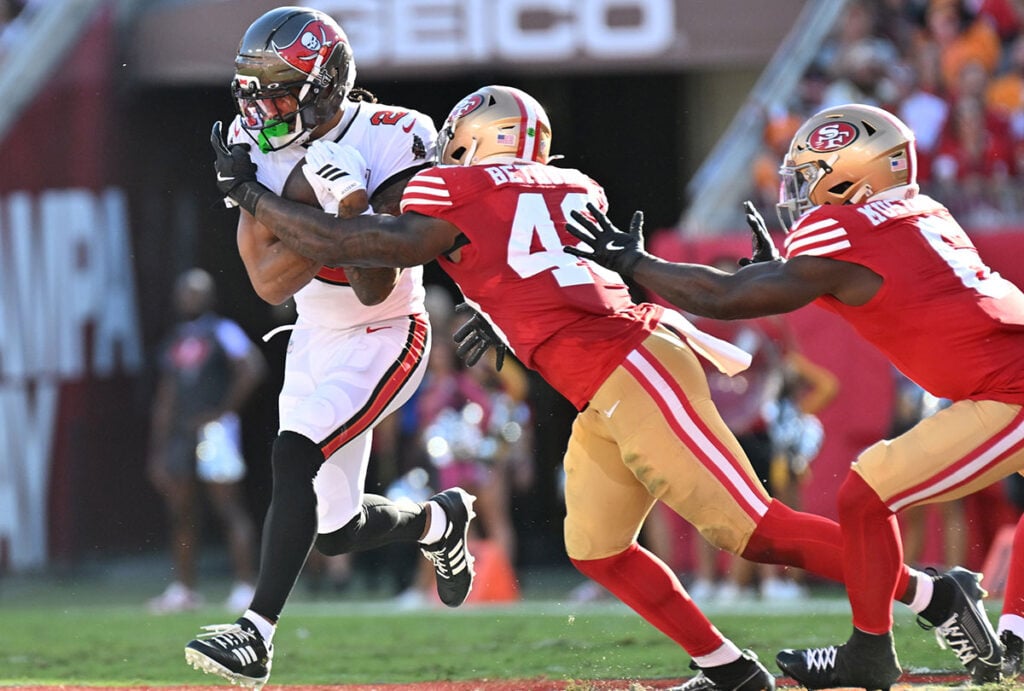
Bucs WR Emeka Egbuka – Photo by: Cliff Welch/PR
What Changed From Q1
The biggest change is the answer to my first question. The intermediate game came back. After catching just one of six targets between 10 and 20 yards in Q1, with that lone reception coming on a broken play, he caught seven of 15 such targets in Q2 on a string of designed concepts. A 19-yard curl settled between zone levels against Seattle. A 13-yard crosser found a void in the middle of the field for 25. An 11-yard dig against Detroit’s Cover 3 opened clean for a catch-and-run. The dead zone became the part of the field they fed him most. My theory that this would come with time looks right, though the mechanism was more about scheme and zone diagnosis than the physical adjustment I had expected.
The most important change is one that was not on my Q1 list, because it did not exist yet. A gap opened between how open he got and what his production showed, and that gap is the strange heart of his second quarter. By separation he was more open in Q2 than in Q1. His average rose and he posted the two highest single-game separation marks of his season. By production he was worse. His catch rate fell, his deep production dried up after Seattle, and his touchdowns nearly disappeared. A player does not get more open and less productive at the same time unless something between the route and the result is breaking.
Three things changed. Defenses started taking him away with man coverage and extra attention, with New Orleans bracketing him with a double and once a third defender. The quality of targets eroded, most glaringly against Detroit, where five of his incompletions came on routes he had won or come open on, including a hung deep ball that should have been a touchdown. And he compounded both with drops, two against San Francisco on adjustment catches and one clean drop against New Orleans on a route he had already won.
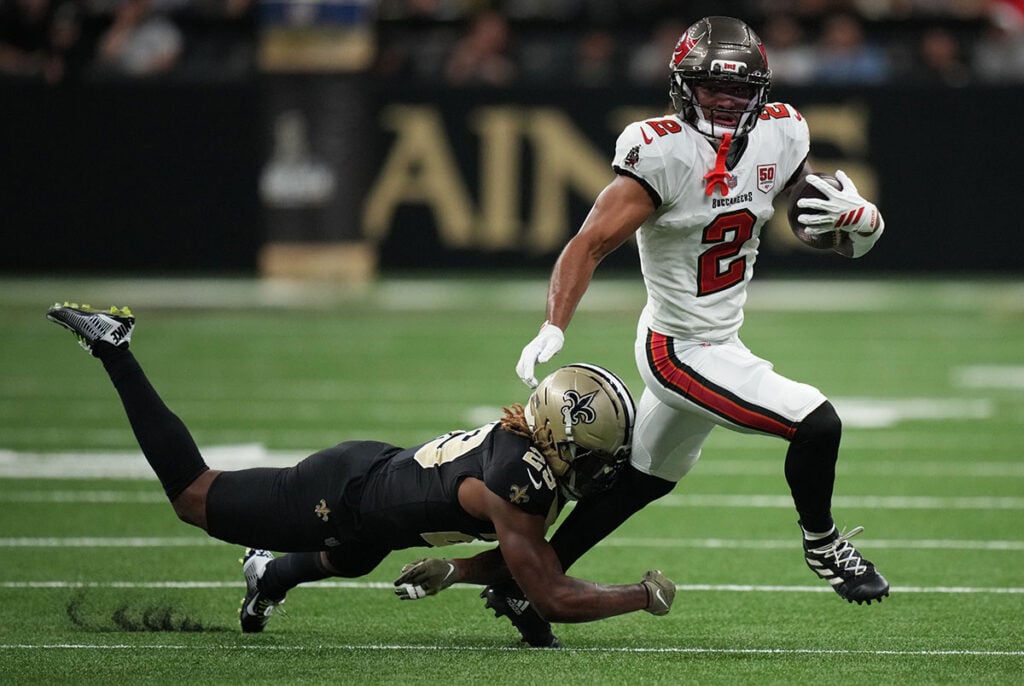
Bucs WR Emeka Egbuka – Photo by: USA Today
The physicality concern from Q1 also changed, and not for the better. In Q1 I framed it as a welcome-to-the-NFL adjustment I expected him to master. In Q2 it hardened into something closer to a trait. Physical corners did not just disrupt his timing, they moved him. New Orleans’ Alontae Taylor jammed and rerouted him, and on two separate reps contact nearly put him on the ground.
New and Existing Questions Headed Into The Second Half of the Season
Egbuka’s production started to slow, in large part due to extra attention from defenses.
- Weeks 1-4 per game production – 7.75 targets, 4.5 receptions, 70.5 yards, 1 TD
- Weeks 5-8 per game production – 7.5 targets, 4.0 receptions, 70. 0 receptions, 0.25 TD
Some of my questions have answers. The intermediate game is back. The deep ball is a real skill, not variance, even if the production cooled. But the second quarter raised harder questions for the back half, which is where his documented collapse actually happened.
First, the existing question that now matters most. Can he beat press man with any consistency, or only flash it? This is no longer a curiosity; it is the single biggest factor in his game. The defenses that gave him trouble all played man, and I expect more of it down the stretch. Across Weeks 10-14 I want to know whether the jam rate increases and can he develop any kind of counters?
Second, an existing question with a new wrinkle. Does the finishing improve? The contested-catch question from Q1 has merged with a new drop problem. His hands look excellent on balls in his frame and shaky when he has to adjust to an off-target throw, with a clean drop mixed in. For a player whose production already rides on a narrow set of wins, leaving plays on the field is expensive.
Third, the new one. Is the production gap a quarterback and offense problem that persists, or does it close? If he keeps getting open and the throws keep missing, the story of his cliff is not that he fell off. Is the connection broke? I want to chart how often he is open and not targeted, and how often the throw is the thing that fails.
And one piece of context shifts underneath all of it. He has another quarter of the season without Evans that forces him into the X role more. But in weeks 15-18 Evans returns. How does that change Egbuka’s usage, usage rate and production?

Josh Queipo joined the Pewter Report team in 2022, specializing in salary cap analysis and film study. In addition to his official role with the website and podcast, he has an unofficial role as the Pewter Report team’s beaming light of positivity and jokes. A staunch proponent of the forward pass, he is a father to two amazing children and loves sushi, brisket, steak and bacon, though the order changes depending on the day. He graduated from the University of South Florida in 2008 with a degree in finance.
 Bucs Confirmed For 2026 Joint Practices With AFC Foes
 Bucs CB Zyon McCollum Working On His Eyes For 2026 Season