
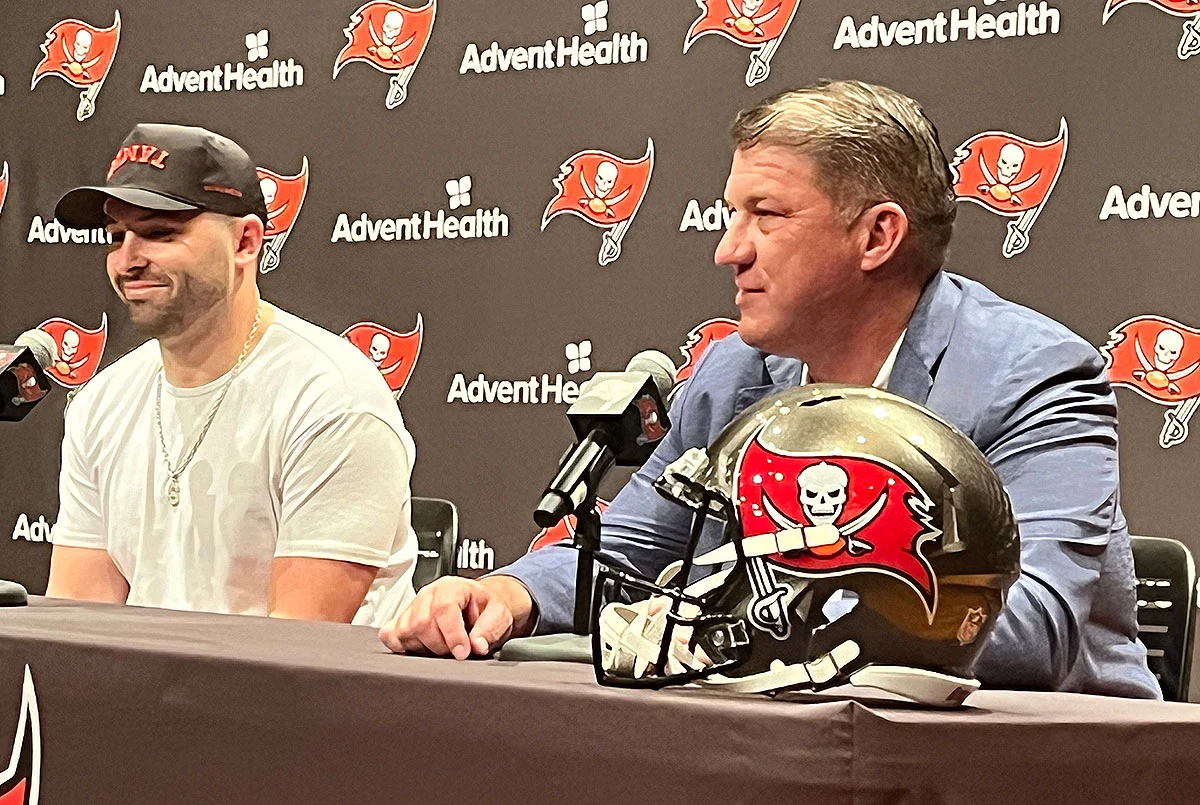
We are now over two weeks past Baker Mayfield’s deadline for a new contract. And he seems resolute in his desire to put the negotiations behind him until after the 2026 offseason concludes. Bucs general manager Jason Licht said during his recent media availability that he would leave the door open to get the deal over the finish line before that, but things appear to be done for now and both sides will have to wait for the 2027 offseason to rekindle negotiations.
Mayfield said the two sides were far apart on multiple fronts but proactively offered length of the offer as the most disappointing part of the whole ordeal. And I think that a little cited rule in the NFL-NFLPA Collective Bargaining Agreement may be to blame for why the Bucs offered Mayfield a shorter contract – one that he didn’t like at all.
The NFL Funding Rule And How It May Be Hurting The Bucs’ Negotiations
The Collective Bargaining Agreement calls for teams to ensure that fully guaranteed money in future years is set aside in an escrow account immediately upon execution of the guarantees. This account has to hold the club’s future fully guaranteed commitments to players, less $15 million. In the case of Baker Mayfield, assuming the two year, $100+ million offer reported by Jeremy Fowler of ESPN was close to, if not fully guaranteed, then the team would essentially have to set aside $140 million or more – immediately. That would be his current salary for 2026 plus the 2027 and 2028 guaranteed salaries.
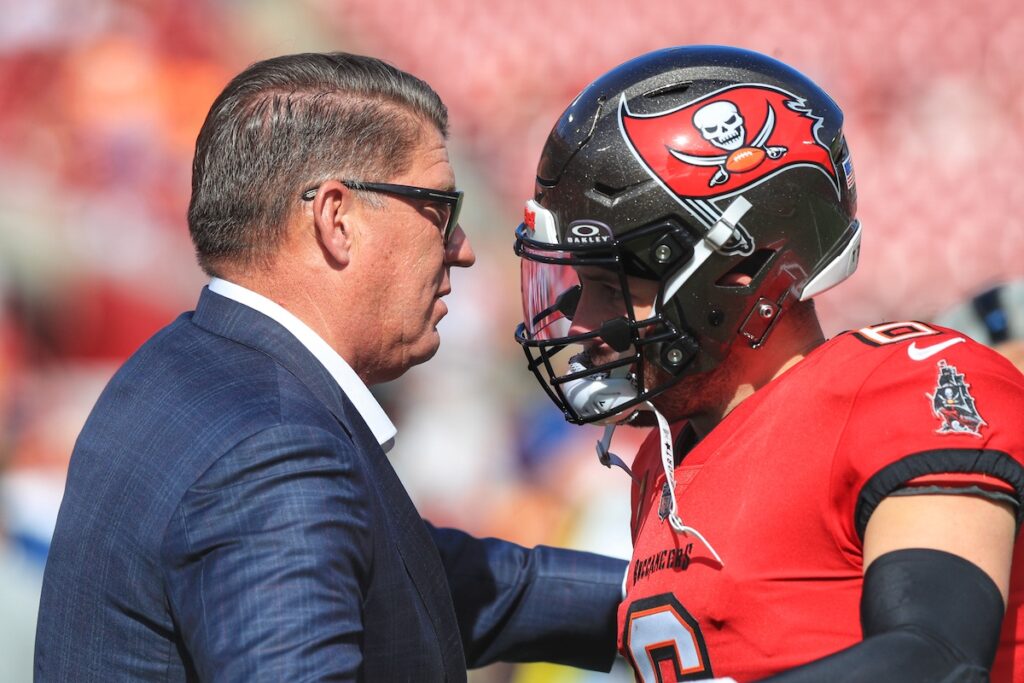
Bucs GM Jason Licht and QB Baker Mayfield – Photo by Cliff Welch P/R
That’s a lot of money to essentially no longer have access to if you are the Glazer family. And it doesn’t count the salary outlays for the rest of the roster for 2026 season. Now imagine if their offer was for more than two new years (three total). Based on comparable contracts – and Fowler reported Mayfield’s representation was citing Jordan Love, Brock Purdy and Trevor Lawrence as the comps he was targeting – all carrying full or year-ahead rolling guarantees into a third new year.
A year-ahead rolling guarantee is a guarantee that takes effect after the initial contract is executed, but a year ahead of when the guarantee is to be paid out. Using Lawrence’s deal as an example. His 2024-2026 salaries were all fully guaranteed. I am assuming the Bucs’ offer was similar in nature guaranteeing all, if not most of, Mayfield’s compensation for 2026-2028.
But the Jaguars also fully guaranteed $29 million of Lawrence’s $41 million 2027 salary at signing. The other $12 million became fully guaranteed earlier this year. The guarantees “rolled” from signing to 2026, and the portion that was guaranteed in 2026 was 2027 salary (a year ahead of payout). I believe this could be why the Glazers balked at a third year in the offer, especially since Mayfield turns 32 next offseason whereas Purdy and Lawrence are 26, and Love is 27
The team knew that Mayfield’s side would want either a full or year-ahead full roll of any 2029 compensation, and that would mean they would have to continue to fund the escrow account into 2028, restricting access to more of their money long before it has to be paid out. Because once an owner’s money is escrow for future guaranteed money it can’t be touched, invested or used elsewhere until it is paid out in those particular future seasons. That’s a lot of investment capital sitting in an escrow account that isn’t even accruing any interest.
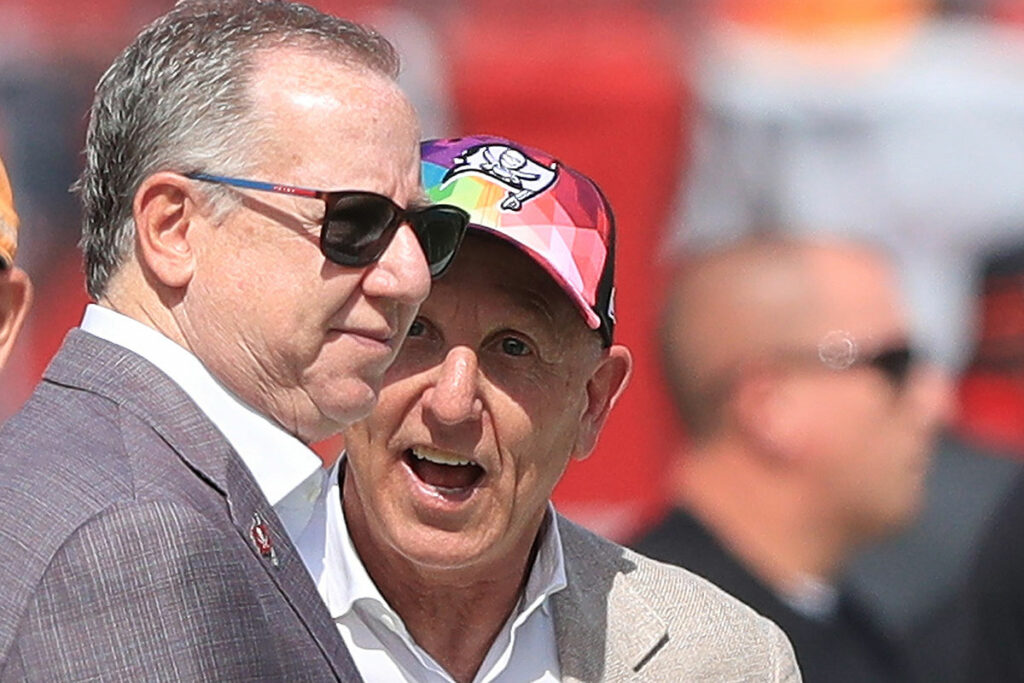
Bucs owners Bryan and Joel Glazer – Photo by: Cliff Welch/PR
Is The Funding Rule Necessary?
The funding rule has long been a part of the NFL’s Collective Bargaining Agreement, harkening back to a less successful period in NFL history. It was put in place to ensure that should an owner become insolvent and players would still be able to collect their guaranteed earnings. But that’s not the NFL of today.
With franchise values in the billions, should an owner be unable to make payroll they would just sell the team to a new owner with the financial wherewithal to realize those obligations immediately. The funding rule has outlived its usefulness and just needlessly ties up tens or hundreds of millions of dollars in owners’ money for the purposes of escrow.
A rule that once was in place for player protection may now be working against player interests, dissuading some ownership groups from committing to guaranteed money that requires more than two years of escrow funding. And the Glazers may be one such ownership group.
The Bucs have never committed to a contract where full guarantees would require them to fund escrow for more than two years. Baker Mayfield’s current contract ended up with guarantees in the third year, but his first year’s salary did not go into escrow. The closest has been Vita Vea, who had a year-ahead guarantee of under $7 million for his third new year. But that amount was under the $15 million “deductible” teams get on the escrow account. In 2024 they guaranteed 2025.
As it stands, I believe this could be a real part of why the negotiations stalled. And why 2026 will be such a pivotal season for Baker Mayfield and the Bucs.

Josh Queipo joined the Pewter Report team in 2022, specializing in salary cap analysis and film study. In addition to his official role with the website and podcast, he has an unofficial role as the Pewter Report team’s beaming light of positivity and jokes. A staunch proponent of the forward pass, he is a father to two amazing children and loves sushi, brisket, steak and bacon, though the order changes depending on the day. He graduated from the University of South Florida in 2008 with a degree in finance.
 Baker Mayfield: “I Want My Lick Back” After Bucs’ 8-9 Season
 Bucs WR Emeka Egbuka Injury Update