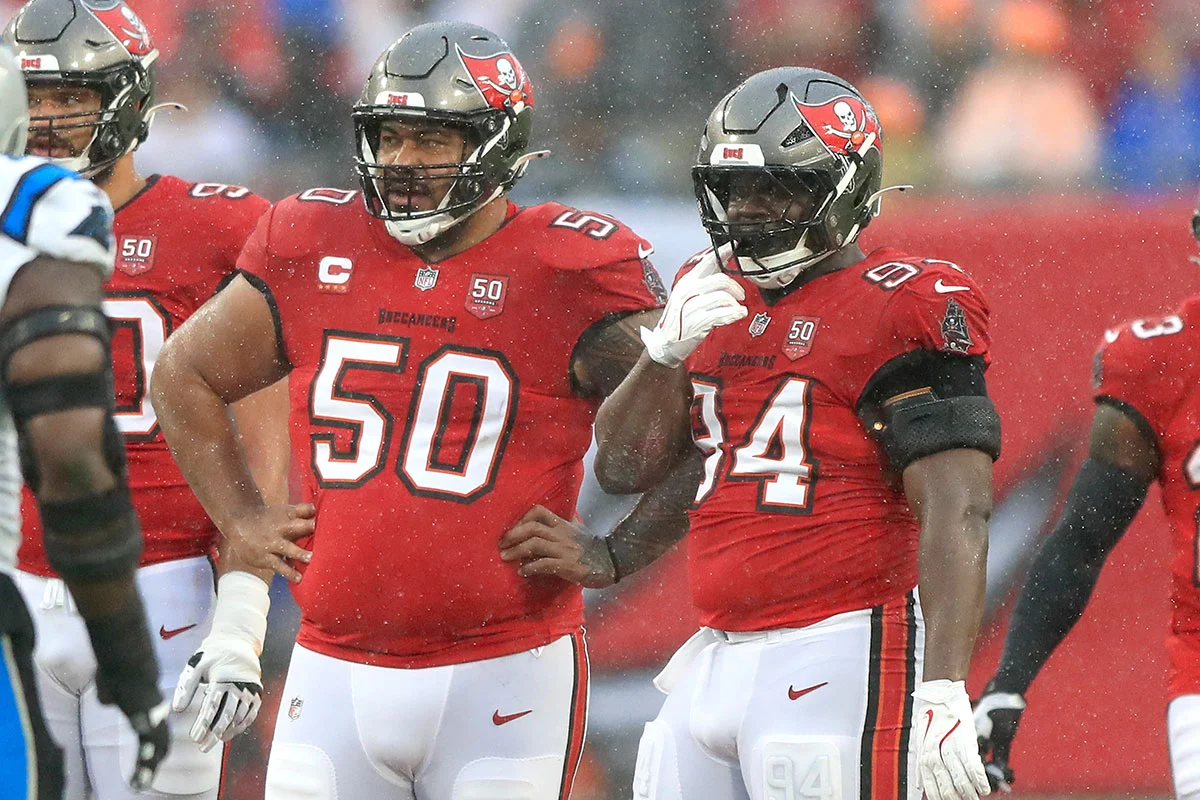
In the NFL, Cover 4 refers to a defensive coverage that aims to cover four deep zones on the field. Following that lead, I’m going to provide you with the same coverage of the Bucs – your favorite football team. Each Wednesday morning I’ll cover four areas as they apply to Tampa Bay: 1. a short film breakdown, 2. a finance angle, 3. a look forward at what’s to come, and 4. a bit of fun.
Film: Calijah Kancey’s Impact
The Bucs have quite possibly the best four-man pass rush since head coach Todd Bowles arrived as defensive coordinator in 2019. There may or may not be a player with Shaq Barrett’s impact, but the floor has certainly been raised. Yaya Diaby, Rueben Bain Jr. and Vita Vea provide a fantastic 1-2-3 punch. But the guy who can, and should, bring it all together is Calijah Kancey.
Kancey has been a tantalizing prospect for three years now. His 81 pressures are in the 62nd percentile among all interior defensive linemen with at least 1,000 snaps since 2023. His pressure rate, which stabilizes for opportunities pushes up to the 73rd percentile. And while he has a reputation as a poor run defender despite his lack of size and length, his stop rate is right at the 50th percentile. It’s an excellent illustration of his boom-bust ability to fit the run.
His gap-shooting helps him make a threat to blow up plays in the backfield (his tackle for loss rate of 2.9% is the highest among all qualifying defensive linemen over the past three years), but he also can also get blown out of the play as long as defenses focus on eliminating him from the play.
What makes him someone who practically lives in the backfield?
Power
Because of his size, Kancey isn’t known as a power rusher. But that doesn’t stop him from winning on bull rushes.
Calijah Kancey's return to action week 18 of 2025 pic.twitter.com/myeWvZUSLu
— Josh Queipo (@JoshQueipo_NFL) July 29, 2026
Kancey leverages his shorter height and quick get-off to explode up into opponents’ chests, driving them backwards and preventing a re-anchor. The result is an offensive lineman dumped in the quarterback’s lap. This pushes the quarterback off of his spot and into panic mode.
Hands
With shorter arms, it is critical for Kancey to keep opponents from getting attached to his frame. That means violent and fast hands are a must for him. And he delivers those traits well, often swiping the outside hand of a opposing guard with his inside hand while pushing through the B gap up field. Alternatively, he can win inside the guard with a mini arm-over with his outside hind to gain access to the A-gap, providing him with the quickest path to the passer.
First Step
All of these traits are paired with an elite first step that he can use both vertically as well as laterally. He can jump from one gap to the next, shoot the B gap to kill a wide zone concept, or beat a double team with a quick split. All of this is predicated on a lightning-fast first step that even when game planned for, leaves offensive linemen unprepared. It also gives him access to winning to either side of an opponent, which is something most defensive linemen just can’t do consistently.
This is where he becomes special fitting the run. Offensive linemen want to get to spots when blocking the run. With his quick first step he can often side-step a lean-in, leaving an opponent falling forward while Kancey has a clear path to the ball carrier. Those tackles for loss are a clear byproduct of this specific trait.
Bend
Kancey is a uniquely versatile player. When discussing interior linemen versatility, the conversation usually centers on can he play out from the nose to a 5-technique. But while Kancey will struggle fully inside, he can stretch past the 5 to a 7-technique, acting as a quasi-edge in exotic packages. That’s because he can bend up and around an arc. It’s not a common ask for someone rushing from inside, but he has put it on tape. And He can use it from a wider alignment.
Kancey’s impact is felt across the defense, forcing quarterbacks to move off their spots and throw quicker, blockers to re-adjust and commit to stopping him rather than climbing to linebackers. He creates opportunities and production for everyone around him. And next to Bain, it gives the Bucs defense two force-multipliers.
Here is a great cut up of each of those traits from NFL analyst Sanjit T.
Calijah Kancey is the best DT in the NFL. People just don't know it yet. https://t.co/jSY49kMDlQ pic.twitter.com/twCbamG72q
— Sanjit T. (@Sanjit__T) August 7, 2025
There is a shot the Bucs can have a special pass rush, and by extension a special defense in 2026. But so much of that is riding on Kancey having a full season. The talent is there. The consistency in the form of availability just needs to show up.
Finance: Vita Vea’s Trade Value
*Writer’s Note – This section was originally written for this Cover-4 article. We at Pewter Report decided to publish it as a standalone article in an effort to get you, the reader, the information as quickly as possible.
On the eve of training camp Bucs defensive tackle Vita Vea escalated his contract dispute with the team by publicly requesting a trade. Vea is seeking a contract extension as he enters the final year of the extension he signed in January of 2022. His $17.75 million average salary is now 19th among all interior defensive linemen and his $18 million cash owed is 13th at his position group for this year.
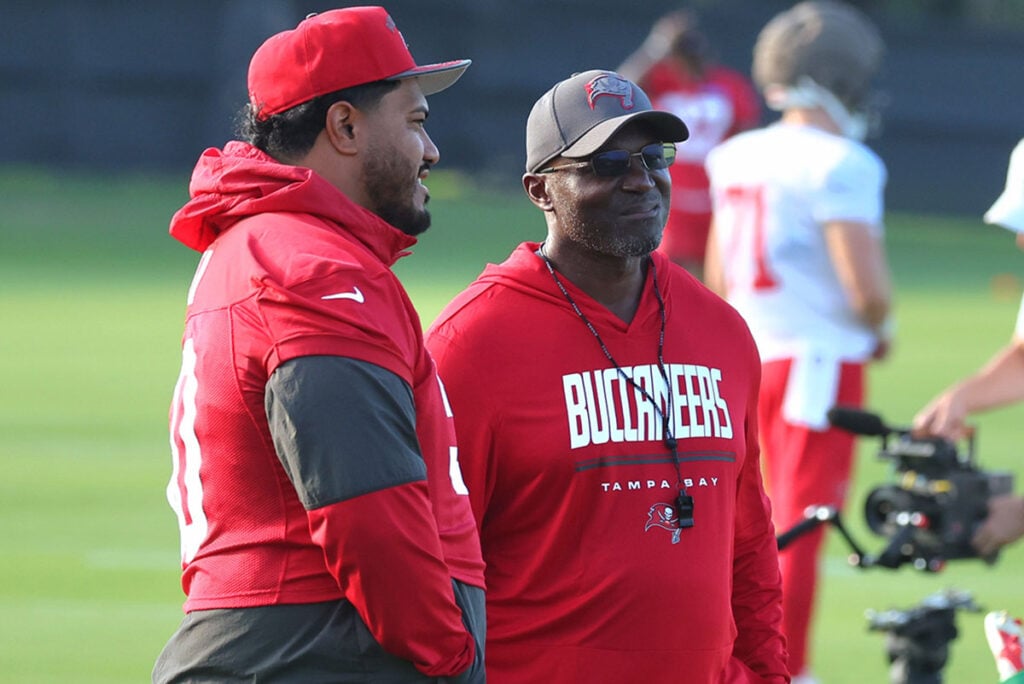
Bucs DT Vita Vea and head coach Todd Bowles – Photo by: Cliff Welch/PR
By comparison he was 15th in snaps, 12th in pressures, 21st in pressure rate, 46th in defensive stops and 29th in sacks last year per Pro Football Focus. Those ranks are almost all down from where he was in 2024, showing the real risk involved with a now-31-year-old defensive tackle. Is Vea currently worth more than the salary the Bucs are set to pay him this year? Yes. Will he continue to be worth it into 2027 and beyond? That’s unclear.
I have maintained, and continue to believe, this all ends with general manager Jason Licht giving Vea a pay raise for 2026 without extending him. A revised salary of somewhere between $21 and 23 million dollars, with potential incentives that could push it higher seems fair. But it won’t satisfy what Vea and his representation are looking for. Namely, more years with guaranteed money into 2027 and perhaps beyond.
Should the situation continue to sour, there will be no shortage of suitors looking to add Vea to their roster this season. But the price they are willing to part with for the Bucs’ big man is not the draft haul many might expect.
Recent Comp Trades
Let’s start with recent trades for defensive tackles. The headliner is the Dexter Lawrence trade from the Giants to the Bengals. Cincinnati gave up the 10th overall pick for “Sexy Dexy”. I’m sure if the Bucs received a similar offer (although hard to nail down equivalent value looking at future draft picks) they would bite the bullet and move Vea. But they won’t get a similar offer.
Lawrence is more than 2.5 years younger than Vita. And while Vea’s production has technically been higher than Lawrence’s of late, most of that comes from how they are asked to play. Both big men are referred to as nose tackles, but the disparity in how they define that role is quite vast.
According to Sumer Sports, Vea ranks 17th in snaps at nose since 2023. Lawrence is #1 and isn’t even close with 1,085 snaps either heads up or as a shade over that time period. Lawrence’s 59 pressures from the nose also dwarf Vea’s 22, although Vea does have the better pressure rate from that alignment at 6.57% to 5.44%. Vea racks up more pressures and sacks because he is put in a better position to get those stats, getting a far greater shake at the 3-technique.
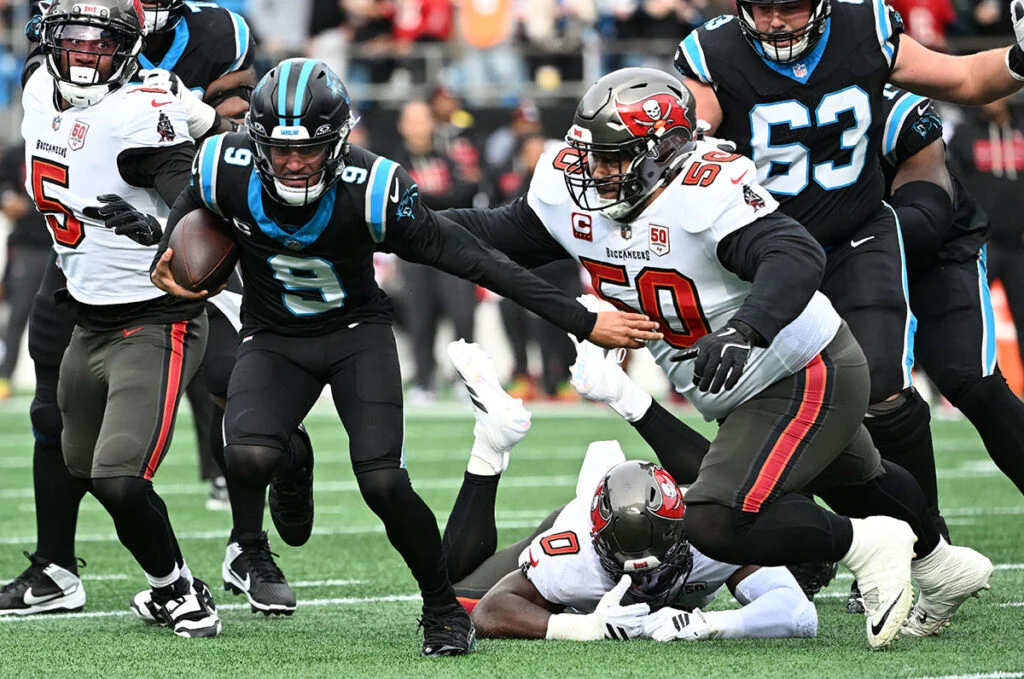
Bucs DT Vita Vea and Panthers QB Bryce Young – Photo by: IMAGN – Bob Donnan
Add in that Lawrence had two years remaining on his current contract when he was traded versus Vea only having one and it becomes obvious that Lawrence is the more valuable trade commodity.
Prior to the Lawrence trade the Cowboys sent defensive tackle Osa Odighizuwa to the 49ers. The price? A third-round pick. Odighizuwa is 3.5 years younger than Vea and had three years remaining on his contract. Now, he hasn’t quite played up to his $20 million per year price tag since inking his current deal, but the 49ers only owe him $16.75 million this year according to Over the Cap, right in line with his current value. Then if his play improves, they have two option years at $20.5 million each.
Where does that leave Vea? His production places his value closer to Lawrence, but between his age and pending free agency, his trade value drops considerably. I have his value at $24 million per year. With him owed just $18 million this year there is $6 million worth of surplus value attached to him, for a total trade value of $30 million according to research I have previously done trying to create a common currency for precisely these types of player-for-pick deals. That’s equivalent to the value of the 78th pick in the draft – a third-round pick.
If a team falls in love with Vea and feels like he is the final piece of the puzzle, I could see an overpay to the tune of an expected late second rounder. But a third is the most likely compensation the team should expect. That will feel light to fans who have seen Vea anchor the Bucs defense for eight years. But trades are just as much about salaries and years of team control as they are about talented players.
Forecast: Bucs Will Be More Successful On 2nd and Long In 2026
Offensive coordinators are a funny group. Often labeled as forward-thinking savants, many still fall into age-old tropes.
One such trope is after a failed first down pass play, many of them shrink up with a 2nd and long run call as a follow up. Of the 25 expected play callers for 2026 with past data, 15 of them call a run on 2nd down after a 1st down incompletion 40% of the time or more.
But there’s a problem with that strategy. Namely, it doesn’t work. From the football social media’s newest star, Ryan Paganetti, formerly of the Eagles, Jaguars and Raiders:
The NFL’s most common overcorrection:
Running on 2nd and 10 after a 1st down incompletion.
Since 2022, passes in this spot have crushed runs:
+16.6 percentage points in success rate
+0.23 EPA/play
+6.5 percentage points in eventual series success rateHere are the 2026 play… pic.twitter.com/d1YzTygEjH
— Ryan Paganetti (@RyanPaganetti) July 7, 2026
Last year under Josh Grizzard, the Bucs ran on 42% of their second downs following a first down incompletion. Their EPA/play on all of those second downs (pass and runs combined) was -0.047 (21st in the NFL) and their success rate was 40% (15th). Those metrics should improve in 2026.
New offensive coordinator Zac Robinson had one of the best offenses in football in that specific situation. The Falcons ranked fourth in success rate in 2025 (51.61%) and 6th in EPA/play (+0.166) last year on second down following an incompletion. And there’s a good reason why. Robinson understands that running in that situation is tantamount to giving up the drive altogether.
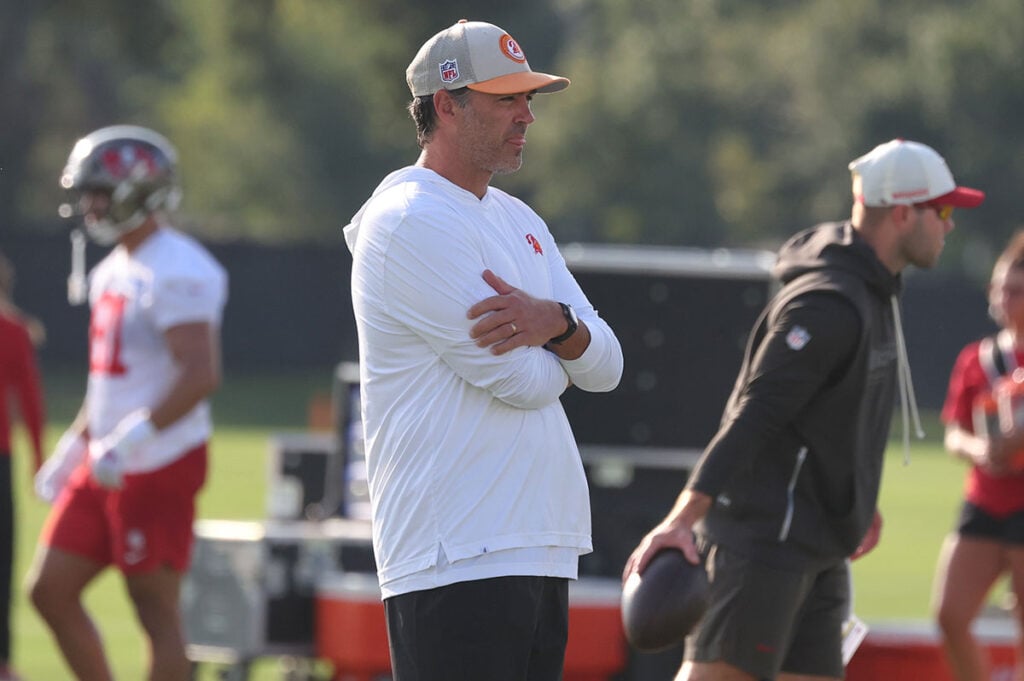
Bucs OC Zac Robinson – Photo by: Cliff Welch/PR
A successful second down for offenses is generally one where they gain 2/3 to 3/4 of the yardage needed for a new first down or touch down. On second-and-10 that means a 7–8-yard gain is needed to get the offense back on track. When the average run play gains 3.5 – 4.5 yards, a run call in that situation is unlikely to yield success. But in a league where the average pass play gains seven yards, a pass attempt gives offenses a legitimate path to gaining a new set of downs.
Where other play callers are conceding the drive and trying to improve the field position game, Robinson yields nothing. He still believes he can attack and wound the defense. And his +50% success rate means he is right more often than not.
And expanding to second-and-long (7+ yards) in general, the Falcons were 2nd in success rate (49.54%) and 9th in EPA/play (+.067), while the Bucs were 16th in success rate (41.26%) and 11th in EPA/play (+0.056), showing they hit some big plays, but struggled to consistently get the necessary yardage to stay on schedule.
Fun Fourth Down: Who Wants To Be A Millionaire? (Not Really)
Let me be very clear at the outset here. Neither Pewter Report, nor I, is offering anyone a million dollars. But the game format is a fun one. Instead of 15 questions I have narrowed it down to nine, so you have a better shot at getting to the end. Let’s see how well you know your favorite team! The twist here is there are no multiple choices here…
$1,000 – This former Bucs first-round pick never played a snap for the Bucs.
$5,000 – This was the last player – not Vita Vea – to publicly request a trade from the Bucs. They did not trade him, and he left in free agency the following season.
$10,000 – How many consecutive losses did the Bucs endure before notching their first win in franchise history?
Your chance to walk away. Do you take it?
$25,000 – How many Hall of Famers have played for the Bucs?
$50,000 – Shaq Barrett’s 19.5-sack 2019 season broke this player’s franchise record.
$100,000 – Only four teams have more playoff wins than Tampa Bay since 2020. Who are they?
Another opportunity to lock in a “victory.” Do you walk away?
$250,000 – This Bucs player is fourth among all non-quarterback offensive skill positions in snaps over the past three seasons at 2,783. He trails only D.J. Moore, Amon-Ra St. Brown and Ja’Marr Chase (per Sumer Sports).
$500,000 – This dynamic Bucs backfield duo combined for 2,763 yards from scrimmage in a single season.
$1,000,000 – In the modern draft era, this player would have been an undrafted free agent. But since he entered the NFL prior to 1994, he holds the distinguished title of best 8th-12th round pick in franchise history after playing eight seasons in Tampa Bay.
Congratulations! You made it to the end. Email me at [email protected] with your answers for a possible prize!

Josh Queipo joined the Pewter Report team in 2022, specializing in salary cap analysis and film study. In addition to his official role with the website and podcast, he has an unofficial role as the Pewter Report team’s beaming light of positivity and jokes. A staunch proponent of the forward pass, he is a father to two amazing children and loves sushi, brisket, steak and bacon, though the order changes depending on the day. He graduated from the University of South Florida in 2008 with a degree in finance.