
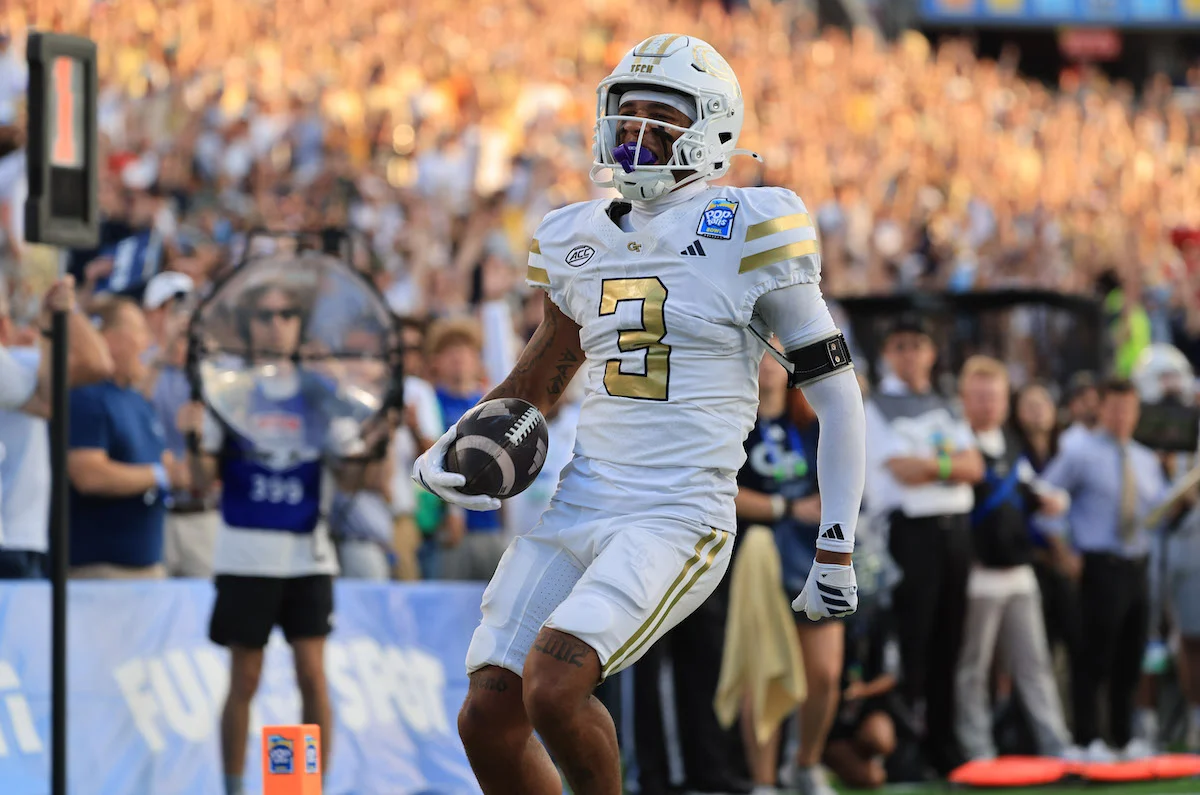
The Bucs have long had a strong receiving corps that has been headlined by Mike Evans and Chris Godwin Jr. Well, Evans is gone and Godwin is coming off the worst season of his career. That leaves opportunities for other receivers like undrafted free agent Eric Rivers to find roles on the team.
Emeka Egbuka and Jalen McMillan will naturally see their roles and snap counts evolve. Rookie Ted Hurst’s profile should expand as the year goes on also. But beyond the top four, the bottom of the Bucs’ receiver room has room for non-expected players to find opportunities to contribute with holdovers like Tez Johnson and Kam Johnson. Rivers may be that non-expected player.
Eric Rivers’ Path To The NFL
A former walk-on defensive back at Memphis he transferred to FIU in 2023 and moved to offense as a wide receiver. In two seasons at FIU, he caught 93 passes for 1,509 yards and 14 touchdowns. His breakout season was 2024 when he posted a 62-1,166-12 line. It also prompted him to make the move to the ACC, transferring to Georgia Tech in 2025. His final year in college football he logged 45 receptions for 649 yards and another two scores.
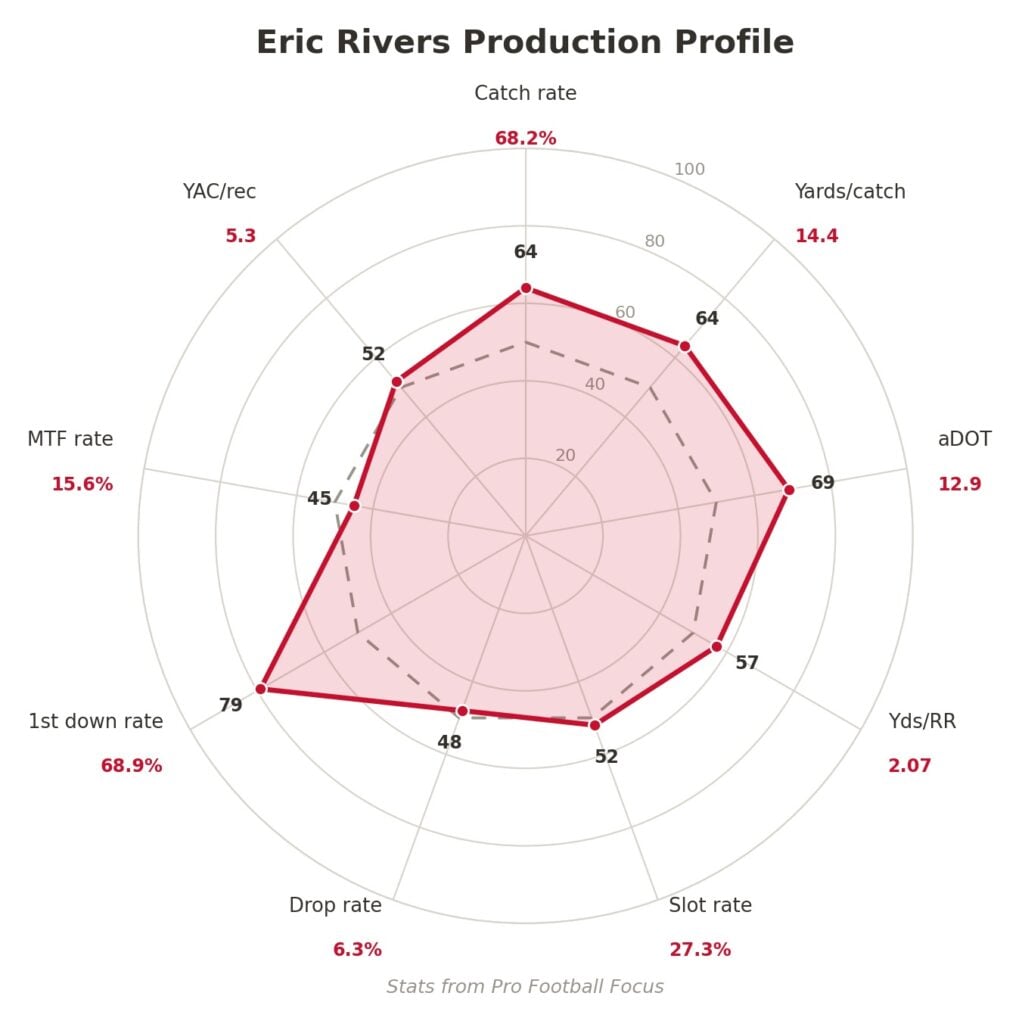
Despite the modest receiving stats, Rivers’ production profile was strong but not elite almost across the board in 2025. His stats from Pro Football Focus.
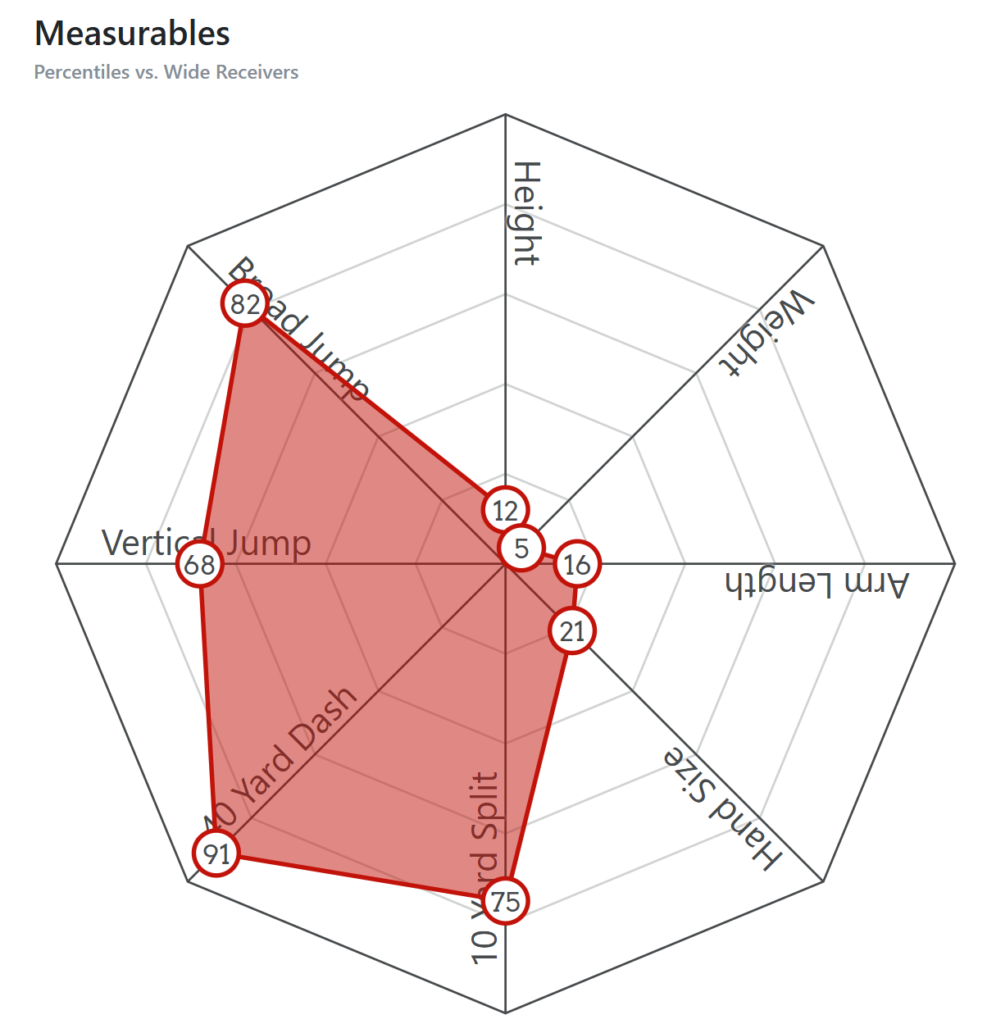
But Rivers went undrafted in the 2026 NFL Draft for a few reasons. His lack of high-end production at the Power 4 level would give NFL evaluators some pause. But that, paired with his small stature and lack of length, makes his NFL prospects a narrow path. Here are his measureables rom Mockdraftable.com.
Height – 5-10
Weight – 176 pounds
Arm Length – 30.5″
Hand size – 9″
40-yard dash – 4.35s
10-yard split – 1.52s
Vertical jump – 37″
Broad jump – 127″
But a narrow path isn’t a closed road. The Bucs like Rivers. They wouldn’t have guaranteed $225,000 of his salary on top of his $25,000 signing bonus if they didn’t think he could provide something to the roster that they felt they needed. What do they like? It has to be the speed.
Tale of the Tape
I watched two full games from Eric Rivers’ 2025 season, Georgia and BYU, along with some highlight reels to get a more robust sample size of routes and catches. The headline: This guy can weaponize his speed, but the limitations in other areas of his game are real and provide a cap on what he can be at the next level. But that doesn’t mean there isn’t a role he can occupy for 3-4 years.
Getting Open
The 40-yard dash time obviously pops off the screen. But the more impressive part of his speed profile is how quickly he can decelerate. That’s what gives NFL cornerbacks the most fits. Can they keep up with a receiver as he breaks down and transitions? For players lined up against Rivers, that answer will often be, no.
Rivers stops at such a violent rate that he throws defensive backs off balance and creates easy separation right at the top of the route. It is every bit the weapon his acceleration is, and it is the reason he is so dangerous on whip and return routes, where he forces a corner to stop, redirect, and re-explode, and then leaves him behind before the corner can do it. He used that exact move twice near the goal line against BYU, one of them for a touchdown to the front pylon.
Going to guess Eric Rivers was really good at tag. pic.twitter.com/Pt6bxG3mSL
— Josh Queipo (@JoshQueipo_NFL) June 4, 2026
The suddenness looks legit, but I don’t think the double start-stop while never moving off the line is going to play in the NFL. pic.twitter.com/lSEaGGS3KY
— Josh Queipo (@JoshQueipo_NFL) June 5, 2026
That movement skill lets him win against man coverage with speed and stop-start, and he is not lost against zone either, showing the patience to settle into soft spots. Against Georgia, the best secondary he faced all year, the Bulldogs respected his speed enough to hedge deep on his motions, conceding the underneath. Rivers took what they gave him on speed cuts rather than forcing the vertical, and the deceleration still created separation against that level of athlete.
The straight-line speed is real, and so is the part that separates a track guy from a receiver. But it’s more than just “go far, fast”. He can modulate his speed, keeping defenders off balance and finding additional gears mid-route. And his ball tracking skills are a genuine plus.
Eric Rivers has real game speed. Mailbox + ball tracking. pic.twitter.com/agGz0N3F4k
— Josh Queipo (@JoshQueipo_NFL) June 6, 2026
The Catchpoint
This is the limiting factor. Rivers posted a 10.1% drop rate in 2024, centered by near-identical rates around 6% in 2023 and 2025. If given the opportunity in the NFL, I think 2024 will be closer to who he is as a pro.
The hands are a real concern. An easy ball on a quick hitch hit him square in the hands and fell to the turf. This wasn’t a difficult grab or a body catch. This was his small hands showing up as an issue on the field, not just the radar chart.
The middle of the field is the hardest projection. Heavy traffic, strong hits over the middle, and the combination of a smaller frame, shorter arms, and smaller hands all point the same direction. His catches are going to need to come with separation, not through bodies, and that narrows the part of the route tree you can ask him to run.
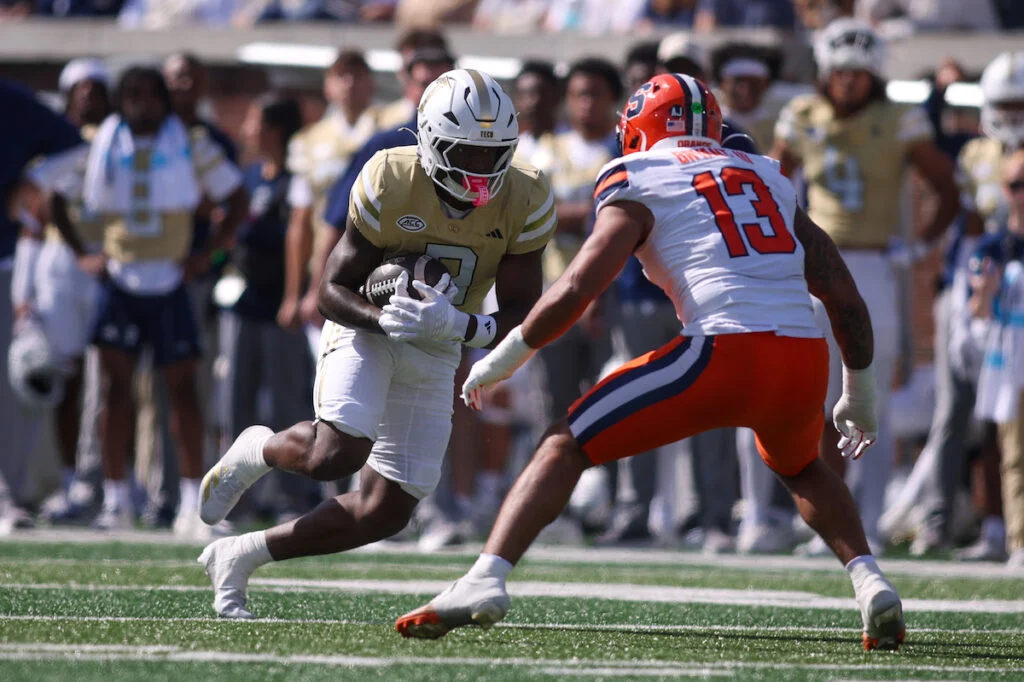
Bucs WR Eric Rivers – Photo by: Brett Davis – IMAGN Images
The one place his size does not stop his effort is as a blocker, where the tenacity is honestly Herculean for a man this small. He works to close on the defender and strikes with everything he has. The results do not always match the effort, and against Georgia some of the size-related losses were ugly, but the willingness is real and it is the kind of trait that travels to special teams and can endear him with coaches.
Speaking of special teams, he wasn’t given many opportunities in college to return punts and kicks, but he did break off a 46-yard punt return against Virginia Tech. With his speed it doesn’t hurt to put him in a competition with Kam Johnson and Tez Johnson to see who brings the best edge in the third phase of the game.
Eric Rivers’ Honest Path to Playing Time With The Bucs
Chris Godwin Jr. is far from the same speed threat he was coming out of Penn State. Emeka Egbuka, Jalen McMillan and Tez Johnson are all smooth movers who surprise defenders as speed gatherers. Ted Hurst has wheels and so does Kam Johnson. But Rivers beats all of them when it comes to pure, adrenaline-seeking, Fast Five, speed.
That’s his edge. He can get downfield faster. And pairing that with the quick breakdown deceleration it gives him a weapon and counter that can fit into a receiver room as something an offense can build off of. Put him in the slot and let him threaten the seams and stretch the field. That opens up slants, digs and crosses underneath – routes that Godwin, Egbuka, Hurst and McMillan can all thrive on.
Against zone-heavy teams, the Bucs can put him out for a few snaps as the X in a 3×1 formation and force brackets against two-high looks or pull the post safety to his side to help account for him as a downhill threat. He can be the corner/go man on Flood concepts. And when defenses try to hedge for him deep he can snap a few hitch/curl/comebacks to pick up yardage underneath.
Add in a few manufactured touches on end-arounds/jet sweeps and perimeter screens and you have the profile of a sideline winner with home run potential who fills a package niche. For $250k guaranteed it’s a safe bet with plenty of upside.

Josh Queipo joined the Pewter Report team in 2022, specializing in salary cap analysis and film study. In addition to his official role with the website and podcast, he has an unofficial role as the Pewter Report team’s beaming light of positivity and jokes. A staunch proponent of the forward pass, he is a father to two amazing children and loves sushi, brisket, steak and bacon, though the order changes depending on the day. He graduated from the University of South Florida in 2008 with a degree in finance.
 Slivon's Slant: Inside The 2026 Bucs Offensive Line Room
 Pewter Pulse: Bucs OTA Standouts From Week 2