
In the NFL, Cover 4 refers to a defensive coverage that aims to cover four deep zones on the field. Following that lead, I’m going to provide you with the same coverage of the Bucs – your favorite football team.
Each Wednesday morning I’ll cover four areas as they apply to Tampa Bay: 1. a short film breakdown, 2. a finance angle, 3. a look forward at what’s to come, and 4. a bit of fun.
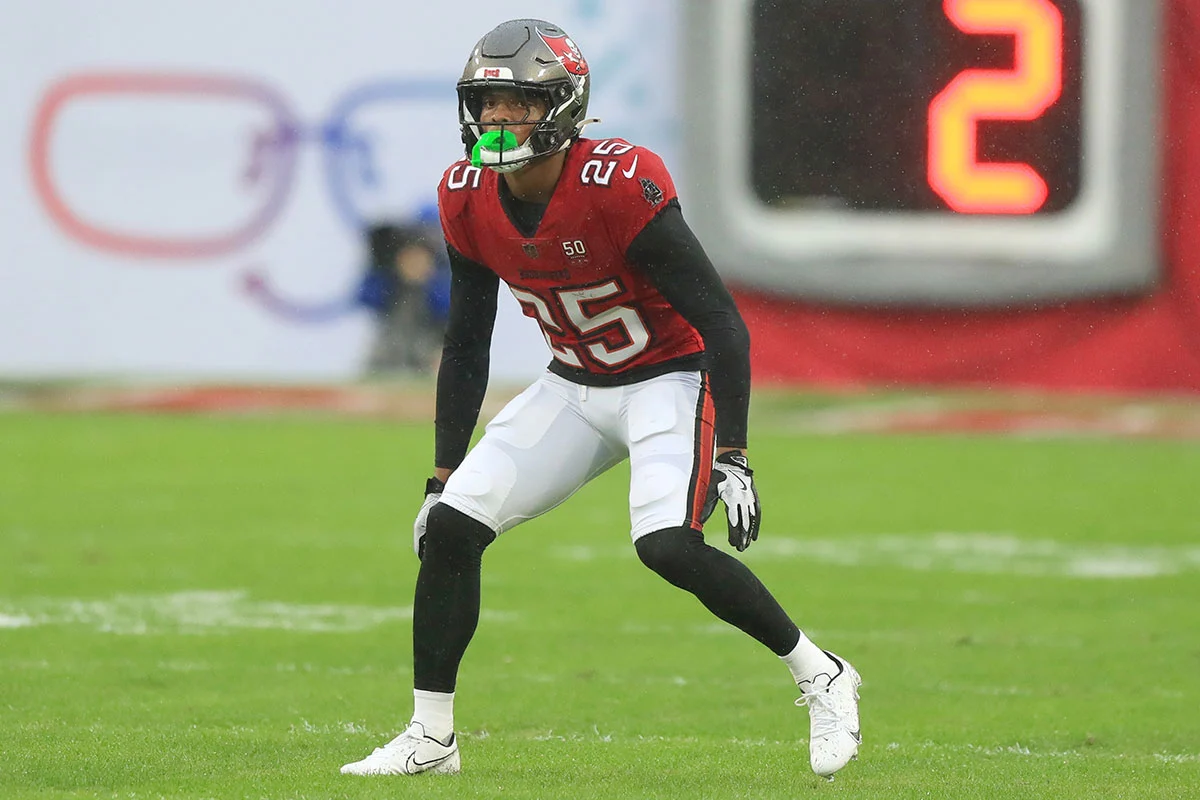
Film: Jacob Parrish As An Outside Corner
In a previous edition of Cover 4 I looked at Benjamin Morrison’s rookie season and gave my honest thoughts on how he might develop in year two. But Morrison isn’t guaranteed the starting role opposite Zyon McCollum. The Bucs have been honest that he is competing for that spot with fellow 2025 draftee Jacob Parrish, who is way ahead of Morrison in that battle. Not just because Morrison missed more time this offseason – the last three practices – with a hamstring injury, but because missed a month of training camp last year, all three preseason games and seven regular season games due to hamstring injuries.
Parrish was selected one round behind Morrison, but had a stronger rookie campaign, playing primarily from the slot. Towards the end of the season he was pushed outside due to injuries to Jamel Dean, Morrison and McCollum, and ended up playing roughly a third of his snaps on the outside.
After some genuinely positive play from Parrish last year and some high-profile losses from Morrison I am of the belief that Parrish has the inside track at the starting outside gig at the moment.
The most exciting part of Parrish’s play is his athleticism. It oozes on just about every rep. His testing speed (4.35) translates to the field and it shows up on more than just long pass plays deep down the field where he keeps up with the fastest receivers in the field. Even more exciting is how he uses his speed functionally against early breaking routes to pounce on outs, curls and comebacks.
An under-recognized part of cornerback play isn’t just how fast a player can spool up to his top speed, but also how quickly he can decelerate and redirect. Parrish can plant and go without a gather step, which shows up most on off coverage, where his click and close turns cushion into a weapon. When the ball comes out, he is already driving, and that closing speed makes him a ball production asset. We saw it throughout last season as he made some key pass breakups while also logging his first interception of the year in Week 18.
Parrish's click and close. pic.twitter.com/N2qi4RCC2r
— Josh Queipo (@JoshQueipo_NFL) July 1, 2026
Suddenness + eyes in right place = INT pic.twitter.com/FgFoYKDmaG
— Josh Queipo (@JoshQueipo_NFL) July 1, 2026
Parrish also redirects to multiple angles without shedding speed, so double moves and hard stems do not stack against him the way they do on stiffer corners. Put it together and he can run with the best receivers in man coverage, matching breaks instead of guessing at them.
Even when matched up against bigger receivers he shows no fear in pressing. Parrish logged plus press snaps against both Tet McMillan and Darren Waller, both easily dwarfing Parrish’s sub-6-foot frame. It didn’t matter. What he lacked in requisite size he made up for with quick feet to stay attached for several yards while slowing each of their routes.
But where his frame did not limit him in press it did show up at the catchpoint where his length hurt him at the top of the catchpoint on more than one rep – most notably against Dareke Young in Seattle for a 36-yard play.
That will have to be an area the Bucs are willing to concede some additional catches over a longer corner, while hoping he makes up for it by forcing quarterbacks to turn down because his phase and coverage was legitimately a blanket throughout most of the year on the outside.
Stop-Start + Redirection pic.twitter.com/zuTWB1y1u1
— Josh Queipo (@JoshQueipo_NFL) July 1, 2026
This is backed up by the numbers where his average separation allowed when targeted (2.4 yards) and his snaps per target (8.8) were better than the league average, but his catch rate allowed was also higher than the average outside corner and higher than expected.
Moving to areas of his game that can stand to improve and are coachable, two things stand out to me.
First, he can bail to half-turn too quickly when he’s playing deep third in Cover 3. When this happens Parrish often leaves himself open to being out of position on a corner or deep out route. This was exploited several times last year, most notably by McMillan and the Panthers. The positive from this is that on other reps when he trusted his backpedal later in the rep he avoided the stem tension and played the ball better. He just has to trust the pedal more.
The second issue is how Parrish plays crossers in zone-match situations. He can be a bit too patient when pinching those routes from a deep alignment, leaving ample space and time for quarterbacks to find those deep over routes for chunk gains. If Parrish can commit to cutting those routes like he does on the perimeter stuff he will level up from his rookie campaign.
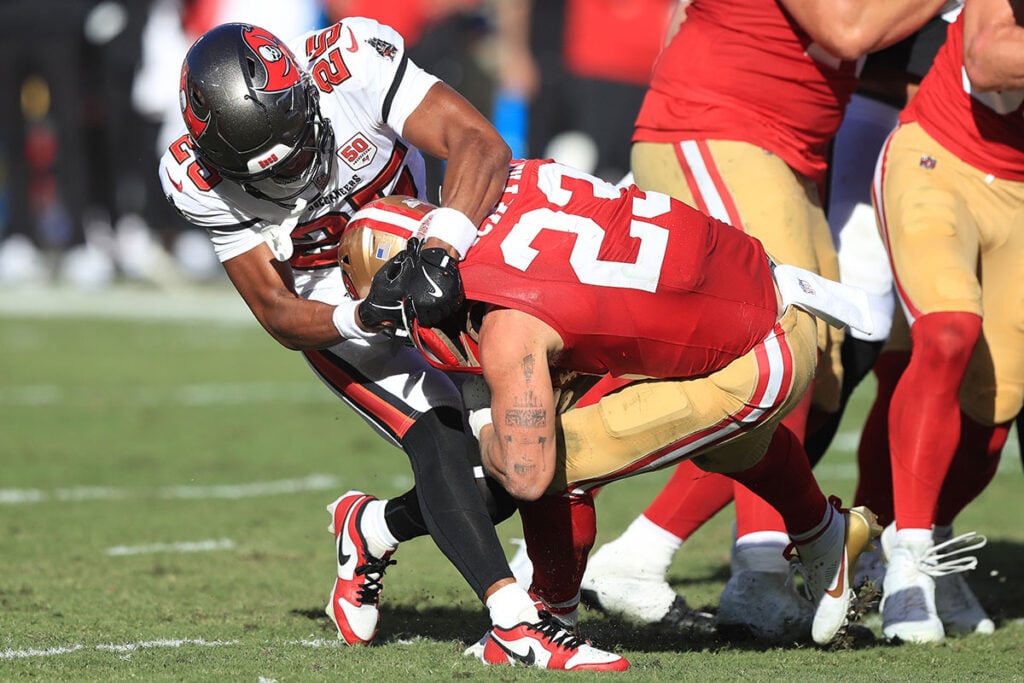
Bucs CB Jacob Parrish and 49ers RB Christian McCaffrey – Photo by: Cliff Welch/PR
As a run defender he brings the same aggressive tenacity that helped Parrish work as a net-positive as a slot corner. He attacks the edges and perimeter screens with a renegade attitude and throws his whole body into his tackle efforts. But his smaller frame shows up from time-to-time leading to an inflated missed tackle rate and more drag down stops than one would like.
Coming back to where the Bucs have signaled they want to take the defense – a more press-man heavy unit where Todd Bowles can get more creative in the back-seven and lighten the load on the front – Parrish profiles perfectly. Despite his stature Parrish can press and carry even the biggest eligibles. His elite athleticism helps him both in zone with click and close as well as man where he can shadow even the most shifty receivers. And Parrish’s plus communication skills, and general smarts will carry the scheme needs.
I have high hopes for Parrish moving forward and think he cements himself as one of the starting outside cornerbacks in this defense sooner rather than later.
Finance: Bucky Irving’s Early Valuation
After a stellar rookie season, Bucky Irving seemed destined for stardom and a giant payday at some point in the future. Over 1,100 rushing yards at 5.4 yards per clip and 1,500 total yards with eight touchdowns.
But fast forward one year and injuries robbed Irving of much of his sophomore campaign. Irving regressed in every measurable way:
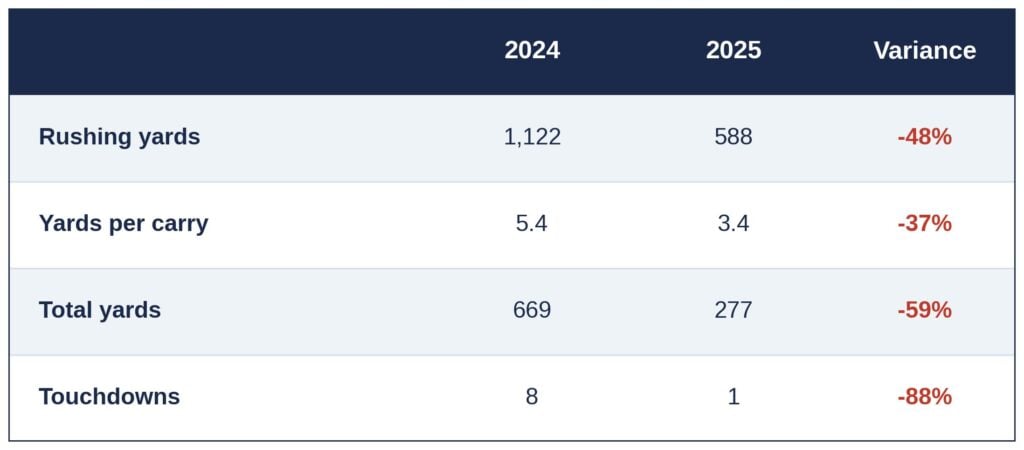
This makes Irving one of the hardest valuations on the team right now. Two seasons. One marked by incredible play and production plus a strong track record of health. The other was basically the opposite in every possible way. Even Irving’s trademarked ability to bounce off of tackles fell off a cliff to the tune of almost a 10% reduction.
Going off of just his rookie season Irving’s APY value would likely be around $13 million per year. But looking at just his 2025, that number is closer to $7 million – which is the going rate for a complementary back with upside (see: Gainwell, Kenny).
But those two seasons don’t operate in isolation. They need to be evaluated as a whole. And two-year sample sizes tend to have the most predictive value in my modeling system. So with that in mind here are some of Irving’s closest comps over that time frame.
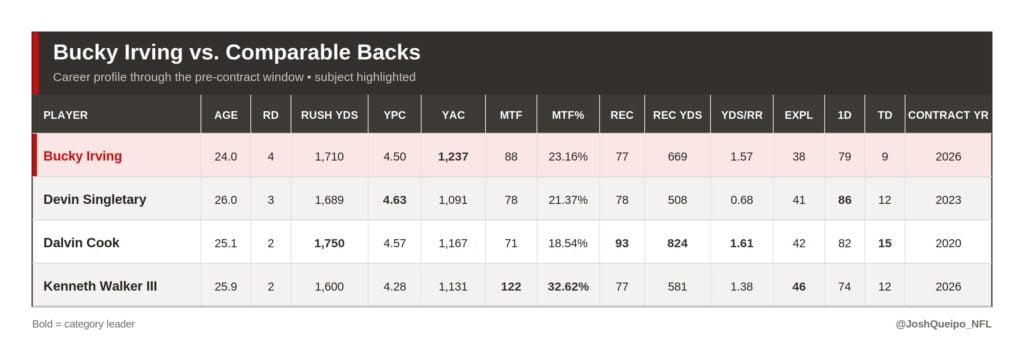
The cap-adjusted APY (average per year) average of these three comps is $12.4 million. Irving’s draft pedigree trails the rest of the group, who were all Day 2 picks, while he was a Day 3 selection. That should balance with his current younger age to keep the projections rather stable.
While the average of the comps is $12.4 million, the spread is a rather large number, ranging from $19.2 million on the high end to $3.7 million on the low. Given that large gap I lean back into my modelling which places his value at $10.25 million per year.
But part of valuation is accounting for directionality. Kenneth Walker III having a similar two-year sample but coming off of a strong season would undoubtedly secure a larger deal than Irving coming off of a disappointing campaign.
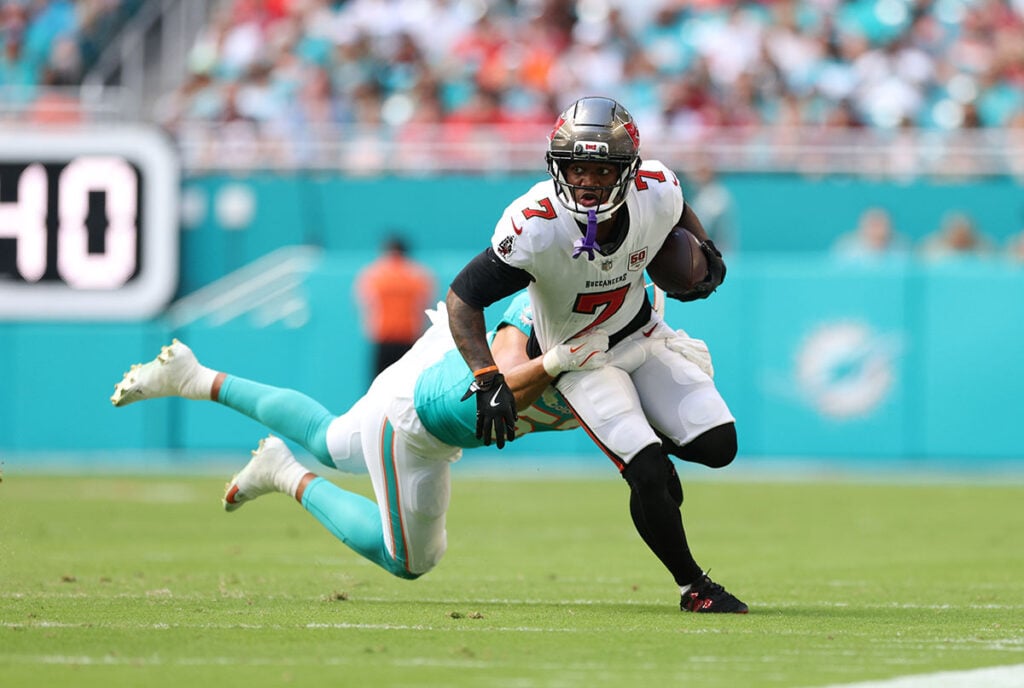
Bucs RB Bucky Irving – Photo by: IMAGN Images – Sam Navarro
Factoring his 2025 season with a projected APY of $7.08 million and a cap-adjusted comp set of $5.11 million puts his 2025 production valuation at just a hair over $6 million. Bringing all of this together I’d peg Irving’s current valuation at $8.5 million. That would make him the 16th-highest paid running back in the league – right between Ashton Jeanty and Chuba Hubbard.
The 2026 season is a pivotal year for Irving. Can he re-establish himself as a lead back worthy of an eight-figure APY? Or will he settle into the secondary market of Gainwell-esque backs who operate as a part of a more committee-based backfield?
Forecast: The Bucs Clear 50 Sacks This Season
Fifty sacks. Todd Bowles has been chasing this one for years. With the exception of last year’s down performance of 37, Tampa Bay has been between 44 and 48 sacks every season since Bowles came to Tampa Bay in 2019 as Bruce Arians’ defensive coordinator.
His high-blitz, stunt-heavy, pressure-by-committee approach has historically put his defenses in the top 5-10 of the league in taking down quarterbacks. The 2024 group finished sixth in the NFL with 46 sacks and did not roster a single player inside the top 35 in individual sacks. Six Bucs’ posted four or more quarterback takedowns. He typically hasn’t asked a single pass rusher to carry the load for everyone like the Browns did with Myles Garrett or the Raiders do with Maxx Crosby.
That model requires a deep bench of passable pass rushers. And last year the lack of depth caught up with the team. This year they may have the best and deepest defensive front since the 2020-2021 heydays.
The two-deep of their front includes former first-round picks Rueben Bain Jr., Vita Vea and Calijah Kancey along with an ascending Yaya Diaby – who may be ready to take the last step to stardom this year. Add in David Walker, who the Bucs are still incredibly high on, and free agent additions Al-Quadin Muhammad and A’Shawn Robinson and this is a unit that can suffer a loss or two, unlike past versions of the team.
With that in mind, here is my forecast for the Bucs’ record-setting 2026 campaign assuming relative health from the bunch.
Starting Four
Calijah Kancey – 375 pass rush snaps, 39 pressures, 6.5 sacks
Yaya Diaby – 435 pass rush snaps, 61 pressures, 10 sacks
Vita Vea – 505 pass rush snaps, 51 pressures, 5.5 sacks
Rueben Bain Jr. – 405 pass rush snaps, 45 pressures, 6.5 sacks
That 28.5 sacks from the starting front goes a long way to getting a defense to the vaunted 50 goal. I’m hoping for health from Kancey because he is the key. Him plus Bain can really create a chaos setting that builds sacks for the group as a whole.
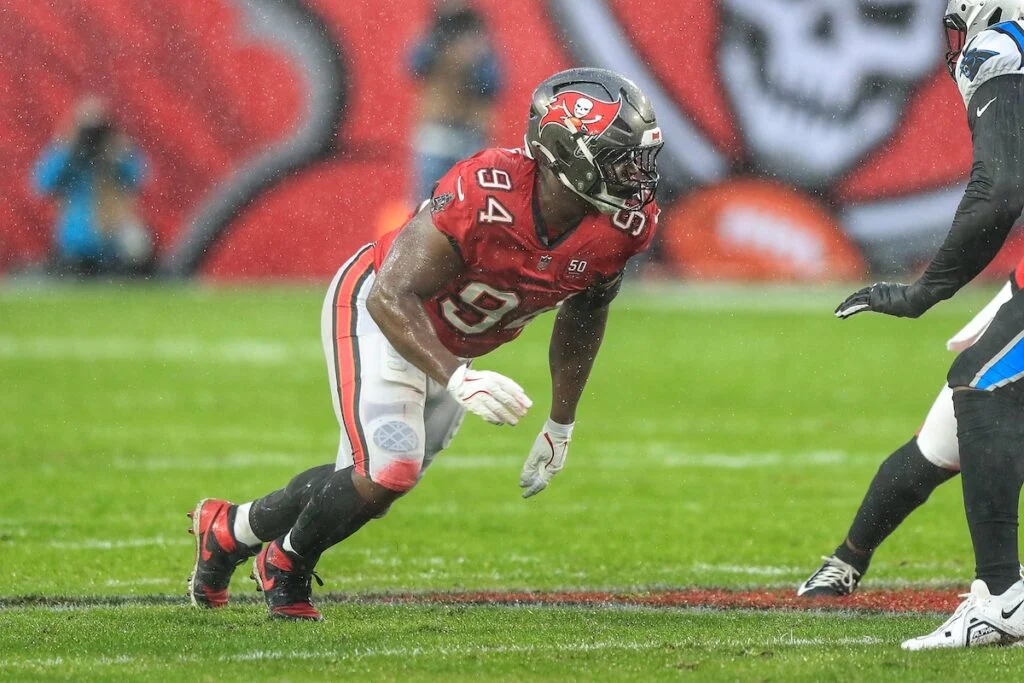
Bucs DT Calijah Kancey – Cliff Welch/PR
Speaking of Bain, 6.5 sacks from a rookie is a really solid entry into the NFL. But I will maintain until proven otherwise that his biggest contributions will be creating for those around him. At the end of his rookie contract many may say he is disappointing because his personal stats might not be gaudy. But the defense as a whole is likely to play better because of him.
Diaby gets to double digits in this forecast, cementing him as one of the 20 best pass rushers in the NFL as his conversion rate improves (thanks to Bain!) while his pressure rate remains strong.
Primary Backups
David Walker – 235 pass rush snaps, 24 pressures, 4.0 sacks
Al-Quadin Muhammad – 150 pass rush snaps, 21 pressures, 3.5 sacks
A’Shawn Robinson – 325 pass rush snaps, 24 pressures, 3.5 sacks
Elijah Roberts – 315 pass rush snaps, 27 pressures, 3.5 sacks
This group really embodies the “four-as-one” mantra with all four players logging between 20 and 30 pressures and 3.5 to four sacks. The net result is 14.5 quarterback drops pushing the team total to 43.0.
Two keys here. One is that Walker out-snaps AQM because he has the higher ceiling and more well-rounded game. The Bucs deploy Muhammad in extremely advantageous spots which helps juice his pressure rate to 14% while Walker’s is a truer and more modest 10.2%. Secondly, Roberts is a more effective pass rusher who logs slightly less snaps than the veteran Robinson.
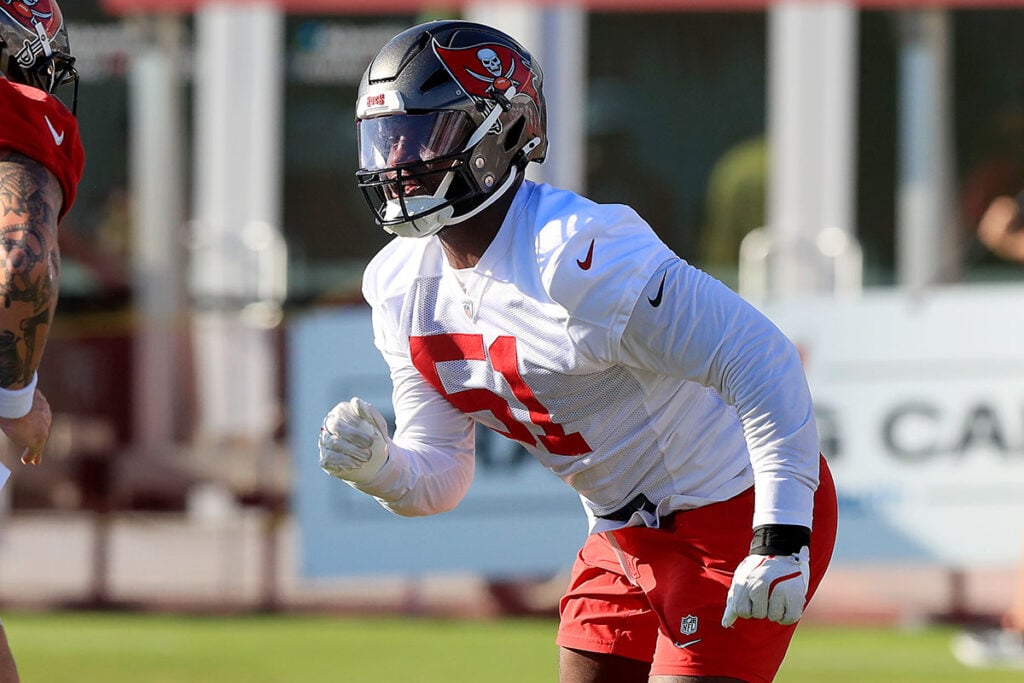
Bucs OLB David Walker – Photo by: Cliff Welch/PR
Key Fifth Men
Anthony Nelson – 58 pass rush snaps, 6 pressures, one sack
DeMonte Capehart – 47 pass rush snaps, 4 pressures, 0.5 sacks
I have Nelson and Capehart as the fifth-man for the outside linebacker and defensive line, respectively. And their low snap counts still yield another 1.5 sacks to push the grand total to 44.5.
That means the team needs another six sacks from the linebacker and secondary rooms. With the additions of Josiah Trotter – the Bucs’ best blitzing linebacker since Devin White left Tampa unceremoniously – and Keionte Scott, who may be the best blitzing slot they have had under Bowles, there is ample room for the two units to compile the extra six sacks.
I believe Scott will net 2.0 on his own with another 3.0 from Trotter. And between Tykee Smith and Antoine Winfield Jr. pressuring on key downs throughout the season another two sacks seem more likely than possible.
That gets the team to 51.5, basically 3.0 per game. General manager Jason Licht has amassed a cavalcade of talent that not only fits Bowles’ scheme, but elevates each other. The net result this year could be special while simultaneously netting a team record.
Fun Fourth Down: Bucs Crossword Puzzle
We’ve broached the trivia side of Bucs history before with a Jeopardy! Game. I thought I would go back to the well, this time paying homage to the Sunday newspaper crosswords I grew up on. Below are 11 clues related to your favorite team. Can you fill the whole crossword in?
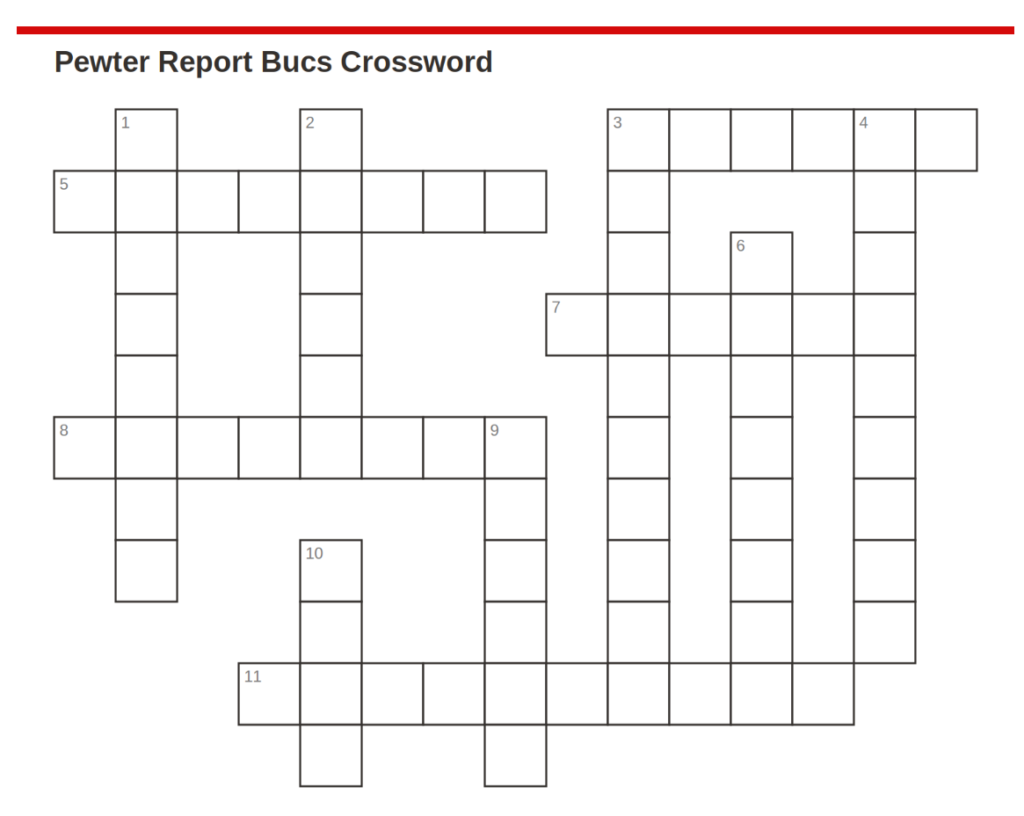
Across
3. Bucs’ biggest rival
5. Player just ahead of Mike Evans on the all-time receiving TD list
7. Tiny Division III college that produced Bucs All-Pro guard Ali Marpet
8. Stadium the Bucs closed by beating the Eagles for the 2002 NFC title
11. Winking pirate on the Bucs’ original creamsicle helmets
Down
1. Bucs’ first stadium, Big ___
2. Bald HOF Bucs player whose has always had a second career cutting hair waiting for him
3. 7th-round slot receiver and returner from Oregon State
4. If Cody Mauch were ever to be cast in a DreamWorks movie, he would assuredly be this dragon
6. Jon Gruden’s favorite car since 2005
9. First draft pick in Bucs history, last name
10. Number worn by Warren Sapp’s biggest rival in Tampa Bay

Josh Queipo joined the Pewter Report team in 2022, specializing in salary cap analysis and film study. In addition to his official role with the website and podcast, he has an unofficial role as the Pewter Report team’s beaming light of positivity and jokes. A staunch proponent of the forward pass, he is a father to two amazing children and loves sushi, brisket, steak and bacon, though the order changes depending on the day. He graduated from the University of South Florida in 2008 with a degree in finance.
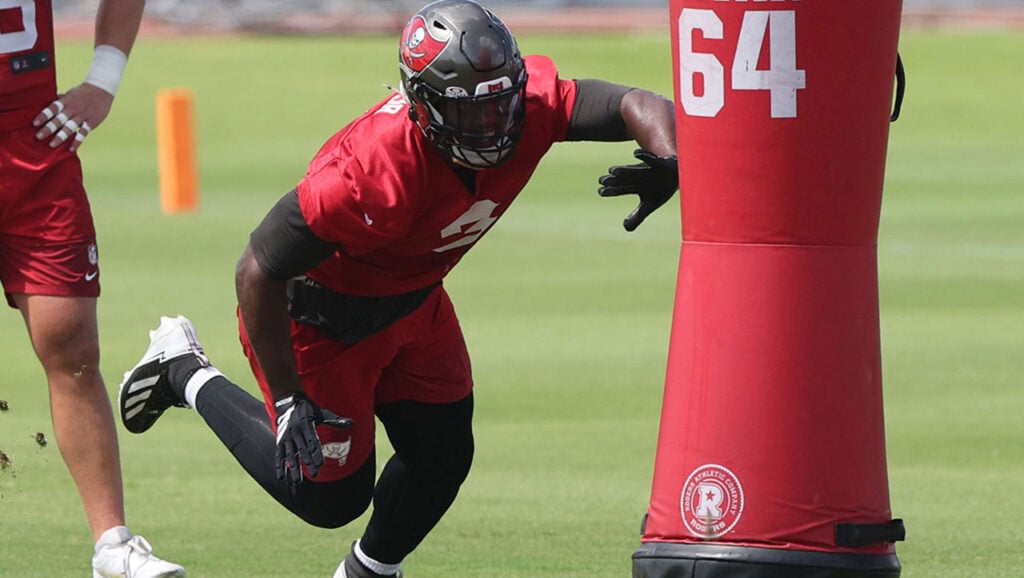 Video: How Will The Bucs Generate Pressure On The Pass Rush?
 Pewter Report Podcast: Bucs Veterans Who Need A Great Camp